
 Niyaz
Niyaz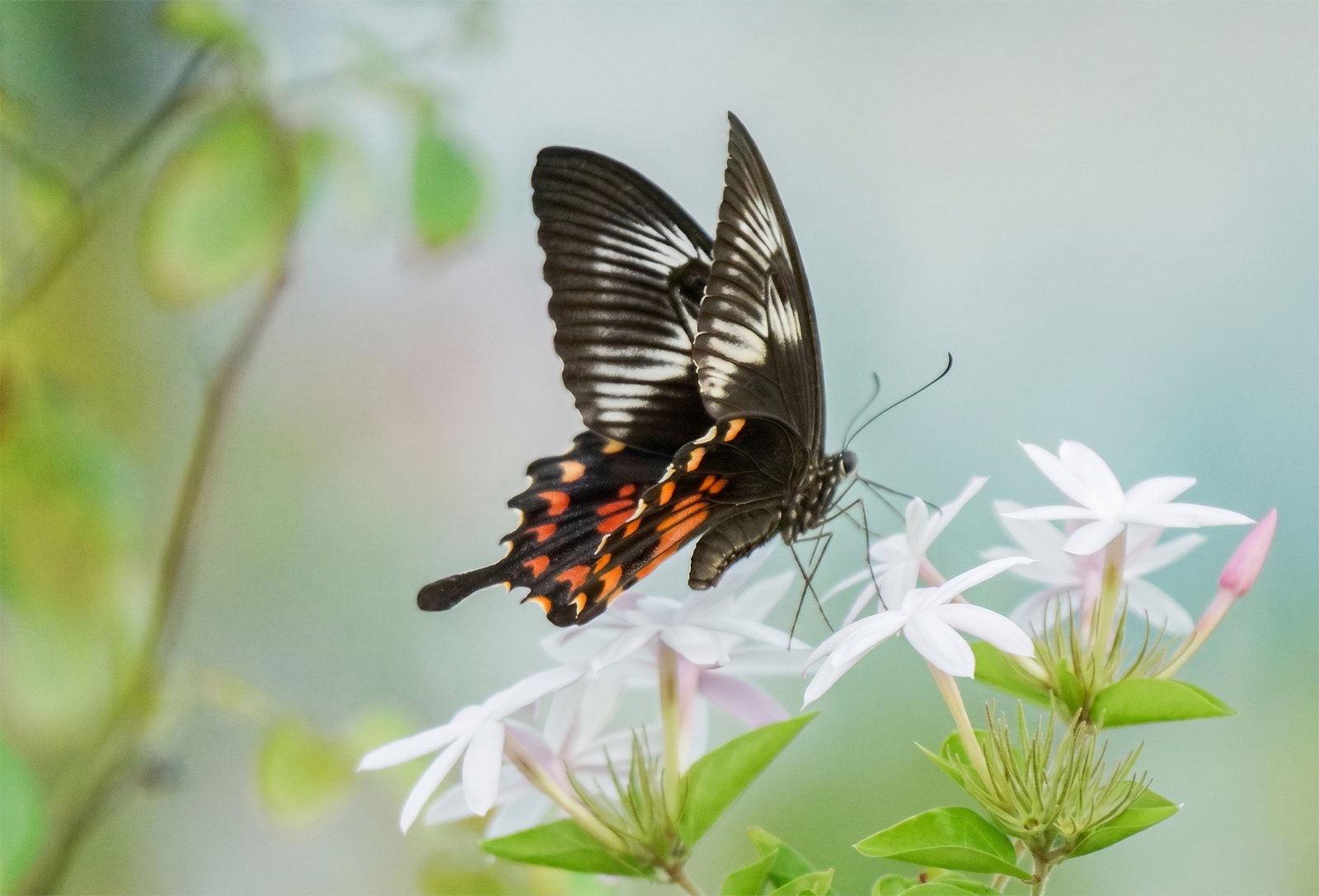
A complete life cycle observation of Papilio polytes
The Common Mormon, Papilio polytes, is one of the swallowtail butterflies that can be found breeding on lime and other citrus plants in the Maldives. I have observed this species many times on lime trees, where the entire life cycle can be followed closely—from egg to caterpillar, chrysalis, and finally the adult butterfly. Because lime trees are common in home gardens and island vegetation, they provide an excellent opportunity to document this species in detail.
This article is based on my repeated observations of the Common Mormon on lime trees in the Maldives, supported by photographs taken during different stages of its life cycle.
The Common Mormon belongs to the swallowtail family, known for their strong flight and distinctive tail-like extensions on the hindwings. In the Maldives, this species is commonly associated with cultivated citrus plants, especially lime.
Host Plant Association (Lime Trees)
In the Maldives, lime trees play an important role as a host plant for this species. Female butterflies lay eggs directly on young leaves, ensuring that the caterpillars have immediate access to fresh foliage after hatching.
From my observations, eggs are usually laid singly on the upper or lower surface of leaves. The larvae feed actively on the leaves, sometimes causing noticeable damage when multiple individuals are present.
Egg Stage
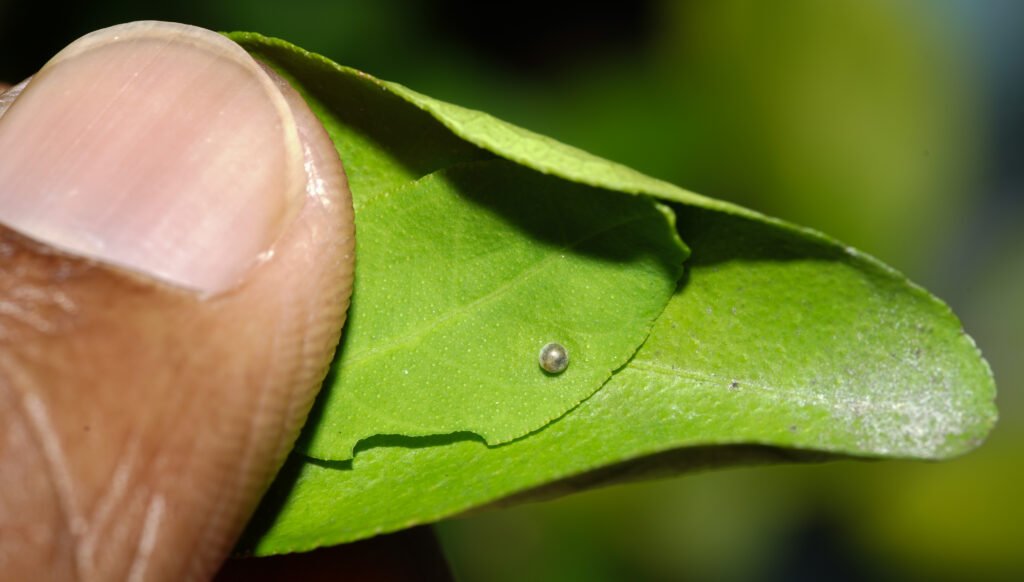
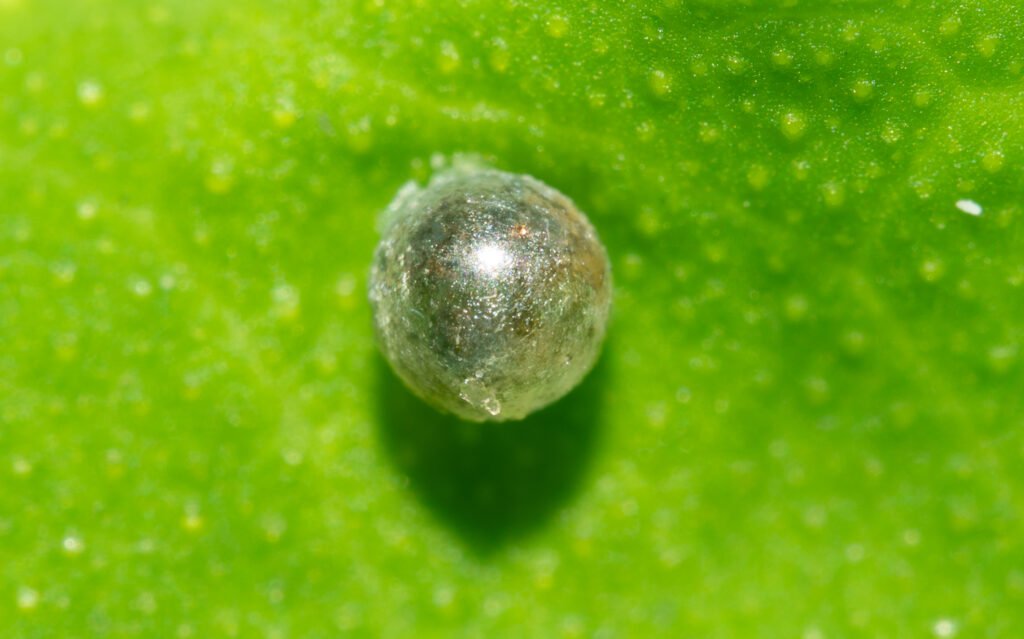
The egg is very small, smooth, and spherical. Its colour is usually pale green to yellowish, blending well with the leaf surface.
- Approximate size: about 1.2–1.3 mm in diameter
- Duration: around 3–4 days before hatching
The egg gradually darkens just before the larva emerges.
Hatching and First Instar Larva
After hatching, the tiny caterpillar consumes part of the eggshell before feeding on the leaf. At this stage, it is extremely small and vulnerable.
The early larva has a dark brown and white appearance that closely resembles bird droppings. This is a defensive adaptation that helps avoid detection by predators.
- Length: approximately 6–8 mm
- Duration: about 2 days
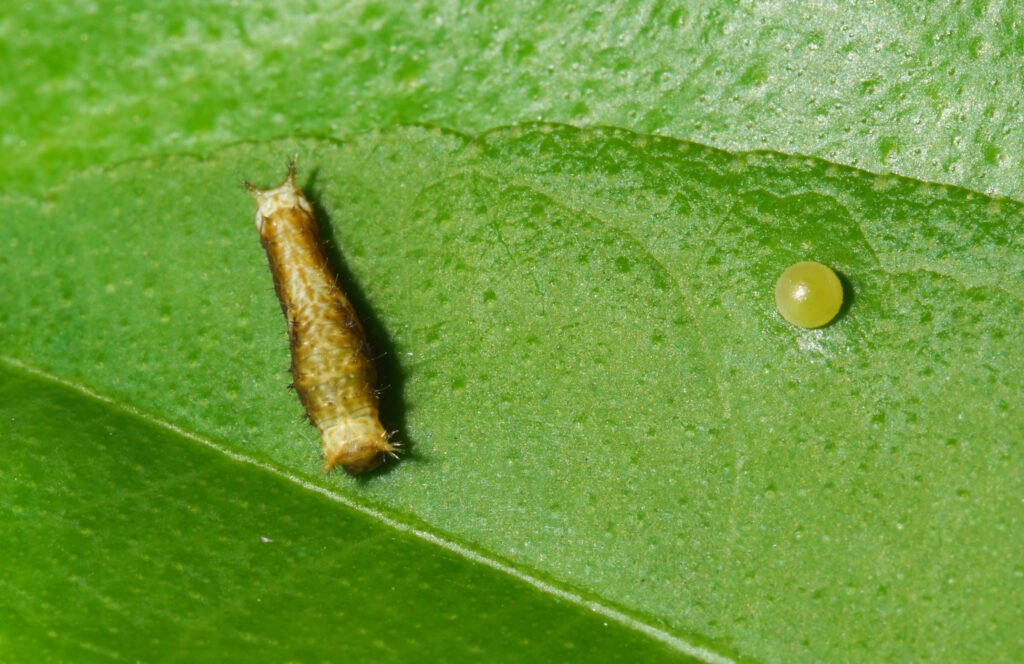
Newly hatched larva beside the egg
Early Larval Stages (Second and Third Instars)
As the caterpillar grows, it continues to maintain its bird-dropping mimicry. The body becomes slightly larger and more textured, with irregular white and brown patches.
This camouflage is highly effective on lime leaves, where the caterpillar can remain unnoticed even when clearly visible.
- Length: increases up to ~13 mm
- Duration: several days across these stages
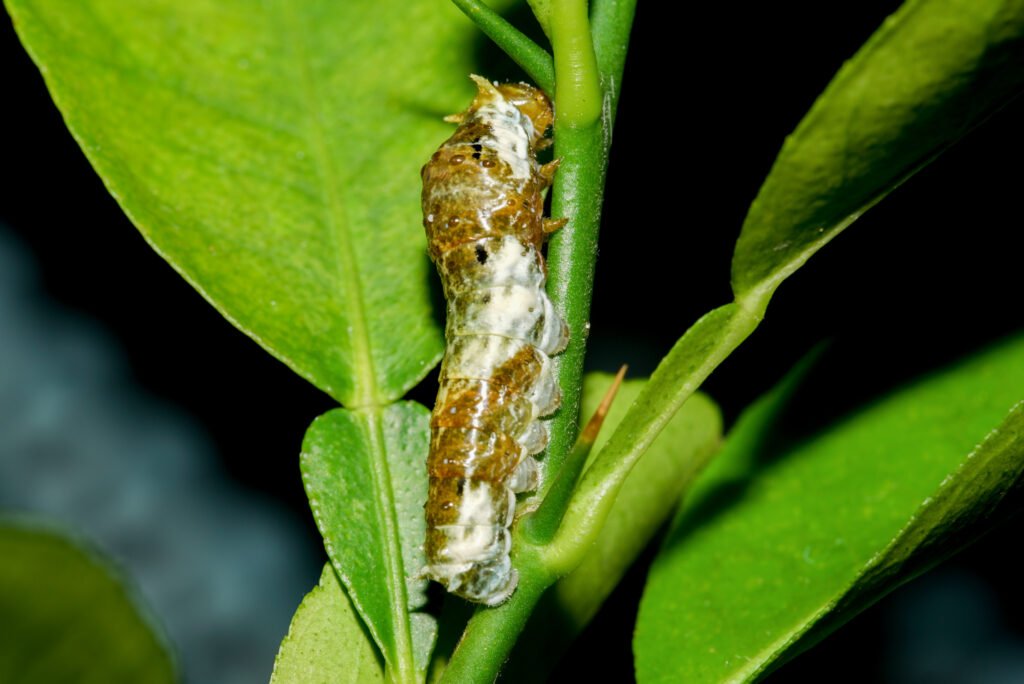
Early larval stage showing bird-dropping camouflage
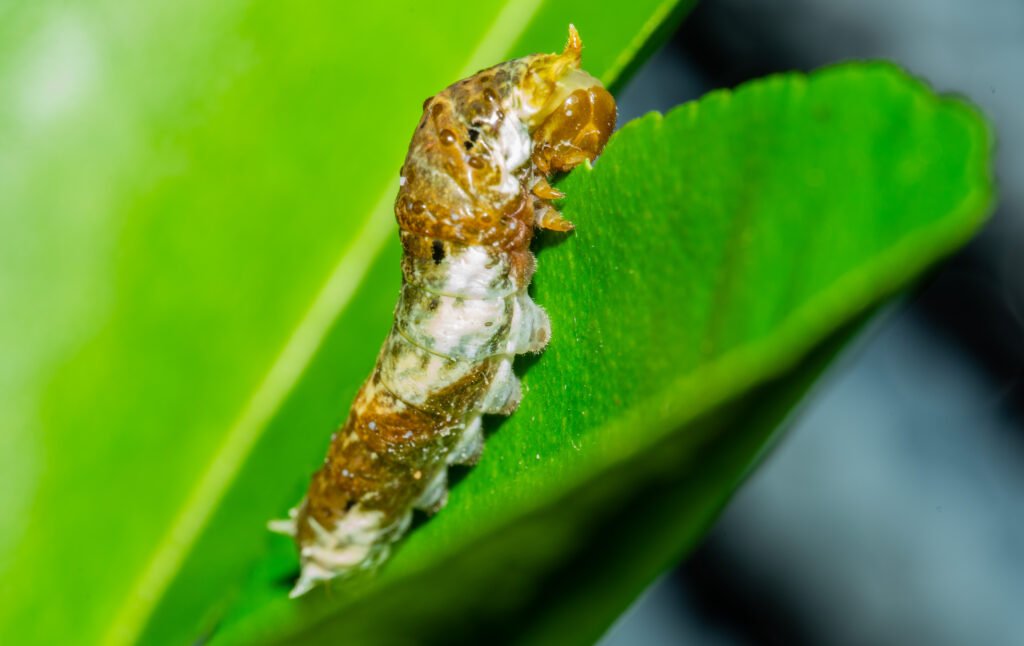
Close-up of larval texture and markings
Late Larval Stages (Fourth and Fifth Instars)
In later stages, the caterpillar undergoes a significant transformation. The body becomes thicker, smoother, and more structured. The earlier bird-dropping appearance begins to change.
The larva may show greenish tones as it prepares for pupation, although variation exists.
At this stage, the caterpillar consumes large amounts of leaf material and grows rapidly.
- Length: up to ~35–40 mm
- Duration: longest part of larval development
Like other swallowtails, the caterpillar possesses a hidden defensive organ called the osmeterium, which can be extended when disturbed and releases a strong odor.
Pre-Pupal Stage
Once fully grown, the caterpillar stops feeding and searches for a suitable place on the plant. It attaches itself securely using silk.
The body shortens and becomes inactive, preparing for transformation.
- Duration: about 1 day
This is a transitional phase between larva and chrysalis.
Chrysalis (Pupal Stage)
The chrysalis is one of the most fascinating stages. It is attached to the plant by the tail and supported by a silk girdle across the body.
Its shape is angular and resembles a leaf or twig, providing excellent camouflage.
- Length: around 30 mm
- Duration: approximately 10–14 days
The colour can vary, but green forms blend perfectly with lime leaves.
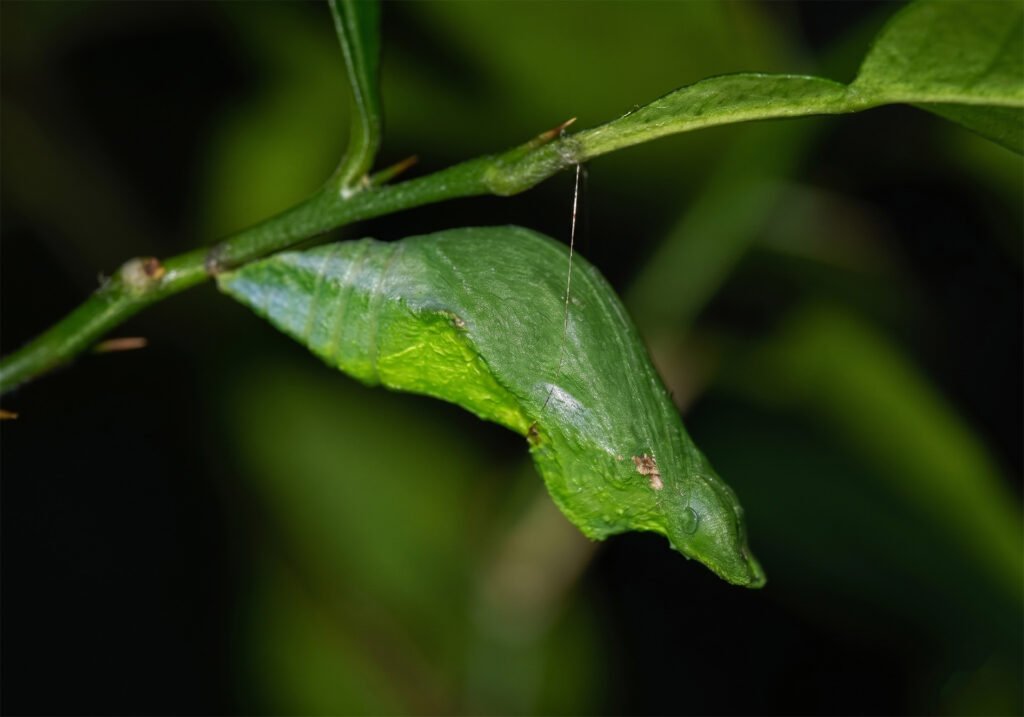
Green chrysalis attached to a lime branch with silk girdle
Adult Butterfly
The adult Common Mormon is a fast-flying swallowtail butterfly. It is commonly seen visiting flowers for nectar and moving actively between plants.
- Wings are mostly black with white markings
- Hindwings have distinct tails
- Some individuals show red or orange markings depending on form
Males and females can differ significantly, with females sometimes mimicking other species.
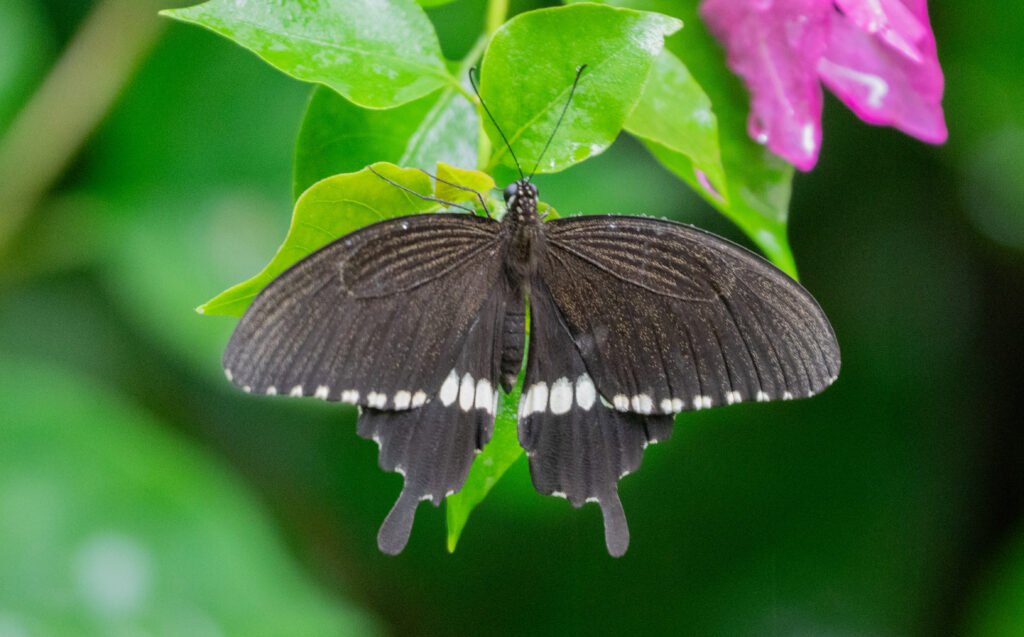
Dorsal (top) view of wings
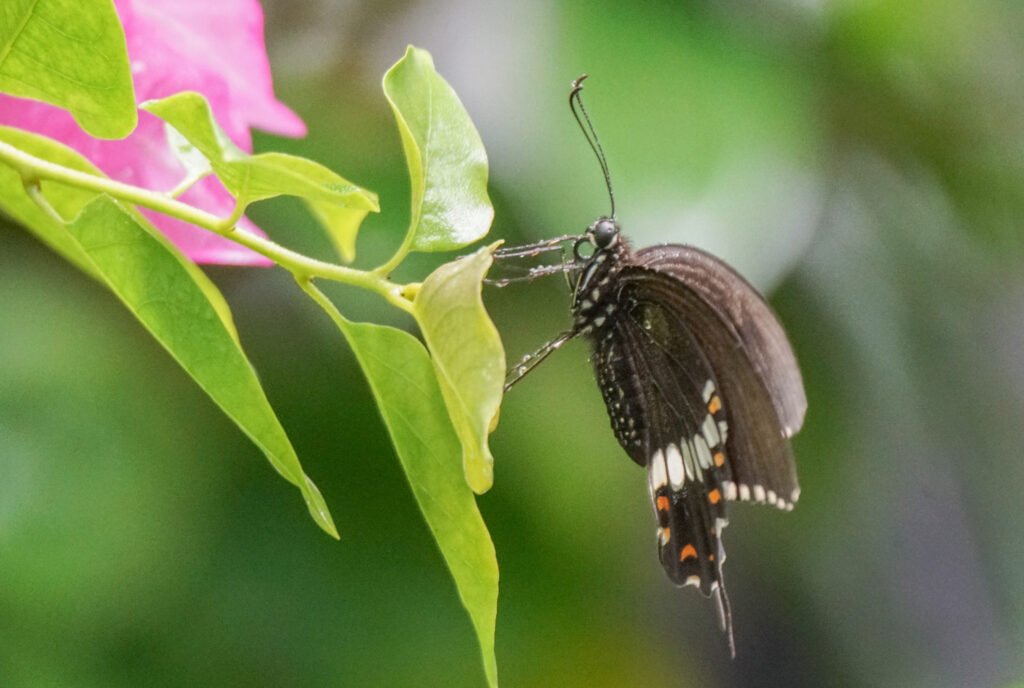
Side/resting view showing wing structure
Life Cycle Duration
Under warm tropical conditions like the Maldives, the full life cycle typically takes:
- Egg: 3–4 days
- Larva: ~14–20 days
- Pupa: ~10–14 days
Total duration: approximately 30–40 days
This allows multiple generations throughout the year.
Camouflage and Survival Strategies
One of the most interesting aspects of this species is how each stage uses a different survival strategy:
- Egg: small and well-hidden
- Early larva: mimics bird droppings
- Late larva: blends with foliage
- Pupa: resembles a leaf or twig
This continuous adaptation makes it difficult for predators to detect the insect at any stage.
Observations in the Maldives
From repeated observations, this species is well adapted to local conditions. Lime trees in home gardens act as reliable breeding sites.
Even in small island environments, the complete life cycle can be observed easily if the host plant is present. This makes the Common Mormon one of the best species for studying butterfly development in the Maldives.
Conclusion
The Common Mormon is not just a garden butterfly—it is a complete transformation story that can be observed closely on a simple lime tree. From a tiny spherical egg to a camouflaged caterpillar, then to a perfectly hidden chrysalis, and finally to a striking swallowtail butterfly, each stage reveals a different adaptation for survival.
In the Maldives, where lime trees are widely grown, this species provides a valuable opportunity to observe and document butterfly life cycles in detail.

Share a useful observation
Comments can help improve local knowledge. Share identification notes, island records, behaviour, host plants, or corrections respectfully.