
 Niyaz
Niyaz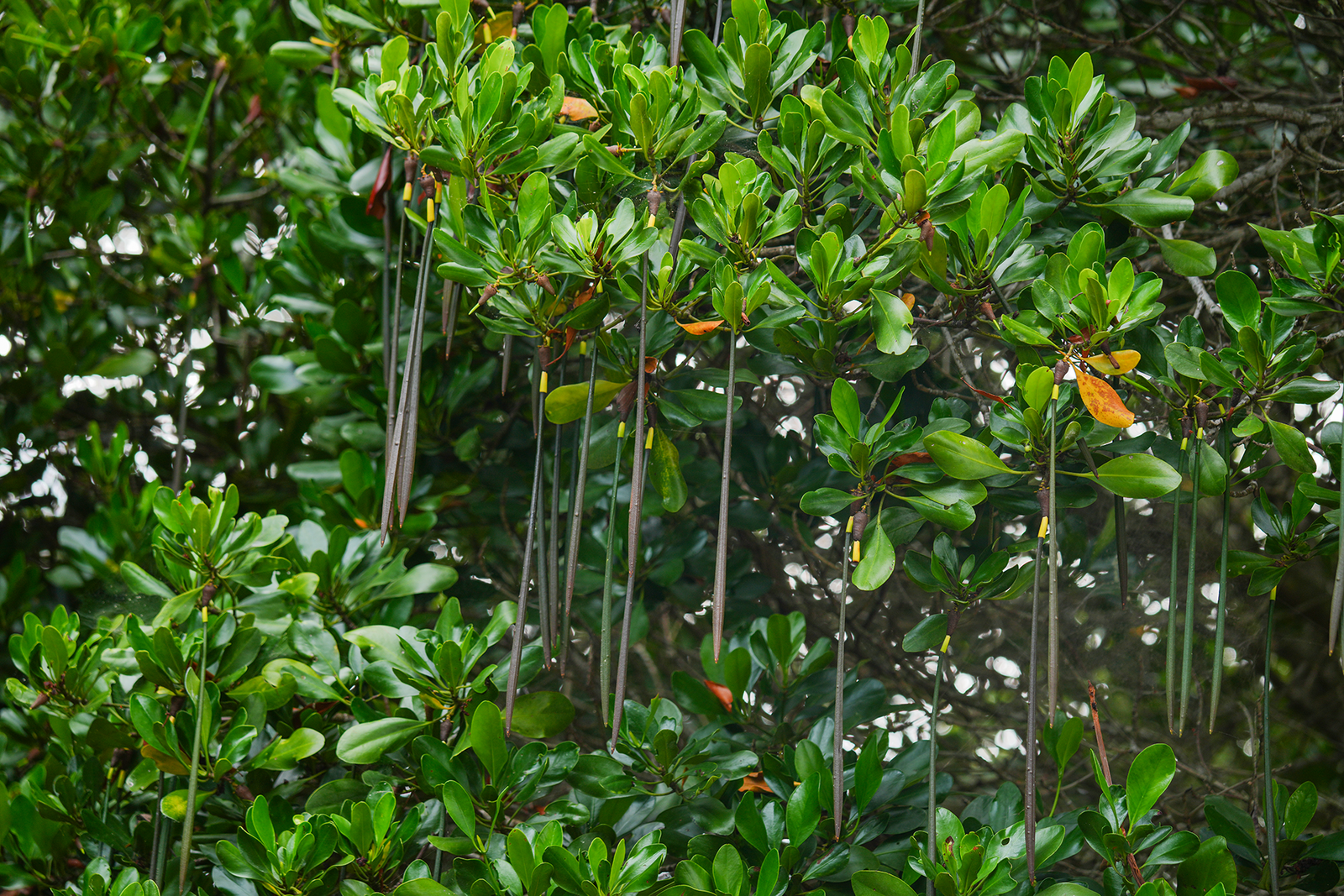
Karamana (ކަރަމަނަ), scientifically known as Ceriops tagal, is a true mangrove species belonging to the family Rhizophoraceae. It is commonly known in English as the Yellow Mangrove or Indian Mangrove. The species is naturally distributed across the tropical Indian Ocean and western Pacific region, including the Maldives.
Karamana grows in coastal mangrove wetlands where plants must tolerate saline water, waterlogged soils and changing tidal conditions. In the Maldives, it occurs in mangrove and wetland habitats on a number of islands. The long, narrow propagules hanging from the branches are one of the most distinctive features of this species.
Identification
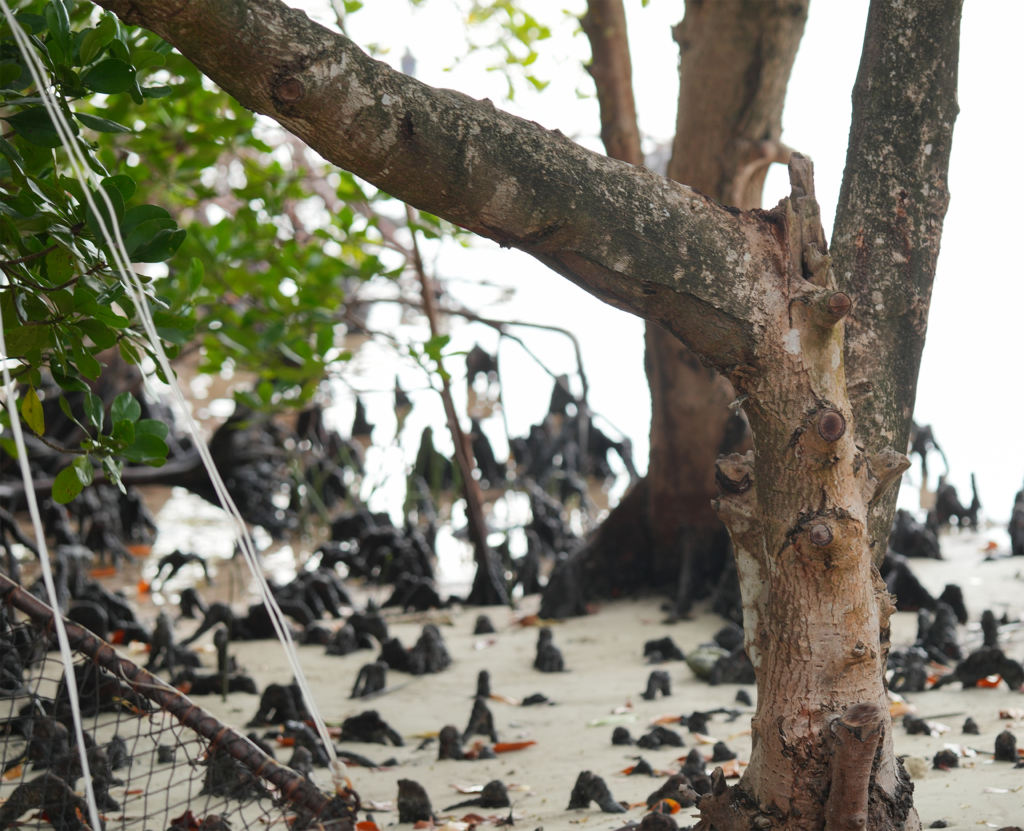
Ceriops tagal usually grows as a shrub or small tree, although larger individuals can develop under favourable conditions. The bark is generally grey to brown, and the lower trunk may develop a flanged or buttressed appearance. Kew describes the species as typically growing as a shrub or small bushy tree, while other botanical references note that it can occasionally become considerably taller.
The leaves are arranged in opposite pairs. They are thick, leathery and usually yellow-green to dark green. The leaf blade is broadly elliptic to obovate, generally with a rounded tip and smooth margins. Kew records leaves of approximately 3–9.5 cm long in its African description of the species.
The flowers are small and occur in clusters around the leaf axils. They are much less noticeable than the mature propagules, particularly when a tree is carrying large numbers of hanging propagules.
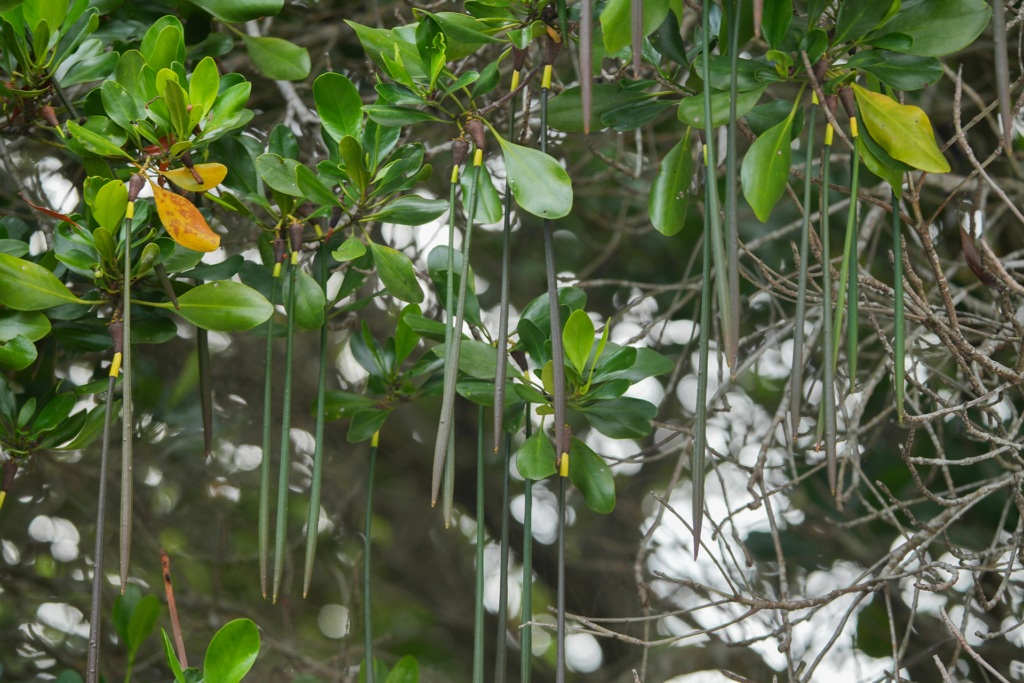
One of the easiest ways to recognise Karamana in the field is by its long, narrow and pendulous propagules. These develop while still attached to the parent tree and hang vertically beneath the branches. Mature propagules can become several tens of centimetres long. In fruiting trees, many propagules may hang together, giving the plant a very distinctive appearance.
In the photograph shown here, numerous propagules can be seen hanging from the branches. Several also show a conspicuous yellowish band near the upper part of the propagule, while the narrow elongated shape and relatively small opposite leaves are characteristic of Ceriops tagal.
Ceriops tagal is currently accepted as a distinct species by Plants of the World Online, maintained by the Royal Botanic Gardens, Kew.
Habitat
Karamana is a true mangrove adapted to tropical intertidal environments. It grows in muddy and saline coastal habitats, including mangrove forests, tidal areas and the margins of coastal wetlands. Members of the genus Ceriops are associated with muddy seashores and estuarine environments and possess adaptations that allow them to survive in soils with limited oxygen.
The exact conditions in which Karamana grows can vary considerably between islands. In the Maldives, mangrove wetlands differ in their connection with the sea, salinity, water depth and frequency of tidal flooding. These differences influence which mangrove species dominate individual wetlands. A national review of Maldivian mangroves has also highlighted that knowledge of their distribution and ecology remains incomplete at the national level.
Reproduction and Propagules
Like several members of the Rhizophoraceae, Ceriops tagal is viviparous. This means that germination begins while the developing seed is still attached to the parent plant. Instead of dropping as an ordinary dormant seed, the young plant develops into a long propagule before separating from the tree.
Once mature, the propagule falls from the parent tree. It may become embedded in suitable soft substrate close to the parent plant or be carried by water to another location. This reproductive strategy is particularly suited to mangrove environments, where ordinary seeds could easily become submerged, buried or carried away before germinating.
The numerous hanging propagules visible on mature Karamana trees are therefore not ordinary fruits or pods. Each represents an early stage in the development of a potential new mangrove plant.
Distribution
Ceriops tagal has a broad natural distribution extending from eastern and southern Africa across the western Indian Ocean and tropical Asia to the western Pacific and Australia. The species grows primarily within the wet tropical biome.
Its occurrence across this large geographical area reflects its adaptation to tropical coastal and mangrove environments.
Occurrence in the Maldives
Karamana is a recognised component of the native mangrove flora of the Maldives. Official information for Laamu Hithadhoo records Yellow Mangrove (Ceriops tagal), locally called Karamana, growing there together with Ran’doo (Rhizophora mucronata) and Burevi (Lumnitzera racemosa). The Hithadhoo mangrove is described as a saltwater mangrove connected to the sea.
During my own field observations in the Maldives, I have personally observed Karamana in Haa Alifu Baarah, Noonu Maalhendhoo, Kaafu Huraa and Laamu Hithadhoo. These observations extend from the northern Maldives through the central atolls to Laamu Atoll in the south-central part of the archipelago.
At these islands, I observed the species within mangrove and wetland environments. Fruiting plants are particularly easy to notice because of the numerous long propagules hanging vertically below the foliage. The photograph accompanying this article shows one of these fruiting Karamana trees with many propagules at different stages of development.
These are locations where I have personally confirmed the species and should not be interpreted as a complete record of its distribution in the Maldives. Karamana occurs on additional islands, and further field documentation is needed to build a more detailed picture of its national distribution. A 2024 review of Maldivian mangroves noted that information on mangrove distribution and diversity at a national scale has historically been limited.
Recent research using both morphological identification and DNA barcoding has continued work towards establishing a verified checklist of the true mangrove species occurring in the Maldives.
Ecological Importance
Karamana forms part of the mangrove vegetation that protects and supports coastal wetland ecosystems. Mangrove roots and surrounding vegetation help stabilise soft sediments and create complex habitats used by many other organisms.
Mangrove wetlands can provide shelter, feeding areas and nursery habitat for fish and invertebrates. This role can be particularly important where a mangrove wetland retains a natural connection with the lagoon or sea. The Maldives Protected Areas authority specifically notes that the sea-connected mangrove at Laamu Hithadhoo functions as a nursery area for reef organisms.
Mangrove vegetation also contributes to the overall ecological diversity of Maldivian islands. Although the land area occupied by these habitats is small compared with surrounding marine ecosystems, mangrove wetlands support a combination of terrestrial, freshwater, brackish-water and coastal species.
Adaptation to Mangrove Environments
Karamana is adapted to conditions that would be difficult for many ordinary terrestrial plants. Mangrove soils are often waterlogged and contain little available oxygen, while salt concentrations can be high.
Ceriops species possess specialised root adaptations associated with these environments. Ceriops tagal also functions as a salt-excluding mangrove, reducing the amount of salt entering the plant through its roots. Its viviparous reproductive strategy provides another advantage by allowing the developing seedling to begin growth before leaving the parent tree.
These adaptations allow Karamana to survive in the changing conditions found around tropical mangrove wetlands.
Conservation
Although Ceriops tagal has a very wide global distribution, the continued survival of individual populations depends on the protection of their mangrove habitats. Mangrove ecosystems can be affected by land modification, changes in natural water circulation, coastal development and other alterations to wetlands.
This is particularly relevant in the Maldives because individual mangrove wetlands are geographically isolated from one another on separate islands. Changes to the hydrology or physical structure of a single wetland can therefore affect an entire local mangrove community.
Documenting where species such as Karamana occur is important for understanding the biodiversity of Maldivian wetlands. Field observations, photographs and verified species records can also provide useful information for future studies of changes in mangrove distribution.
References
Royal Botanic Gardens, Kew. Plants of the World Online – Ceriops tagal (Perr.) C.B.Rob.
Ministry of Climate Change, Environment and Energy, Maldives. L. Hithadhoo Kulhi and surrounding area – Maldives Protected Areas.
Cerri, F. et al. Mangroves of the Maldives: a review of their distribution, diversity, ecological importance and biodiversity of associated flora and fauna. Aquatic Sciences, 2024.
FAO. Rhizophoraceae – Ceriops tagal. Species description and mangrove information.
Ruang-areerate, P. et al. Comparative research on mangrove adaptations in Ceriops and Avicennia. 2022.

Share a useful observation
Comments can help improve local knowledge. Share identification notes, island records, behaviour, host plants, or corrections respectfully.