
 Niyaz
Niyaz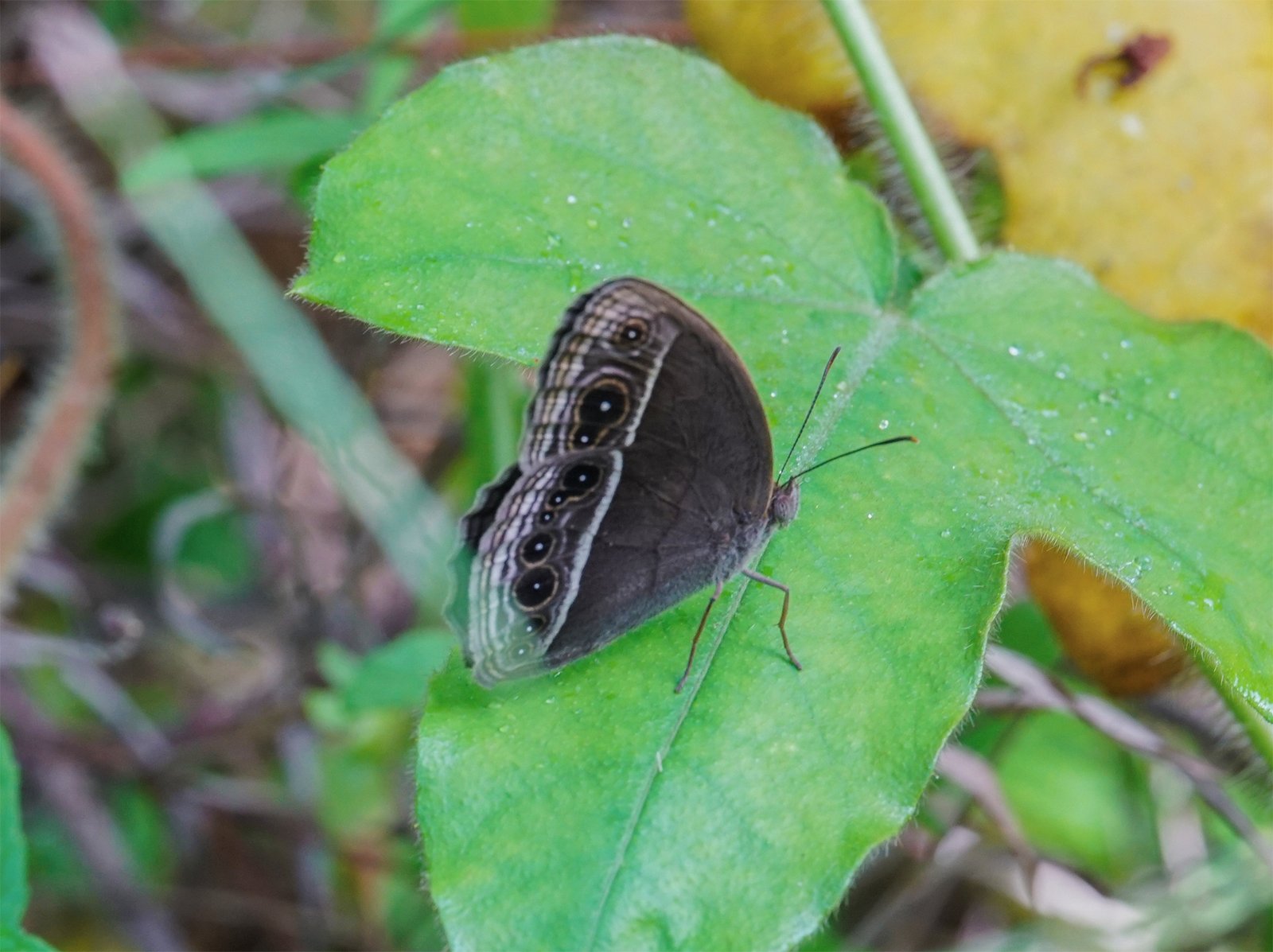
The Dark-branded Bushbrown (Mycalesis mineus), also called the Dark-brand Bushbrown, is a brown butterfly belonging to the family Nymphalidae and the subfamily Satyrinae. It is found mainly in tropical parts of South and Southeast Asia. Like many bushbrown butterflies, it usually remains close to the ground and prefers shaded or partly shaded places with grasses and low vegetation.
The species does not appear to be commonly observed in the Maldives. A Dark-branded Bushbrown was found on Noonu Lhohi, providing an important personal observation from the northern Maldives. Further observations and photographs are needed to understand whether it has an established local population or occurs only in a small number of suitable habitats.
Description
The Dark-branded Bushbrown is a small to medium-sized butterfly, generally measuring around 40 to 45 millimetres across the wings. Its upper wings are dark brown, with thin, paler lines near the outer margins. A prominent black eyespot with a white centre and an orange-brown ring is usually visible on the forewing.
The underside of the wings is more strongly patterned. A pale transverse band crosses both wings, followed by several rounded eyespots. These eyespots have white centres surrounded by black, yellowish-brown and pale rings. The pattern helps break up the butterfly’s outline when it rests among dead leaves, grasses and shaded vegetation.
Males and females are similar in their general appearance, although males are usually smaller, darker and possess specialised scent-producing scales and hair-like structures on their wings. These structures are associated with courtship and help specialists distinguish the Dark-branded Bushbrown from closely related species.
Seasonal forms
The appearance of the Dark-branded Bushbrown changes according to seasonal conditions. This ability to produce different wing patterns is known as seasonal polyphenism.
The wet-season form usually has well-developed eyespots and a clearly visible pale band on the underside of the wings. These markings may help divert attacks away from the butterfly’s head and body.
The dry-season form is generally paler and has much smaller or less visible eyespots. Its underside may resemble a dry leaf, helping the butterfly remain concealed during periods when vegetation becomes brown and dry. The difference between the seasonal forms can be considerable, and dry-season individuals may be difficult to identify from photographs alone.
Distribution and habitat
The Dark-branded Bushbrown occurs across a wide area of Asia, extending from the Indian subcontinent through Southeast Asia to Indonesia and the Philippines. It is mainly associated with tropical and subtropical environments.
It inhabits forest edges, secondary forests, shaded gardens, grassy paths, woodland clearings and areas with low vegetation. It is often found in damp or partly shaded places where grasses used by its caterpillars are available.
The butterfly normally avoids exposed, intensely sunny areas. It frequently flies within grasses or low undergrowth and usually settles close to the ground. Its brown colour allows it to blend effectively with soil, fallen leaves and dried plant material.
Behaviour
The Dark-branded Bushbrown has a low, weak and irregular flight. It usually moves only a short distance before settling again among grasses or dead leaves. When disturbed, it may fly rapidly into nearby vegetation and remain motionless with its wings closed.
Adults are often most active during the cooler parts of the day. They may become less active during strong midday sunlight and remain inside shaded vegetation.
When resting, the butterfly normally keeps its wings closed above its body, displaying the patterned underside. This position helps it blend into its surroundings. The eyespots may also confuse predators by drawing attention away from the butterfly’s vulnerable body.
Feeding
Adult Dark-branded Bushbrowns do not depend mainly on brightly coloured flowers. They are often attracted to overripe or decaying fruit, plant sap and other fermenting organic material on or near the ground. These food sources provide sugars, minerals and other nutrients.
The butterfly may occasionally visit flowers, but it is more frequently observed feeding in shaded places where fallen fruits and moist organic matter are present.
Life cycle
The female lays her eggs on grasses that can later be eaten by the caterpillars. Recorded larval food plants include broad-leaved carpet grass, Axonopus compressus, and buffalo grass, Paspalum conjugatum. Both belong to the grass family Poaceae. Other grass species may also be used in different parts of the butterfly’s range.
The caterpillar is green and elongated, with markings that help it remain hidden along grass leaves. It usually rests lengthwise beneath a leaf when it is not feeding. After completing several stages of growth, the caterpillar forms a chrysalis attached to vegetation.
The adult later emerges from the chrysalis, expands and dries its wings, and begins searching for food and mates. Environmental conditions experienced during development influence whether the adult develops the more strongly marked wet-season form or the less conspicuous dry-season form.
Occurrence in the Maldives
The Dark-branded Bushbrown is not considered a commonly reported butterfly in the Maldives. Its occurrence may be limited by the country’s small land area, isolated islands and limited availability of shaded grassy habitats.
The observation from Noonu Lhohi suggests that at least some Maldivian islands contain suitable conditions for this species. Shaded areas with grasses, shrubs, fallen leaves and moderate moisture may provide habitat for both the caterpillars and adults.
It is not yet clear whether the butterfly is a long-established resident on Lhohi, a recently introduced species or an overlooked species that occurs more widely in the Maldives. Repeated observations of adults, caterpillars, eggs or chrysalises would provide stronger evidence that it breeds locally.
Identification
The Dark-branded Bushbrown closely resembles several other members of the genus Mycalesis, including the Common Bushbrown and Long-brand Bushbrown. Identification based only on the underside of the wings can be difficult because the number and size of the eyespots vary between individuals and seasons.
In the wet-season form, four of the lower eyespots on the hindwing are generally arranged in a nearly straight line. In the similar Common Bushbrown, usually only three of these spots form the corresponding straight row. However, this feature should be used carefully because worn butterflies and dry-season forms may have greatly reduced markings.
The shape and colour of the male scent brand provide more reliable identification, but these features may require clear photographs of both sides of the wings. For a rare Maldivian record, photographs showing the upper wings, undersides and male brand are especially valuable.
Conservation
The Dark-branded Bushbrown has a broad Asian distribution, but information about its population in the Maldives is limited. On small islands, the removal of grasses, shrubs and shaded vegetation could quickly reduce suitable breeding habitat.
Excessive pesticide use may kill caterpillars and adult butterflies, while clearing all low vegetation can remove larval food plants. Maintaining small areas of natural grass, shrubs, fallen leaves and shaded ground can support this species and many other native insects.
The observation from Noonu Lhohi is therefore valuable for documenting butterfly diversity in the Maldives. Continued photography and monitoring may reveal whether the species is established on Lhohi and whether it occurs on other islands.

Share a useful observation
Comments can help improve local knowledge. Share identification notes, island records, behaviour, host plants, or corrections respectfully.