
 Niyaz
Niyaz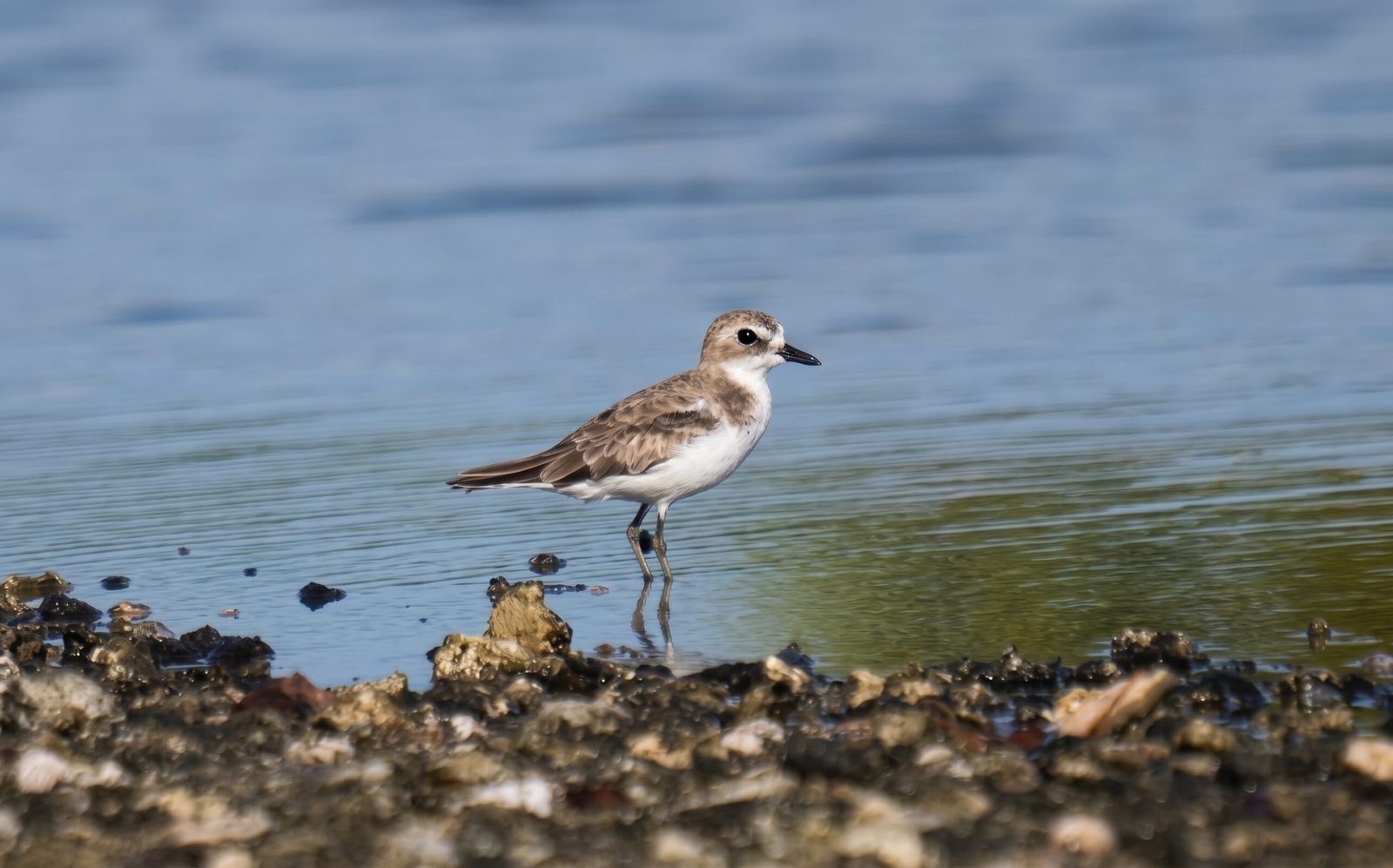
The Tibetan Sand-Plover (Anarhynchus atrifrons), locally known as Bodana or Bondana, is a small migratory shorebird of the plover family, Charadriidae. In the Maldives it is a non-breeding migrant, occurring on beaches, reef flats, mudflats, shallow lagoons and wetland margins.
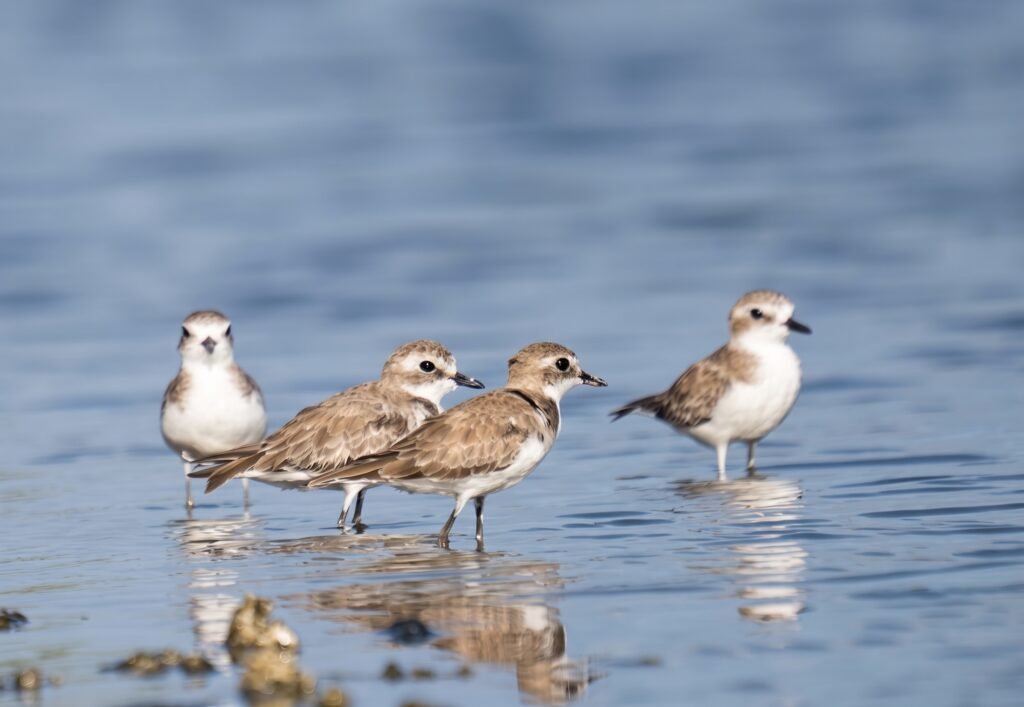
Although Bodana is a very familiar bird name among Maldivians, the Tibetan Sand-Plover itself should not be described as one of the country’s very common birds. The 2025 national assessment lists it as widespread but uncommon in the Maldives.
I photographed the group shown here in the wetland area of Haa Alifu Baarah. Several birds were together in shallow water, using the open wetland edge as a feeding area. Baarah is particularly important for birds because it contains an extensive mixture of wetlands, mangroves, muddy margins, shallow water and coastal habitat.
Identification
The Tibetan Sand-Plover is a small, compact plover, generally around the size expected of the former “Lesser Sand Plover” group. In non-breeding plumage it is much less colourful than during the breeding season.
The birds I photographed at Baarah show the typical pale appearance of non-breeding sand plovers. They have sandy-grey to brown upperparts, white underparts, a dark bill, dark legs and brown markings on the sides of the breast rather than a strong complete breast band.
Tibetan Sand-Plovers can be difficult to separate from some other small plovers, particularly Greater Sand-Plover and the closely related Siberian Sand-Plover. Even specialist identification references note that the three sand-plover species can be difficult to distinguish in non-breeding plumage.
The birds in my Baarah photograph fit Tibetan Sand-Plover particularly well because of their relatively small size, compact structure, short dark bill, dark legs and breast-side patches.
During breeding plumage the species changes considerably. Adults develop rich orange or chestnut colouring across the breast and neck, together with darker facial markings.
The taxonomy of this bird has changed in recent years.
For a long time, Tibetan Sand-Plover was included within the Lesser Sand Plover, traditionally known as Charadrius mongolus. Genetic and morphological research showed that the old Lesser Sand Plover contained separate evolutionary groups. The Tibetan Sand-Plover, including the atrifrons, pamirensis and schaeferi forms, was therefore separated as its own species.
Further taxonomic changes moved this group of plovers from Charadrius into the genus Anarhynchus. Therefore, the name currently used is Anarhynchus atrifrons.
This is important when looking at older Maldivian bird records. A bird recorded simply as Lesser Sand Plover (Charadrius mongolus) in an older publication may now require reinterpretation under the newer Tibetan/Siberian Sand-Plover classification.
The Name “Bodana” in the Maldives
The name Bodana/Bondana can cause some confusion because Maldivians use related names for several species of plover.
The 2025 Maldives bird assessment specifically lists:
Tibetan Sand-Plover – Bondana
Greater Sand-Plover – Valu Bondana
Common Ringed Plover – Agothi Bondana
Kentish Plover – Kiru Bondana.
The older national checklist also used Bondana for Little Ringed Plover and Caspian Plover.
This shows that Bondana is not necessarily a name restricted to one species. It is also part of the local naming system for several similar-looking plovers.
For this article, however, Bodana refers specifically to the Tibetan Sand-Plover, Anarhynchus atrifrons.
Habitat
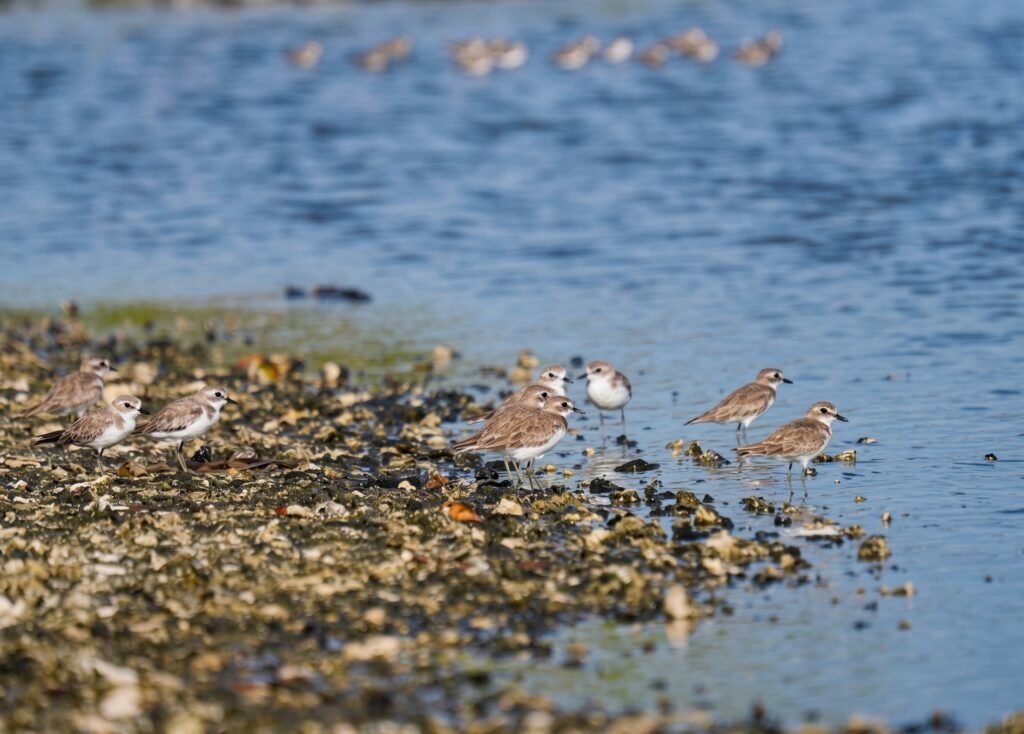
Tibetan Sand-Plovers breed far from the Maldives in high-altitude regions of Central Asia, including the Himalayas, Tibetan Plateau, Pamir region and surrounding areas. During the non-breeding season they migrate south and occur widely along the coasts of South Asia, the Middle East, eastern and southern Africa and parts of Southeast Asia.
Their non-breeding habitats include:
- intertidal mudflats and sandflats;
- shallow lagoons and tidal pools;
- sandy and rocky shores;
- estuaries;
- reef flats;
- wetland margins and shallow pools.
These habitats provide open ground where the birds can easily see and capture small invertebrates.
In the Maldives, similar habitats occur around many islands, but large natural wetlands such as those at H.A. Baarah provide additional feeding and resting areas for migratory shorebirds.
Behaviour
Tibetan Sand-Plovers spend much of their feeding time walking or running over mud, sand or very shallow water.
Like many plovers, they use a characteristic run-stop-peck feeding technique. A bird runs a short distance, suddenly stops, watches the surface and then quickly picks up prey.
They rely strongly on eyesight rather than continuously probing deep into the mud like many sandpipers.
They may feed alone, but suitable feeding areas can attract several individuals. The birds I observed at Baarah were present as a small group, moving through the shallow wetland area together.
Studies of the former Lesser Sand Plover complex have recorded birds feeding on mudflats and mangrove-associated areas and taking small crabs, worms and other invertebrates.
Diet
The diet consists mainly of small animals found on or close to the surface of mud and sand.
Food may include small crustaceans such as crabs and amphipods, polychaete worms, molluscs, insects and insect larvae. Studies of Lesser Sand Plover populations before the recent taxonomic split found particularly strong use of crustaceans and marine worms in tropical intertidal environments.
This type of diet explains why shallow wetlands, mudflats and mangrove edges can be valuable feeding areas. Wet mud may contain large numbers of small invertebrates even when little food is obvious to the human eye.
Breeding and Migration
Tibetan Sand-Plovers do not breed in the Maldives. The national Maldives assessment lists them as non-breeding birds.
Their breeding range is in the mountains and high plateaus of Central Asia. After the breeding season they migrate south towards warmer coastal regions. Tibetan Sand-Plovers winter widely from South Asia westwards into Africa and eastwards into Southeast Asia.
The Maldives lies within this wider non-breeding region.
Therefore, a Bodana seen on a Maldivian beach or wetland has travelled a very long distance from its breeding grounds.
Some individuals may remain in the tropics for extended periods, while others continue through the region during migration.
Occurrence in the Maldives
The Tibetan Sand-Plover is currently regarded as widespread but uncommon in the Maldives rather than common. It has no known breeding population here.
The older 2020 national bird checklist recorded the former Lesser Sand Plover as an uncommon northern winter visitor. Following the taxonomic split, the 2025 Maldives assessment uses Tibetan Sand-Plover for the regularly occurring form and gives the local name Bondana.
This distinction is useful because the word Bodana itself is extremely familiar in the Maldives. A familiar local name does not necessarily mean that a particular species carrying that name is abundant.
My Observation at H.A. Baarah
I photographed this group of Tibetan Sand-Plovers at H.A. Baarah, where they were standing and feeding in a shallow wetland area.
The observation was particularly interesting because I did not find only a single bird. Several Bodana were using the same area together.
Baarah is one of the most interesting wetland islands I have visited for bird photography. Its landscape contains a mixture of mangrove forest, open wetland, shallow water, muddy areas and coastal habitat, providing many different places for birds to feed, rest and shelter.
Official information records 10 separate mangrove and wetland areas on the eastern side of Baarah, with evidence that some may once have been connected. Baarah has a total land area of about 256.7 hectares, of which approximately 39 hectares are mangroves. The designated H.A. Baarah Wetland protected area covers 51 hectares.
This large amount of wetland habitat helps explain why the birdlife of Baarah can appear particularly rich compared with many smaller Maldivian islands where extensive natural wetlands are absent.
Mangroves of Baarah
Baarah is also particularly rich in mangrove vegetation.
Research reviewing the mangroves of the Maldives recorded six mangrove species from Baarah, with Bruguiera cylindrica particularly abundant. The recorded mangroves include Bruguiera cylindrica, Ceriops tagal, Excoecaria agallocha, Lumnitzera racemosa, Rhizophora apiculata and Rhizophora mucronata.
Among the trees I observed around the Baarah wetland landscape are several well-known Maldivian mangroves:
Kan’doo – Bruguiera cylindrica
Small-leaved Orange Mangrove
Ran’doo – Rhizophora mucronata
Red Mangrove
Karamana – Ceriops tagal
Yellow Mangrove
Thakafathi – Rhizophora apiculata
Tall-stilted Mangrove
Burevi – Lumnitzera racemosa
Black Mangrove
Another mangrove recorded from Baarah is Thela – Excoecaria agallocha, also known as the Blind-your-eye or Milky Mangrove. The Maldivian local names for these mangrove species are also documented in national vegetation references.
The variety of mangrove species creates different microhabitats around the wetlands. Open mud, shallow water, mangrove roots, leaf litter and forest edges can each support different invertebrates and birds.
For a migratory bird such as the Tibetan Sand-Plover, the most important areas are generally the open muddy or sandy margins where it can move freely and search for prey.
Other Plovers Found in the Maldives
The Tibetan Sand-Plover is only one member of the plover family recorded from the Maldives.
National bird records show several species, although their abundance and frequency differ considerably.
| Species | Scientific name | Dhivehi/local name in Maldives records | Maldives status |
|---|---|---|---|
| Tibetan Sand-Plover | Anarhynchus atrifrons | Bondana | Widespread, uncommon |
| Greater Sand-Plover | Anarhynchus leschenaultii | Valu Bondana | Widespread, uncommon |
| Common Ringed Plover | Charadrius hiaticula | Agothi Bondana | Widespread, uncommon |
| Kentish Plover | Anarhynchus alexandrinus | Kiru Bondana | Widespread, uncommon |
| Pacific Golden Plover | Pluvialis fulva | Bileymaa Dhooni | Widespread, uncommon |
| Grey Plover | Pluvialis squatarola | Alaka | Widespread, uncommon |
| Little Ringed Plover | Charadrius dubius in the 2020 Maldives checklist | Bondana | Uncommon northern winter visitor |
| Caspian Plover | Anarhynchus asiaticus | Bondana | Vagrant |
The 2020 checklist also records the Sociable Lapwing (Vanellus gregarius), another member of the plover family Charadriidae, under the local name Andhun Bondana. It is a very rare visitor to the Maldives.
A current international checklist also lists Siberian Sand-Plover (Anarhynchus mongolus) as rare or accidental in the Maldives. However, this species was formerly combined with Tibetan Sand-Plover under “Lesser Sand Plover”, so older Maldives observations cannot always be assigned confidently to one of the two newly separated species.
This is why photographs are particularly valuable for modern biodiversity records.
Tibetan Sand-Plover and Greater Sand-Plover
One of the most likely identification problems in the Maldives is separating Tibetan Sand-Plover from Greater Sand-Plover.
Greater Sand-Plover is generally larger, with a larger head and a noticeably longer and heavier bill. Tibetan Sand-Plover normally appears smaller and more compact, with a shorter bill.
However, size can be difficult to judge when birds are seen alone, and plumage varies with age, sex, season and moult. Non-breeding sand plovers can therefore be challenging even for experienced observers.
Good photographs showing the bird from the side, front and in comparison with nearby birds can be very useful.
Tibetan Sand-Plover and Common Ringed Plover
The Common Ringed Plover is a separate species.
In typical plumage it shows a much stronger breast band and usually has more obvious orange or yellowish legs. Tibetan Sand-Plover has darker legs and, in non-breeding plumage, usually shows softer brown markings along the sides of the breast.
In Maldives records, the naming also differs:
Tibetan Sand-Plover – Bondana
Common Ringed Plover – Agothi Bondana.
Tibetan Sand-Plover and Kentish Plover
Kentish Plover is another small pale plover that can occur in similar habitats.
Kentish Plover normally has a more delicate structure, smaller bill and clearer white areas around the neck. The breast markings are normally restricted to smaller patches on either side.
The Maldives assessment lists it as Kiru Bondana and, like Tibetan Sand-Plover, describes it as widespread but uncommon.
Ecological Importance of Wetlands for Migratory Birds
Most migratory shorebirds do not need only one protected place. They depend on a chain of suitable habitats extending from their breeding grounds to their wintering areas.
A bird may breed thousands of kilometres away, stop at several wetlands during migration and spend the northern winter on tropical shores.
Loss of even small feeding areas can therefore affect birds that spend only part of their lives in the Maldives.
The H.A. Baarah wetland is important in this context. Its protected area was designated on 30 December 2018, and official information specifically recognises its mangrove diversity and importance for birds.
The mixture of mangroves, shallow wetlands, mud and coastal habitat gives Baarah ecological value well beyond the individual trees growing there.
My observation of a group of Bodana using the wetland is another example of how these natural areas are used by migratory wildlife.
Conservation
The Tibetan Sand-Plover is currently classified globally as Least Concern.
This status does not mean that its habitat has no conservation importance. Migratory shorebirds depend heavily on coastal mudflats, wetlands, mangrove margins and undisturbed resting areas.
In the Maldives, many of these habitats are naturally small. Changes to wetland drainage, reclamation, coastal development, disturbance and loss of intertidal feeding grounds can reduce the amount of suitable habitat available to visiting birds.
Protecting natural wetland systems such as H.A. Baarah therefore benefits not only resident Maldivian wildlife but also migratory species travelling between countries and continents.
The small group of Bodana I photographed at Baarah may spend only part of its annual cycle in the Maldives, but during that period the island’s shallow wetlands provide exactly the type of habitat these birds need.
References
- Environmental Regulatory Authority. Status of Common Breeding and Migratory Birds in the Maldives, 2025.
- Anderson, R. C. & Shimal, M. A Checklist of Birds of the Maldives, Indian BIRDS Monographs 3, 2020.
- IOC World Bird List. Species and taxonomic updates for Tibetan Sand-Plover and the sand-plover complex.
- British Trust for Ornithology. Tibetan Sand Plover – BirdFacts.
- Maldives Protected Areas. H.A. Baarah Wetland.
- Mangroves of the Maldives: a review of their distribution, diversity, ecological importance and biodiversity of associated flora and fauna.
- Ministry of Environment, Maldives. Mangrove species and Dhivehi names.

Share a useful observation
Comments can help improve local knowledge. Share identification notes, island records, behaviour, host plants, or corrections respectfully.