
 Niyaz
Niyaz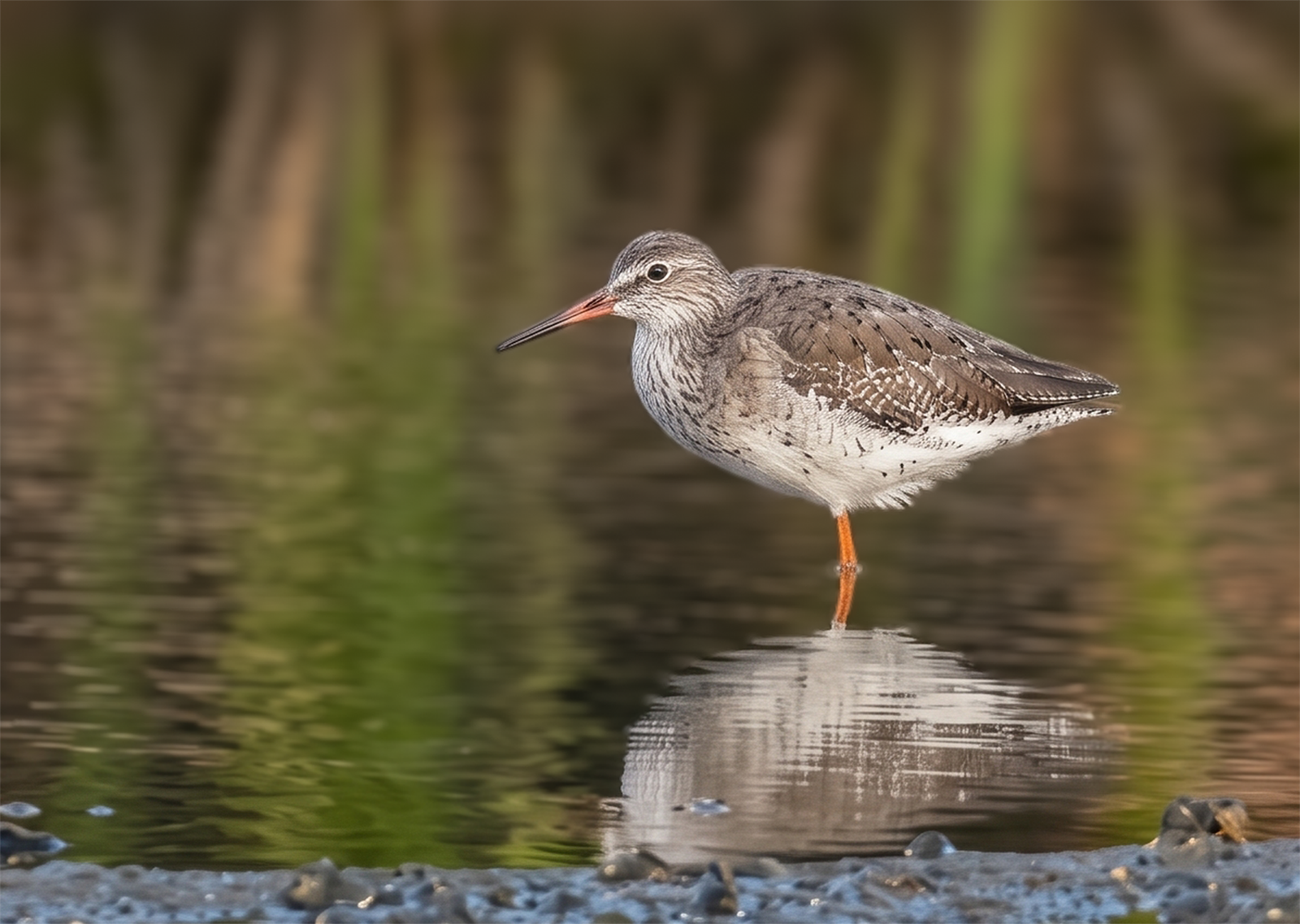
The Common Redshank (Tringa totanus), locally known in the Maldives as Rathafai Ilolhi (ރަތަފައި އިލޮޅި), is a medium-sized migratory wading bird belonging to the sandpiper family, Scolopacidae. It is easily recognised by its bright orange-red legs and the reddish-orange base of its bill.
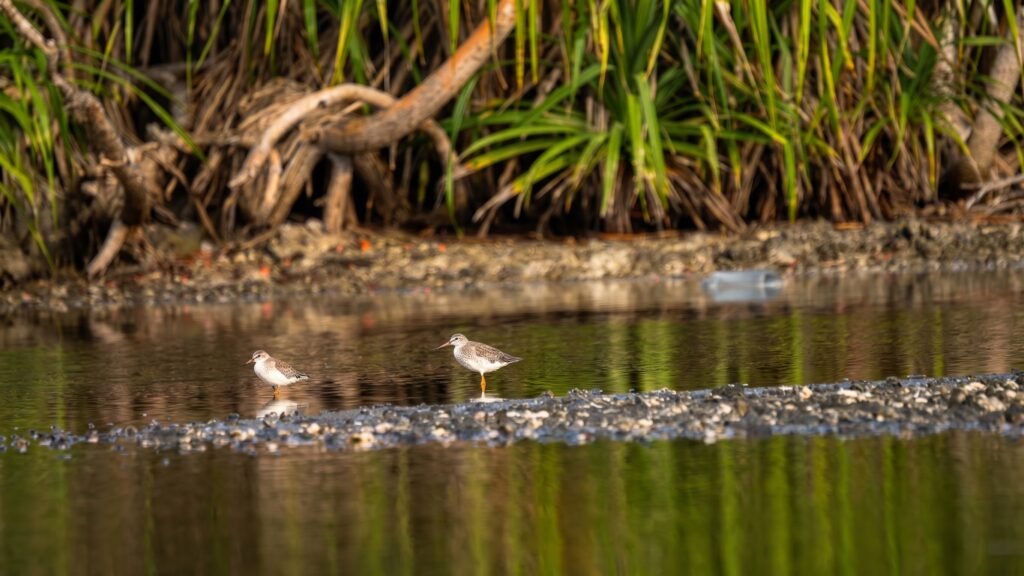
I photographed the two birds shown here in the wetland area of Haa Alifu Baarah. They were standing in shallow water close to the muddy wetland edge and vegetation. The extensive wetland and mangrove habitats of Baarah provide suitable feeding and resting areas for migratory waders such as the Common Redshank.
The Common Redshank is not among the most abundant waders in the Maldives. The national bird checklist describes it as an uncommon northern winter visitor.
Identification
The Common Redshank is a medium-sized shorebird with relatively long legs and a straight, medium-length bill.
Its most distinctive features are the bright orange to reddish legs and a bill that is reddish or orange near the base and dark towards the tip. The upperparts are grey-brown with darker markings, while the breast and neck are finely streaked. The belly is mainly white.
The birds I photographed at Baarah show these characters particularly clearly. Both have:
- bright orange-red legs;
- reddish-orange colour at the base of the bill;
- a dark bill tip;
- grey-brown upperparts;
- streaking across the neck and upper breast;
- white lower underparts;
- a pale eye-ring.
These features make the identification as Common Redshank very strong. The bright legs and two-coloured bill are especially useful field characters. The RSPB also describes orange-red legs and an orange-based bill as the species’ most obvious identification features.
When the bird flies, another very useful identification feature becomes visible: a broad white trailing edge to the wing and a white wedge extending up the back.
The scientific name Tringa totanus was established by Linnaeus in 1758. It belongs to the genus Tringa, which also contains the greenshanks, marsh sandpiper, wood sandpiper and several related waders.
The Dhivehi name ރަތަފައި އިލޮޅި is also listed for Tringa totanus in the Maldives Protected Species Regulation.
The Name Rathafai Ilolhi
The name Rathafai Ilolhi is descriptive and particularly appropriate for this bird because its brightly coloured legs are one of its most obvious characteristics.
There can, however, be some confusion with another familiar Maldivian shorebird.
The Ruddy Turnstone (Arenaria interpres) is known simply as Rathafai in Maldivian bird references, while the Common Redshank is Rathafai Ilolhi. They are completely different species.
Ruddy Turnstones are shorter-legged, more compact birds with a short wedge-shaped bill, while Common Redshanks are taller waders with long red-orange legs and a longer straight bill. The Maldives checklist records Ruddy Turnstone as common, while Common Redshank is considered uncommon.
Habitat
Common Redshanks use a wide variety of wet habitats.
During the non-breeding season they commonly occur around:
- tidal mudflats;
- mangrove edges;
- estuaries;
- shallow lagoons;
- saltmarshes;
- freshwater and brackish wetlands;
- muddy pools;
- coastal shallows.
They prefer places where they can walk through shallow water or across soft mud while searching for small animals.
Mudflats and wetland margins are particularly important because they contain large numbers of worms, crustaceans, molluscs, insects and other invertebrates.
The habitat where I photographed these birds at Baarah fits this preference very well: shallow water, exposed mud and dense wetland vegetation occur together within a relatively small area.
Behaviour
Common Redshanks are active waders.
They usually walk steadily through shallow water or over exposed mud while searching for prey. They may pick animals directly from the surface or probe into soft mud with their bill.
Unlike the short run-and-stop feeding style of plovers such as Bodana, a Redshank often walks continuously while probing and picking food from the substrate.
They may occur alone, in pairs or in loose groups.
The two individuals I observed in Baarah were standing close to one another in the shallow wetland water. Their red-orange legs were particularly noticeable against the dark mud and water.
Common Redshanks are also well known for being alert birds. When disturbed, they often give loud, repeated calls and may be among the first waders in a wetland to react to danger.
Diet
The Common Redshank is mainly carnivorous and feeds on small invertebrates.
Its food includes worms, small crustaceans, molluscs, insects and insect larvae. During the non-breeding season, birds feeding on estuaries and mudflats make extensive use of worms, molluscs and crustaceans living in wet sediment.
The bill is well suited for picking prey from the surface and probing shallow mud.
Wetland margins such as those at Baarah therefore provide suitable feeding habitat because shallow water and soft organic mud support many of these small animals.
Breeding
The Common Redshank does not normally breed in the Maldives.
Its breeding range extends across large areas of Europe and Asia. Birds breed mainly in wet grasslands, marshes, saltmarshes and other damp open habitats.
The nest is normally a shallow depression on the ground, usually concealed among vegetation. A typical clutch contains around four eggs, and both parents participate in incubation. The chicks are precocial and can walk and feed shortly after hatching.
After breeding, migratory populations travel south to warmer regions.
Migration
The Common Redshank has a very large geographical range. Different populations breed across Europe and Asia and migrate varying distances during the northern winter.
Asian populations move south towards regions including the Indian subcontinent and Southeast Asia.
The Maldives lies along an important region used by migratory birds associated with the Central Asian Flyway. The 2025 Maldives bird assessment notes that Maldivian islands can function as stepping-stones and overwintering grounds for migratory waders travelling through this region.
The Common Redshanks visiting the Maldives are therefore seasonal migrants rather than resident breeding birds.
Occurrence in the Maldives
The Common Redshank is a recognised migratory bird of the Maldives.
The comprehensive 2020 national checklist classifies Tringa totanus as an uncommon northern winter visitor. It is less frequently encountered than the Common Greenshank, which is listed as a common northern winter visitor.
Historical Maldivian bird records also describe redshanks visiting during the northeast monsoon, generally in relatively small numbers. Some older literature used the name Eastern Redshank for these birds.
Because several geographical populations and subspecies of Common Redshank exist, I would identify the birds in my Baarah photograph simply as Tringa totanus rather than attempting to assign a subspecies from the photograph alone.
The species is also included among birds protected nationally under the Maldives Protected Species Regulation.
My Observation at H.A. Baarah
I photographed these two Common Redshanks at the H.A. Baarah wetland, standing in shallow water near a muddy wetland margin.
The location is particularly suitable for waders because the landscape contains shallow pools, exposed mud, mangrove margins and areas of dense wetland vegetation.
Baarah has an unusually extensive wetland and mangrove system for a Maldivian island. Official information records 10 separate mangrove and wetland areas on the eastern side of the island, with indications that some were historically connected. Baarah has a total land area of about 256.7 hectares, including approximately 39 hectares of mangroves. The protected H.A. Baarah Wetland itself covers 51 hectares.
Six mangrove species have been recorded from the island, and the area supports a variety of birds and other wildlife.
During my visits, I have found Baarah particularly rich in birdlife compared with many Maldivian islands I have surveyed. The combination of mangrove forest, open wetland, shallow water, muddy margins and nearby marine habitat allows very different bird species to use the same island.
The presence of migratory waders such as Rathafai Ilolhi is another example of the value of these natural wetlands.
Other Shanks and Related Waders Found in the Maldives
Several other Tringa species have been recorded in the Maldives and can sometimes occur in similar wetland habitats.
| Species | Scientific name | Local name recorded in Maldives | Maldives status in 2020 checklist |
|---|---|---|---|
| Common Greenshank | Tringa nebularia | Chonchon Ilolhi | Common northern winter visitor |
| Common Redshank | Tringa totanus | Rathafai Ilolhi* | Uncommon northern winter visitor |
| Marsh Sandpiper | Tringa stagnatilis | Furedhi Ilolhi | Uncommon northern winter visitor |
| Wood Sandpiper | Tringa glareola | Findhan Ilolhi | Uncommon northern winter visitor |
| Spotted Redshank | Tringa erythropus | — | Vagrant |
| Green Sandpiper | Tringa ochropus | — | Vagrant |
*The official protected-species regulation records Rathafai Ilolhi for Common Redshank, although the local name was omitted from the Common Redshank entry in the 2020 checklist.
Common Redshank and Common Greenshank
The Common Greenshank (Tringa nebularia) is probably the most important confusion species in the Maldives.
The Greenshank is noticeably larger and taller, with longer grey-green legs and a longer bill that is slightly upturned. The Common Redshank is smaller and has unmistakably orange-red legs.
The difference in local names is also useful:
Common Redshank – Rathafai Ilolhi
Common Greenshank – Chonchon Ilolhi
Common Greenshank is considerably more frequently recorded in the Maldives and is listed as a common northern winter visitor.
Interestingly, the official Baarah protected-area description specifically mentions Common Greenshank among birds recorded from the wetland.
Common Redshank and Spotted Redshank
The Spotted Redshank (Tringa erythropus) is another related species but is much rarer in the Maldives, where it has been classified as a vagrant.
In non-breeding plumage it is generally paler and more elegant than Common Redshank, with longer legs and a longer, finer bill.
In breeding plumage, Spotted Redshank becomes dramatically different, turning almost black with fine white spotting.
The two birds in my photograph are clearly Common Redshanks, not Spotted Redshanks.
Common Redshank and Marsh Sandpiper
The Marsh Sandpiper (Tringa stagnatilis), known as Furedhi Ilolhi, is another migratory Tringa recorded in the Maldives.
It is slimmer and more delicate than Common Redshank, with very long pale legs and a much thinner, needle-like bill.
The Maldives checklist classifies Marsh Sandpiper as an uncommon northern winter visitor, similar in frequency category to Common Redshank.
Importance of Baarah Wetland for Migratory Waders
Wetlands are particularly important for migratory shorebirds because they provide both food and safe resting places.
A migratory bird may travel thousands of kilometres between its breeding and wintering areas. Along that journey it depends on suitable wetlands, mudflats and coastal habitats where it can stop and replenish its energy.
The Maldives bird assessment identifies the country’s islands as potentially important stepping-stones and wintering areas for migratory species travelling along the Central Asian Flyway.
Baarah provides several habitat types within one island: mangrove forest, muddy margins, open shallow water and nearby marine areas.
For species such as the Common Redshank, this variety is particularly useful. The bird can rest in quiet shallow water and then feed on exposed mud and wetland edges as water levels change.
The H.A. Baarah Wetland was designated as a protected area on 30 December 2018.
Conservation
The Common Redshank is currently classified globally as Least Concern, although populations in some regions have undergone substantial declines.
Loss and degradation of wetlands are among the main problems affecting the species in parts of its range. Drainage, development, disturbance and changes to wetland vegetation can reduce suitable feeding and breeding habitat.
In the Maldives, the species is also nationally protected. The wider protection of mangroves, wetlands, shallow coastal habitats and mudflats is important because these habitats are shared by many migratory waders.
My observation of Rathafai Ilolhi at H.A. Baarah shows how even an uncommon Maldivian visitor can make use of intact island wetlands.
Protecting areas such as Baarah therefore supports not only resident wildlife but also birds that connect the Maldives with distant parts of Asia through their annual migration.
References
- Anderson, R. C. & Shimal, M. A Checklist of Birds of the Maldives, Indian BIRDS Monograph 3, 2020.
- Maldives Government. Protected Species Regulation (2021/R-25) — listing Tringa totanus as Rathafai Ilolhi.
- Steibl, S. et al. Status of Common Breeding and Migratory Birds in the Maldives, 2025.
- Maldives Protected Areas. H.A. Baarah Wetland.
- British Trust for Ornithology. Redshank – BirdFacts.
- Royal Society for the Protection of Birds. Redshank – identification, habitat and ecology.

Share a useful observation
Comments can help improve local knowledge. Share identification notes, island records, behaviour, host plants, or corrections respectfully.