
 Niyaz
Niyaz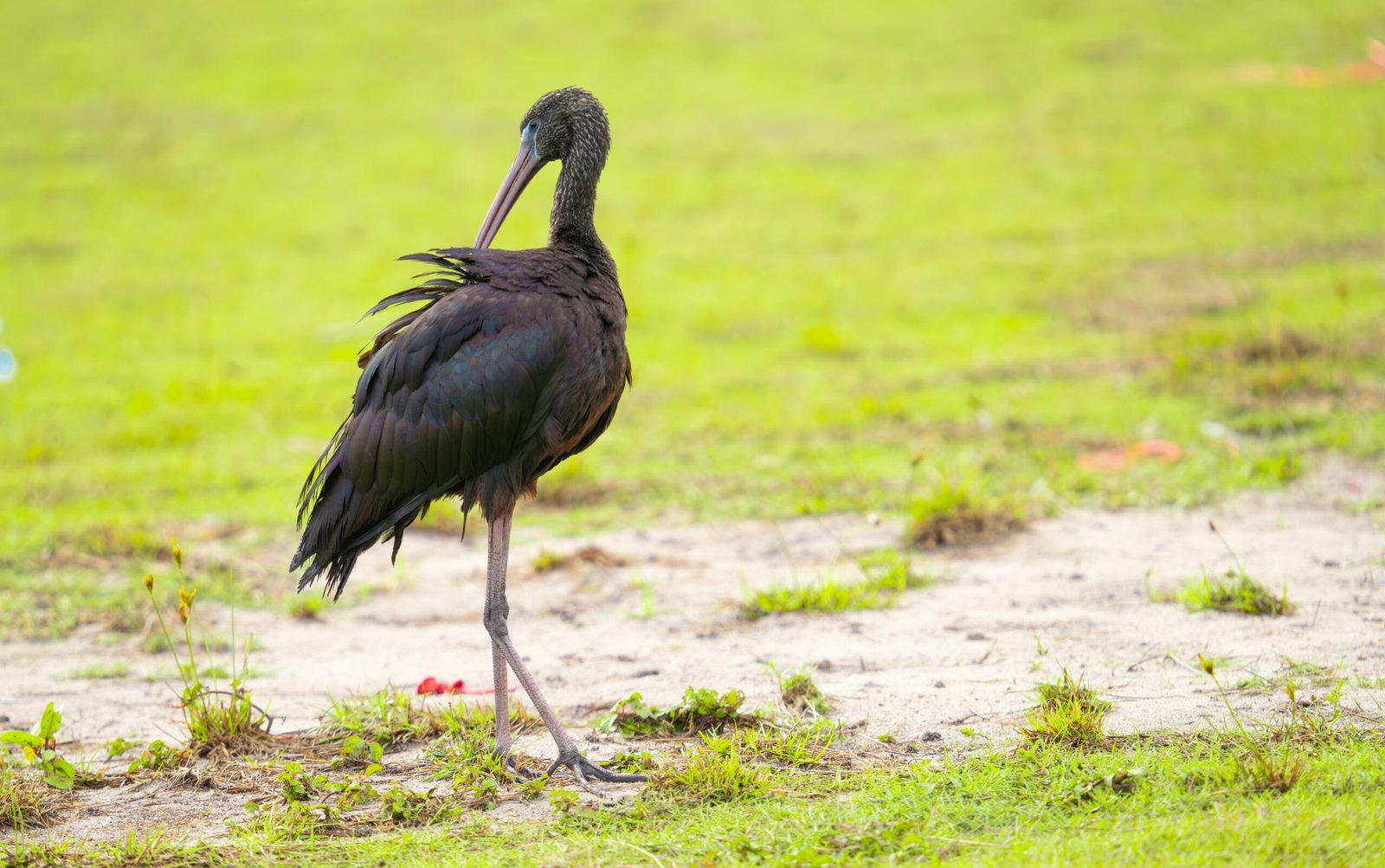
Plegadis falcinellus
The Glossy Ibis, locally known as Kalhu Bulhithunbi, is an uncommon migratory waterbird recorded in the Maldives. It belongs to the ibis and spoonbill family Threskiornithidae within the order Pelecaniformes. Although the bird can appear almost completely black from a distance, its plumage reveals metallic green, bronze, violet and deep maroon colours when viewed in good light.
The species has a wide global distribution, occurring across parts of Europe, Africa, Asia, Australia and the Americas. Some populations remain within the same general region throughout the year, while others migrate or disperse over long distances after the breeding season. Its wandering behaviour enables individual birds to appear temporarily in islands and areas far from their main breeding grounds.
Identification
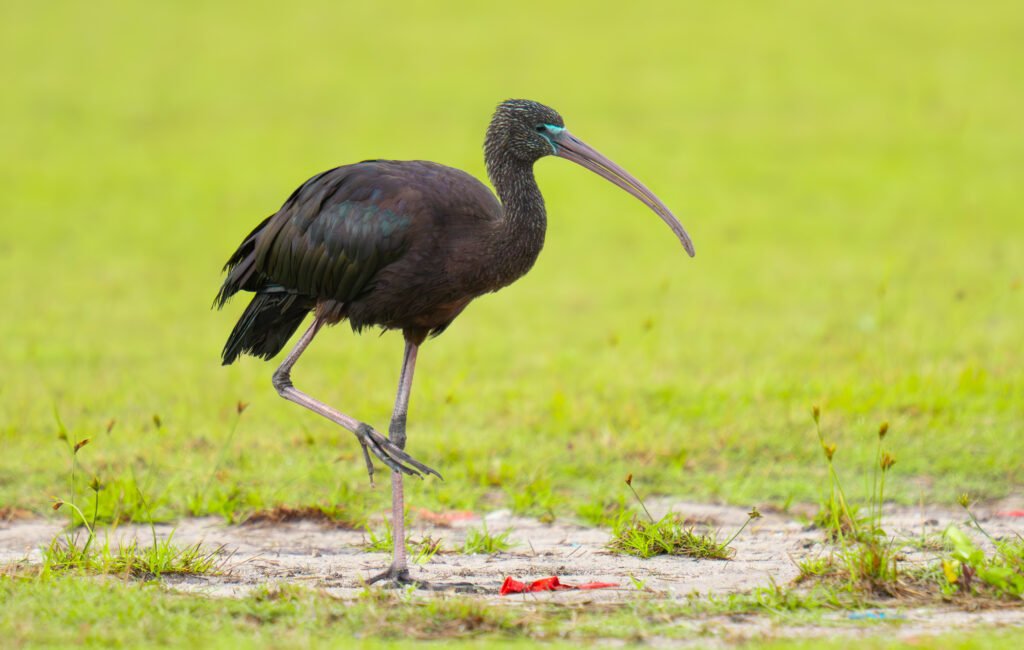
The Glossy Ibis is a medium-sized wading bird measuring approximately 48–66 centimetres in length. It has a compact body, a long neck, long legs and a distinctive slender bill that curves downward. The long curved bill is one of the easiest features for identifying the species.
Breeding adults usually have a rich maroon or chestnut-coloured body, while the wings display strong metallic green, bronze and purple reflections. Outside the breeding season, the bird appears darker and duller. Non-breeding birds and younger individuals often have fine pale streaks across the head and neck.
The bird I photographed at Hoandehdhoo appears to be in non-breeding plumage, with pale streaking visible along the head and neck, blue-grey facial skin and dark iridescent feathers across the wings and body. The colours change considerably according to the direction and strength of the light.
In flight, the Glossy Ibis keeps its neck extended forward and its legs trailing behind the tail. This helps separate it from herons, which normally pull their necks inward while flying.
Habitat
The Glossy Ibis is usually associated with shallow wetlands, including freshwater marshes, brackish lagoons, salt marshes, mangrove areas, mudflats, flooded agricultural fields and the edges of lakes and ponds. However, it may also feed on wet grasslands, pastures and other open places where the soil is soft enough for probing.
This ability to use moist grassy areas may explain why the bird I observed in Hoandehdhoo was feeding on a football ground rather than inside a permanent wetland. Temporary rainwater and damp soil can create suitable feeding conditions by bringing worms, insects and other small animals close to the surface.
Feeding and behaviour
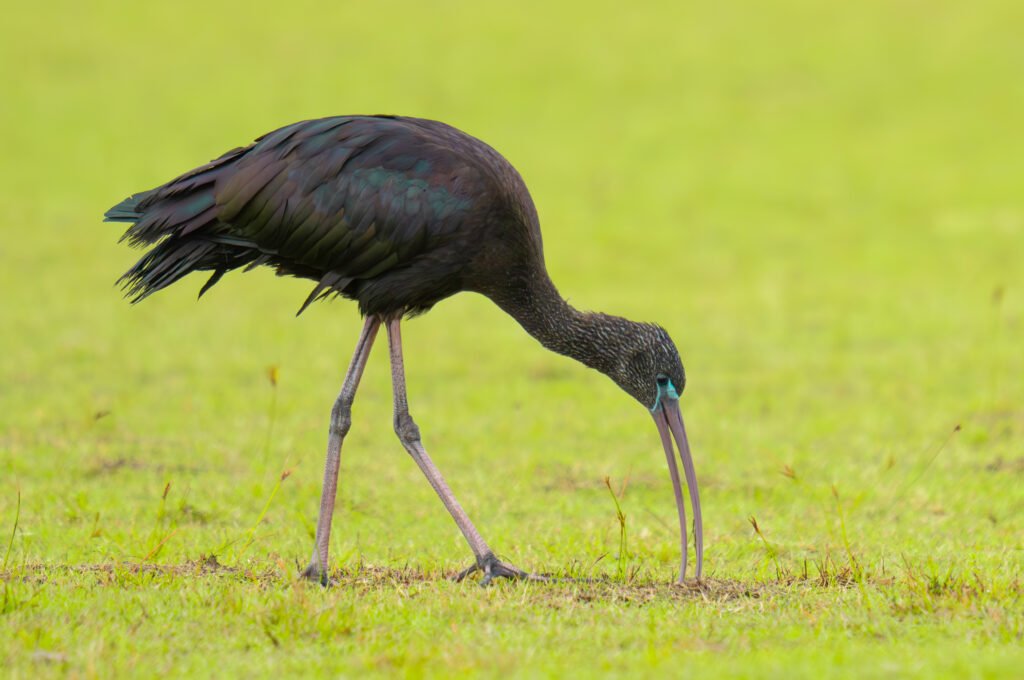
The Glossy Ibis normally walks slowly while repeatedly pushing its curved bill into soft mud, shallow water or moist soil. It can locate prey by both sight and touch. The bird may also move its bill from side to side through the mud or water while searching for food.
Its diet includes aquatic insects, beetles, dragonfly larvae, grasshoppers, worms, molluscs, snails, crabs, shrimp, small fish and amphibians. The exact diet changes according to the habitat and the food available at the time.
Glossy Ibises are often social birds. They may feed, rest and travel in small groups, although wandering individuals can also be seen alone. Larger flocks may gather in suitable wetlands during migration or outside the breeding season.
Breeding
Glossy Ibises usually breed in colonies, sometimes together with herons, egrets, spoonbills and other waterbirds. Their nests are constructed from sticks, reeds and other vegetation and are normally placed in reed beds, shrubs or low trees close to wetlands.
A typical clutch contains three or four eggs. Both parents participate in nesting activities and care for the young. The incubation period is generally around 20–22 days.
There is currently no indication from my observations that the species breeds in the Maldives. The individuals recorded in the country are better regarded as migratory or wandering visitors.
Occurrence in the Maldives
In the Maldives, Kalhu Bulhithunbi appears to be an uncommon migratory visitor rather than a regularly encountered waterbird. I have seen photographers from some northern islands sharing photographs and videos of this species. Photographers and nature observers in Huvadhoo have also recorded it.
These scattered observations suggest that the Glossy Ibis can reach both northern and southern parts of the Maldives during migration. Its appearance may depend on seasonal winds, rainfall and the availability of temporary feeding habitats.
The species can easily remain unnoticed because it may stay only briefly in one location. Its dark body may also make it difficult to distinguish from other dark waterbirds when observed from a distance.
My observation in Hoandehdhoo
I observed and photographed this Glossy Ibis at the Hoandehdhoo football ground in Gaafu Dhaalu Atoll, Huvadhoo. The bird was walking through the short grass with its head lowered, repeatedly probing the ground with its long curved bill.
The football ground probably provided suitable feeding conditions because the soil and grass were moist. Although it was not a typical marsh habitat, damp open ground can contain worms, insects and other small prey consumed by the Glossy Ibis.
My photograph clearly shows the bird’s long legs, downward-curving bill, streaked neck and metallic green and bronze reflections across the wings. From a distance, the same bird appeared almost entirely black, which may be connected to the local name Kalhu Bulhithunbi.
My observation in Sri Lanka
I also observed this species on Mannar Island in northwestern Sri Lanka. A Sri Lankan naturalist who was observing birds with me explained that the Glossy Ibis was considered rare in that area.
Sri Lankan sources describe the Glossy Ibis as a rare migrant or a fairly rare but regular winter visitor. Although its occurrence has historically been irregular, the species has occasionally remained and bred in suitable Sri Lankan wetlands.
My sightings in Mannar and Hoandehdhoo show how the same migratory species can appear in suitable habitats across Sri Lanka and the Maldives. Islands and coastal wetlands may provide important temporary resting and feeding places during these movements.
Conservation
The Glossy Ibis has an extremely large global range and is presently classified as Least Concern. However, being secure globally does not mean that it is common in every country. In places such as the Maldives and Sri Lanka, it may remain locally rare or irregular.
The species depends heavily on healthy wetlands and moist feeding areas. Wetland drainage, pollution, pesticides, disturbance and the destruction of mangroves and marsh vegetation can reduce the places available for feeding, resting and breeding.
The increasing number of photographs and videos shared by Maldivian observers can help improve our understanding of Kalhu Bulhithunbi. Recording the island, date, habitat and number of birds seen will be especially valuable in determining its migration period and distribution across the Maldives.

Share a useful observation
Comments can help improve local knowledge. Share identification notes, island records, behaviour, host plants, or corrections respectfully.