
 Niyaz
Niyaz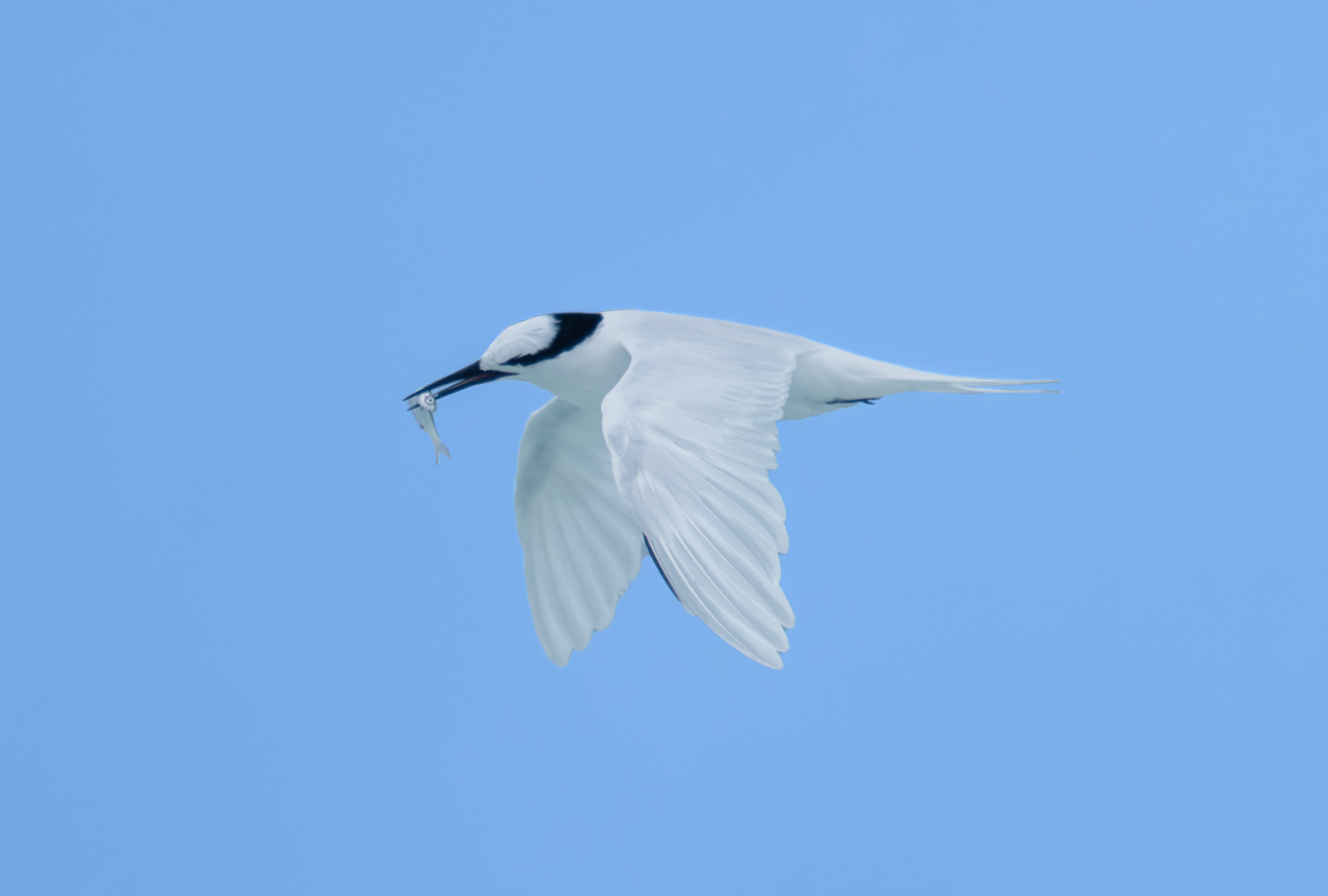
The Black-naped Tern (Sterna sumatrana), locally known as Kirudhooni (Kiru dhooni), is one of the most familiar breeding seabirds of the Maldives. It is a slender, mostly white tern found around lagoons, reefs, sandbanks, coral-rubble islands and shallow tropical seas.
Kirudhooni is not simply an occasional visitor to the country. It is a common breeding resident and breeds in most parts of the Maldivian archipelago. The 2025 national bird assessment describes the Black-naped Tern as the most widely occurring breeding seabird species in the Maldives. Earlier Maldivian ornithological studies also described it as one of the country’s most abundant and widespread terns.
Breeding is known from northern, central and southern Maldives, including Noonu Atoll, where colonies occur on islands, rocky banks and sandbanks. This wide breeding distribution makes Kirudhooni an important native component of Maldivian coastal and marine biodiversity.
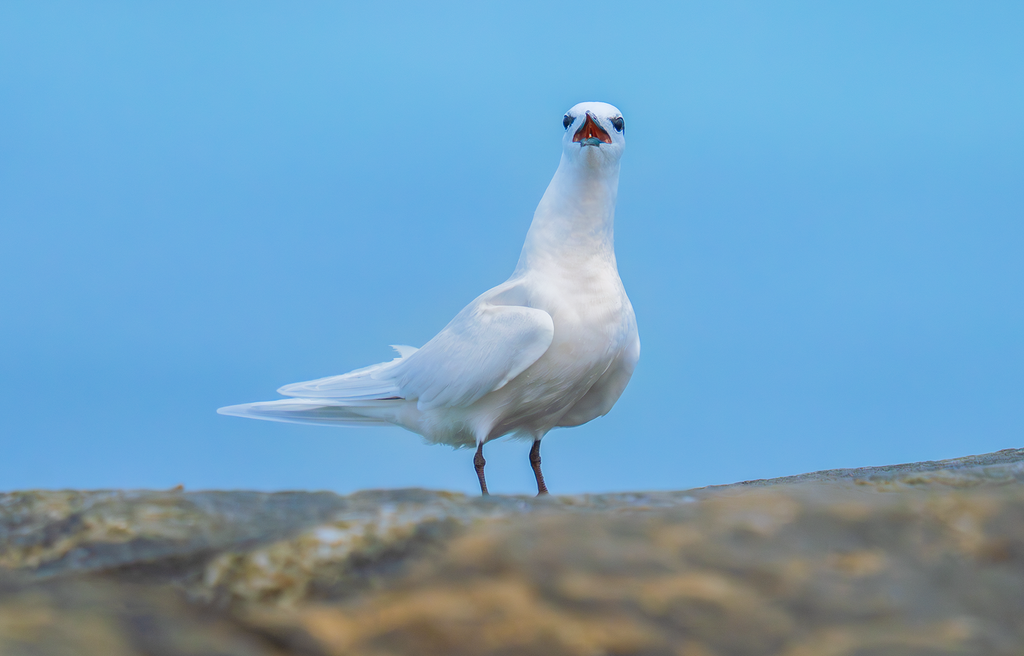
The adult bird in my photograph shows the species particularly well: an almost entirely white body, very pale grey wings, a long dark bill and the characteristic narrow black marking extending through the eye and around the back of the head.
Identification
The Black-naped Tern is a medium-small, graceful tern with long pointed wings and a deeply forked tail. Adults appear almost completely white when seen from a distance, especially when flying over bright lagoon water.
The most distinctive feature is the black band running from the eye to the back of the head and across the nape. Unlike many other terns, the top of the head remains white. This produces a very clean white-headed appearance with a narrow black mask.
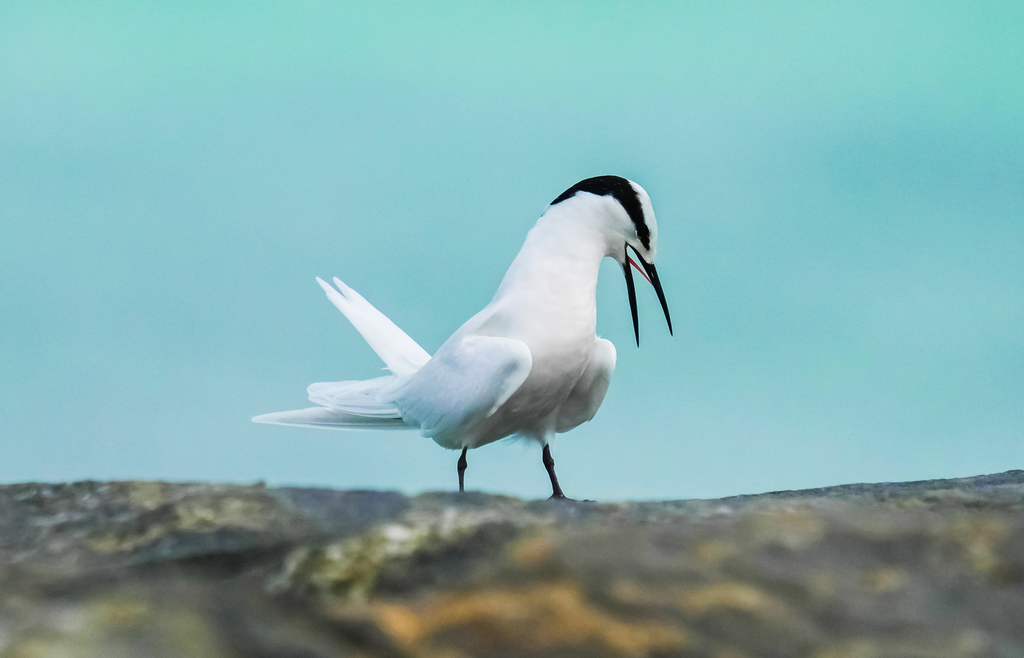
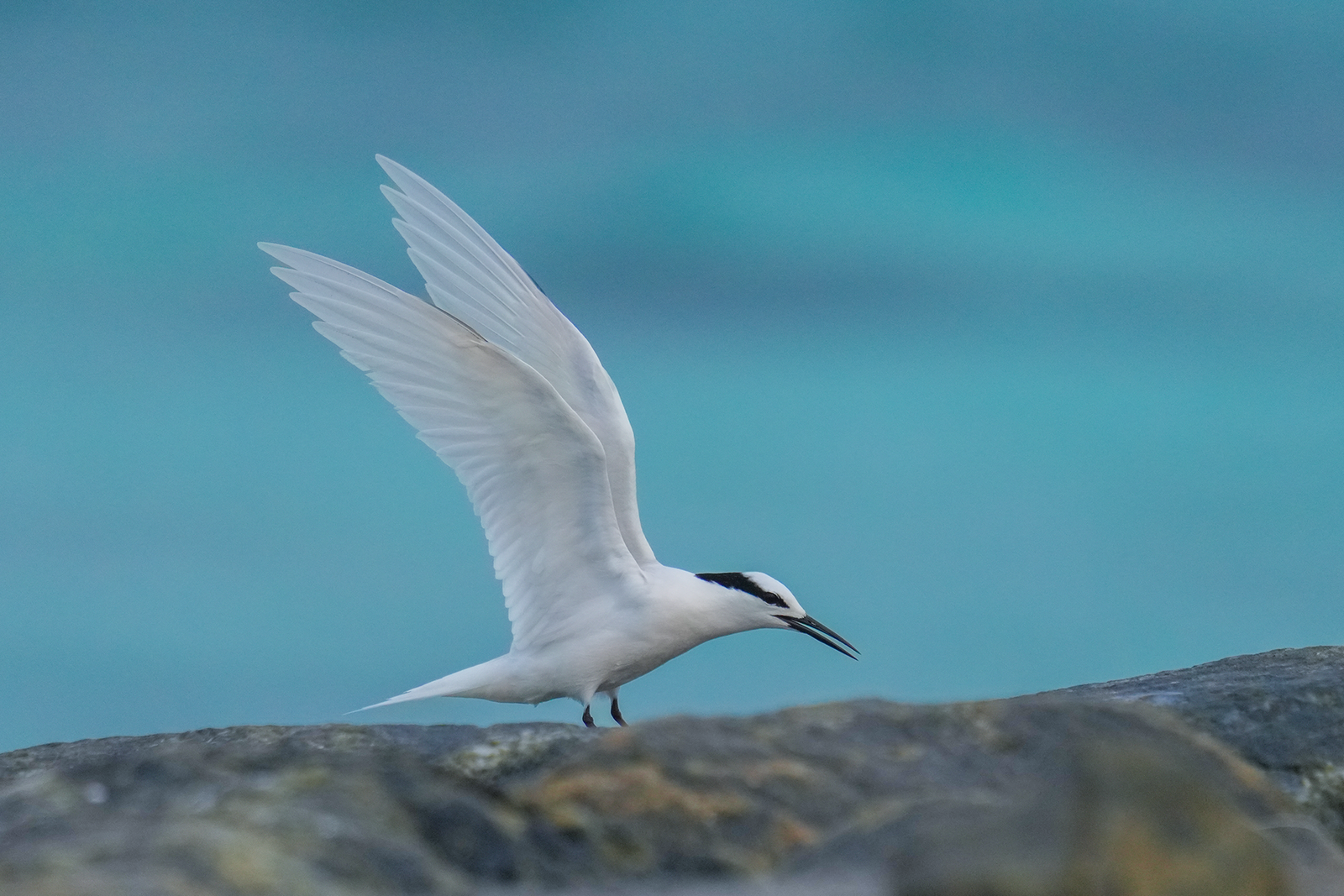
The bill is long, straight and black. The legs and feet are dark, while the back and upper wings are extremely pale grey. The breast, belly, neck, forehead and crown are white. eBird describes adults as almost snow-white apart from the thin black nape stripe and dark outer primary markings.
The bird in my photograph is an adult Black-naped Tern. The white crown, black eye-to-nape stripe, dark bill and pale body separate it clearly from most other terns occurring in the Maldives.
Juveniles look different from adults. Young birds may show grey-brown or darker markings over the head, back and wings, and their plumage is generally less clean and uniform.
The scientific name Sterna sumatrana was introduced by Stamford Raffles in 1822 and remains the accepted species name.
Two subspecies are generally recognised. The birds of the western Indian Ocean, including those of the Maldives, are assigned to Sterna sumatrana mathewsi. Historical ornithological literature specifically records this subspecies breeding in the Maldives, and modern taxonomic databases give its range as Aldabra, the Amirantes, Chagos and the Maldives.
The Name Kirudhooni
Kirudhooni is the established Maldivian name for the Black-naped Tern. The national Maldives bird checklist records the species as Kiru dhooni, while the 2025 national assessment uses the same local name.
It is one of the Maldivian seabirds whose local name remains widely recognised because the species lives and breeds throughout much of the country.
Unlike many migratory shorebirds that spend only part of the year in the Maldives, Kirudhooni is closely connected with Maldivian islands throughout its life cycle. Adults feed in Maldivian lagoons and reef waters, breed on Maldivian sandbanks and islands, and raise their chicks here.
Habitat
Kirudhooni is a bird of tropical marine environments. It is mainly associated with coral reefs, lagoons, reef flats, shallow coastal seas, sandbanks, exposed coral-rock areas and small islands.
The species is particularly well adapted to the geography of the Maldives. The archipelago contains thousands of reef structures, sandbanks and small islands surrounded by shallow productive seas.
Black-naped Terns usually remain relatively close to marine habitats. They rest on beaches, exposed reef rocks, sandbanks and small offshore islands and feed over surrounding lagoons and reef waters.
The species can also use artificial or newly created open coastal areas. The Maldives assessment records cases where Black-naped Terns quickly colonised reclaimed or construction areas when suitable undisturbed ground was available.
Behaviour
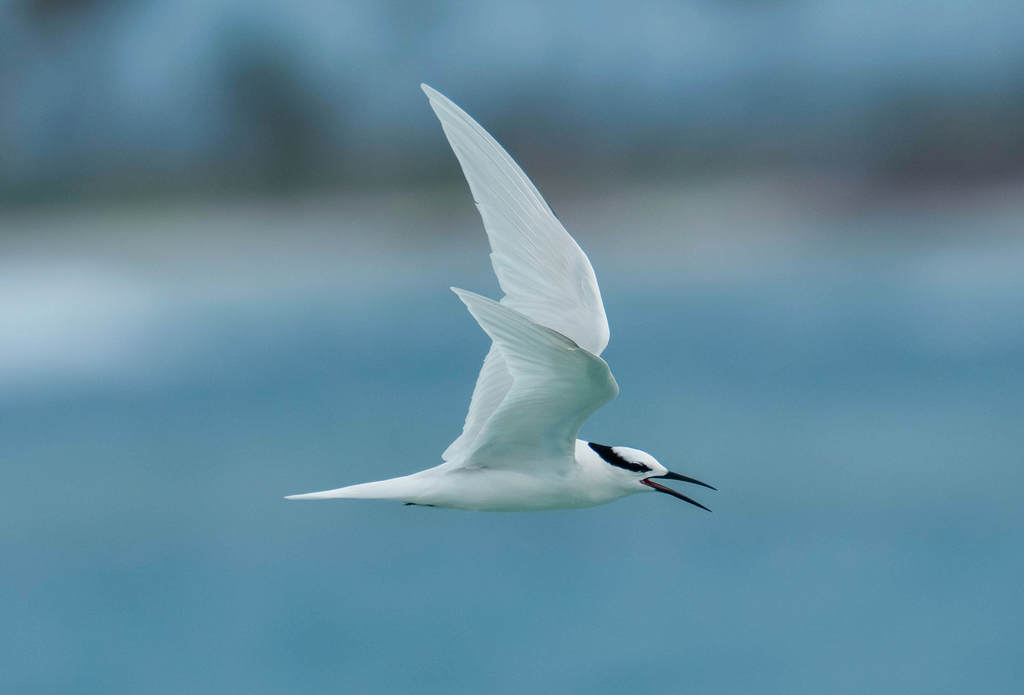
Black-naped Terns have light, graceful flight. They often fly relatively low above the water while looking for small fish near the surface.
Their feeding behaviour commonly includes hovering briefly before dropping towards the water and taking prey from just below the surface. They can also make shallow plunge-dives. eBird notes that the species frequently hovers while feeding and dips down to collect prey from near the water surface.
Kirudhooni may feed alone, in pairs or in groups. It can also associate with other tern species around productive feeding areas.
When not feeding, birds frequently rest together on sandbanks, reef rocks and quiet beaches.
During breeding, their behaviour changes noticeably. Adults become defensive around nests, eggs and chicks. They may circle above a person or other animal approaching the nesting area and repeatedly call or dive towards the intruder.
Diet
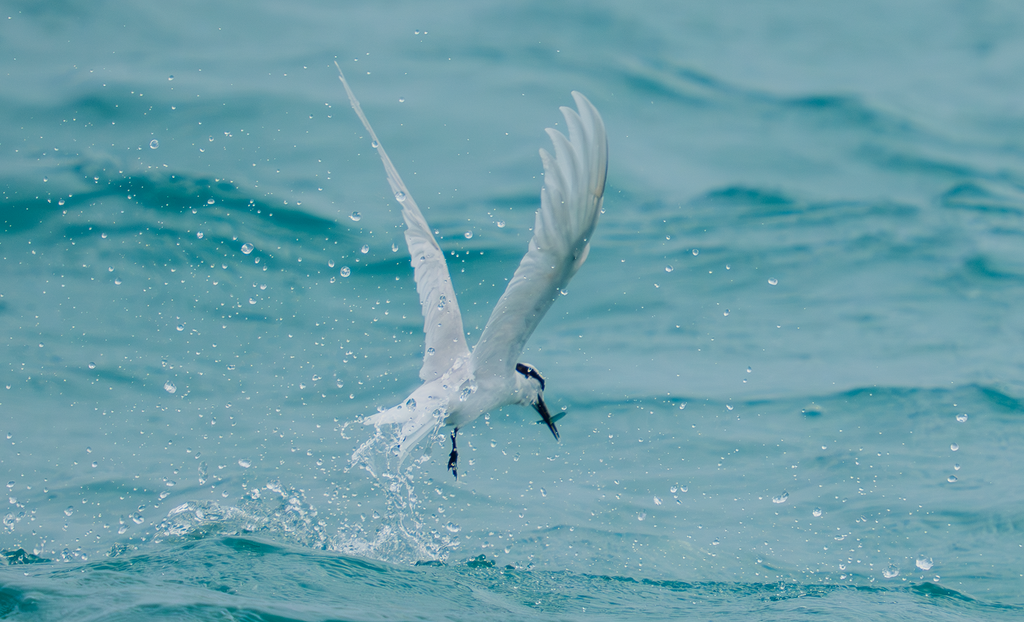
The diet of Kirudhooni consists mainly of small fish caught close to the sea surface.
The 2025 Maldives assessment lists small fish as the principal food of the species.
This feeding ecology links Kirudhooni closely with healthy reef and lagoon environments. Shallow reef waters support many small schooling fishes that can be captured by terns from the air.
Rather than diving deeply underwater, Black-naped Terns usually take prey near the surface. Their slender body, pointed wings and light flight allow them to rapidly change direction while following fish.
Breeding
Kirudhooni is a ground-nesting seabird.
It does not build a large nest. Instead, the eggs are normally laid in a small unlined depression in sand, gravel or coral rubble, sometimes close to shells, pieces of coral or sparse vegetation.
The 2025 Maldives assessment gives a typical clutch of one to two eggs, with incubation lasting approximately 21–23 days. Young birds generally fledge at around 21–28 days.
Black-naped Terns generally form relatively small colonies, commonly around 5–20 pairs, although much larger groups can occur. They may sometimes breed close to Roseate Terns or Bridled Terns.
Because their eggs are laid directly on the ground, nests can be extremely difficult to notice. Eggs and chicks often blend with sand, stones and coral fragments.
This makes breeding colonies particularly vulnerable to people walking through nesting areas, vehicles, tourism activities, sand extraction and other disturbance.
Breeding in the Maldives
Kirudhooni breeds across most regions of the Maldives, from the far north through the central atolls and into the south.
The 2025 assessment documented breeding in Ihavandhippolhu, Thiladunmathi, Makunudhoo, Miladhunmadulu, North Maalhosmadulu, South Maalhosmadulu, Faadhippolhu, Ari, South Malé, Felidhoo, North and South Nilandhoo, Mulaku, Kolhumadulu, Haddhunmathi, Huvadhoo and Addu, among other areas.
Breeding in Noonu Atoll
Noonu forms part of Miladhunmadulu, where breeding Black-naped Terns are well documented.
The national assessment specifically records breeding and roosting at locations including N. Orivaru, N. Loafaru, N. Dhekenanfaru and N. Raafushi, as well as additional sandbanks in the area.
This fits the wider pattern seen throughout the Maldives: Kirudhooni commonly uses small islands, finolhu, rocky reef banks and other quiet open areas for breeding.
Noonu is therefore not an isolated breeding area. It is part of a broad network of Black-naped Tern breeding habitat extending across most of the Maldivian archipelago.
Occurrence in the Maldives
The national status of Kirudhooni can be summarised simply as:
Breeding: Yes
Distribution: Widespread
Occurrence: Common
These are the classifications used in the 2025 Maldives bird assessment.
The 2020 Checklist of Birds of the Maldives likewise lists Black-naped Tern as a common breeding resident.
Historical accounts agree with this pattern. Phillips in the 1960s described Black-naped Terns as the most abundant and widespread tern of the Maldives and reported them breeding in large numbers. Ash and Shafeeg later also described them as abundant, widespread and present throughout the year. These historical accounts are summarised in the recent national assessment.
Kirudhooni can therefore be regarded as one of the characteristic breeding seabirds of the Maldives.
Distribution Outside the Maldives
The Black-naped Tern occurs widely across the tropical Indian and western Pacific oceans.
In the western Indian Ocean it breeds in places including the Seychelles, Chagos and Maldives. Farther east, breeding populations occur around the Andaman and Nicobar Islands, Southeast Asia, southern China and Japan, the Philippines, Indonesia, New Guinea and parts of the western Pacific.
Some populations remain relatively close to breeding colonies throughout the year, while others disperse more widely at sea during the non-breeding period. Long-distance migration patterns are not as clearly defined as those of many northern migratory terns.
Other Terns Found in the Maldives
The Maldives supports several species of terns. Some breed within the country, while others are mainly seasonal visitors or offshore species.
The 2020 Maldives checklist records Black-naped Tern as common and breeding, together with several other tern species of different status.
Local names can sometimes overlap between related seabirds, making photographs and scientific names useful when documenting observations.
Black-naped Tern and Roseate Tern
The Roseate Tern (Sterna dougallii) is another pale, elegant tern that breeds in the Maldives.
The easiest difference is the head.
Kirudhooni has a white forehead and white crown with a narrow black eye and nape band. A breeding adult Roseate Tern has a much more extensive black cap covering the top and back of the head.
Roseate Terns are also less common in the Maldives. The national assessment describes Black-naped Tern as widespread and common, while Roseate Tern is widespread but uncommon.
Black-naped Tern and Great Crested Tern
The Great Crested Tern (Thalasseus bergii) is substantially larger than Kirudhooni.
It has a heavier body, much larger bill and a shaggy black crest at the rear of the head. Its bill is yellow, making identification relatively easy when seen well.
Kirudhooni is smaller, more delicate and has a slender black bill.
Both species breed widely in the Maldives.
Black-naped Tern and Saunders’s Tern
Saunders’s Tern (Sternula saundersi) is considerably smaller than Kirudhooni.
It has a compact body and a more extensive black crown pattern, especially in breeding plumage. Kirudhooni has a longer, more elegant body and the distinctive narrow black nape band with a predominantly white head.
The Maldives assessment considers Saunders’s Tern a breeding species with a more localised distribution, whereas Black-naped Tern is widespread.
Black-naped Tern and White Tern
The White Tern (Gygis alba) is another almost entirely white seabird found in the Maldives, particularly in the southern atolls.
The two species are quite different when seen closely.
White Terns lack the black nape stripe completely. They have a larger dark eye surrounded by a dark eye-ring and a thicker pointed bill. Their nesting behaviour is also very different: White Terns normally lay a single egg directly on a tree branch rather than nesting on the ground.
Kirudhooni nests on sand, rock and coral rubble.
Importance of Sandbanks and Small Islands
Small sandbanks and apparently barren coral-rubble islands can be extremely important bird habitat.
To people, a small finolhu may appear to contain very little wildlife. To a ground-nesting seabird, however, the absence of dense vegetation and terrestrial predators can make it an ideal breeding site.
Black-naped Terns depend heavily on such places.
Because the species breeds directly on the ground, even relatively small changes can affect a colony. Frequent visits, people walking through nesting areas, sand mining or construction can cause adults to abandon nests.
This is particularly relevant in the Maldives because many suitable sandbanks and tiny islands are also attractive locations for tourism and development.
Conservation
The Black-naped Tern is globally classified as Least Concern, but this does not mean local breeding colonies are secure.
The 2025 Maldives assessment identified several concerns affecting Kirudhooni. These include egg collection, loss of breeding islands, resort development, vegetation clearance, sand mining and frequent disturbance of nesting sandbanks. Interviewees also reported declines or disappearance of colonies from some former breeding areas.
Egg collection is especially damaging to colonial seabirds because repeated removal of eggs can greatly reduce breeding success.
Development of small islands and sandbanks can also permanently remove nesting habitat. Even where land remains physically present, regular human activity may make it unsuitable for breeding.
Interestingly, Black-naped Terns can quickly occupy newly available habitat. The Maldives assessment reports birds colonising reclaimed islands and construction areas when those places temporarily remained quiet. In some cases, birds disappeared again once regular human activity increased.
This shows that the species can respond positively when suitable nesting ground is protected.
Importance to Maldivian Biodiversity
Kirudhooni is particularly important because it is not simply a migrant using the Maldives as a temporary stopping point.
It breeds here.
Its eggs are laid on Maldivian islands and sandbanks. Its chicks grow beside Maldivian lagoons. Adults feed in surrounding reef waters and return to nesting colonies with fish for their young.
The species therefore represents a direct ecological connection between the islands, reefs, lagoons and open sea.
Protecting Kirudhooni requires more than protecting individual birds. It requires keeping suitable sandbanks, reef islands, rocky banks and coastal breeding sites undisturbed during nesting periods and maintaining healthy marine environments where adults can find food.
As one of the most widespread breeding seabirds of the country, Kirudhooni is an important part of the natural birdlife of the Maldives.
References
- Steibl, S. et al. Status of Common Breeding and Migratory Birds in the Maldives, 2025. The assessment records Kirudhooni as a widespread, common breeding species and the most widely occurring breeding seabird in the country.
- Anderson, R. C. & Shimal, M. A Checklist of Birds of the Maldives. Indian BIRDS Monograph 3, 2020.
- Cornell Lab of Ornithology / eBird. Black-naped Tern – Sterna sumatrana.
- Maldives seabird assessment – Black-naped Tern breeding biology and Indian Ocean distribution.
- Phillips & Sims. Historical documentation of Sterna sumatrana mathewsi nesting in the Maldive Islands.
- Avibase/Clements. Distribution of Sterna sumatrana mathewsi in the western Indian Ocean, including the Maldives.

Share a useful observation
Comments can help improve local knowledge. Share identification notes, island records, behaviour, host plants, or corrections respectfully.