
 Niyaz
Niyaz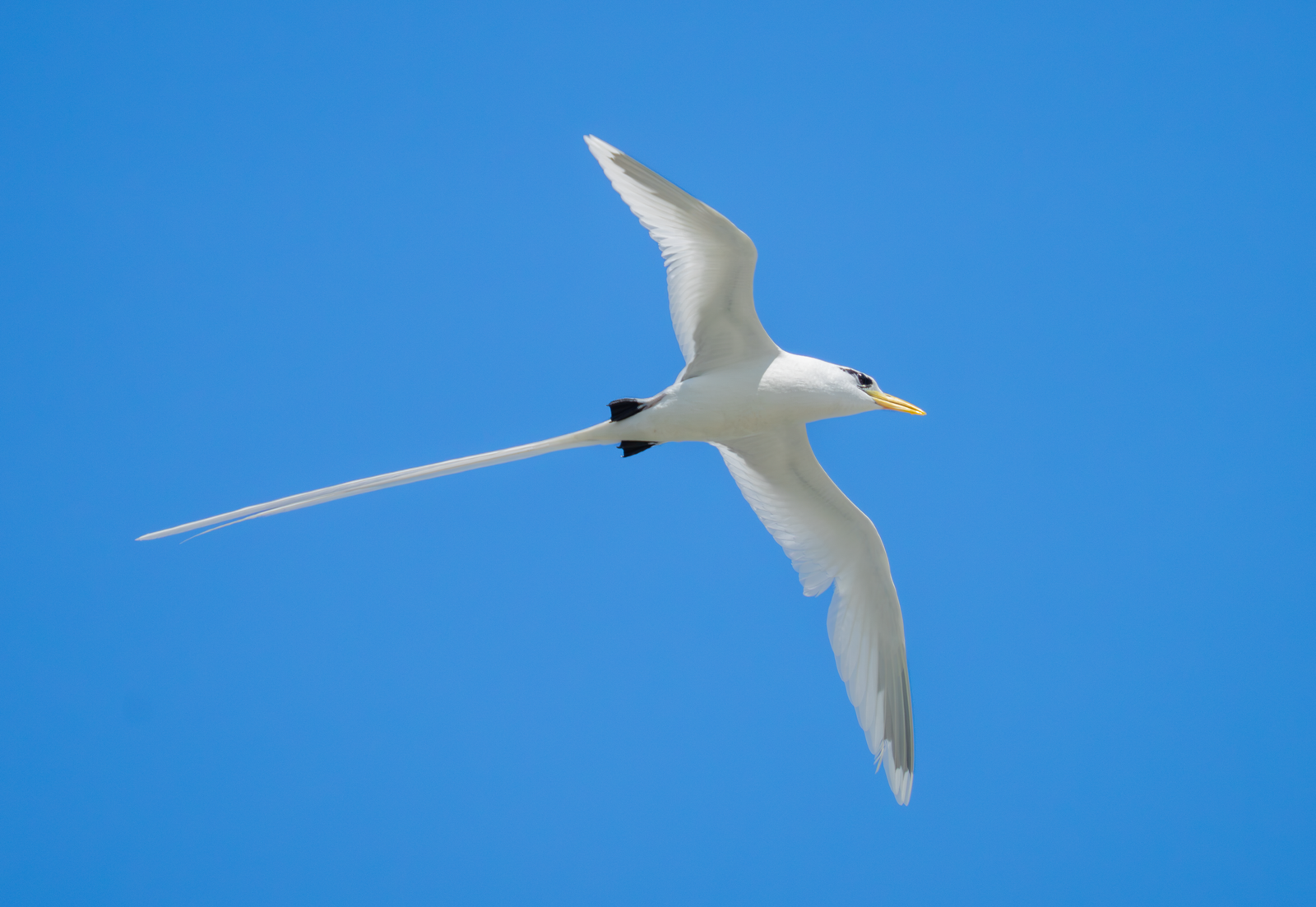
The White-tailed Tropicbird (Phaethon lepturus), locally known in the Maldives as Dhandifulhu Dhooni, is a distinctive tropical seabird and an important native breeding species of the Maldives. It is recognised by its almost completely white body, black markings around the eyes and across the wings, yellowish bill and extremely long white central tail feathers.
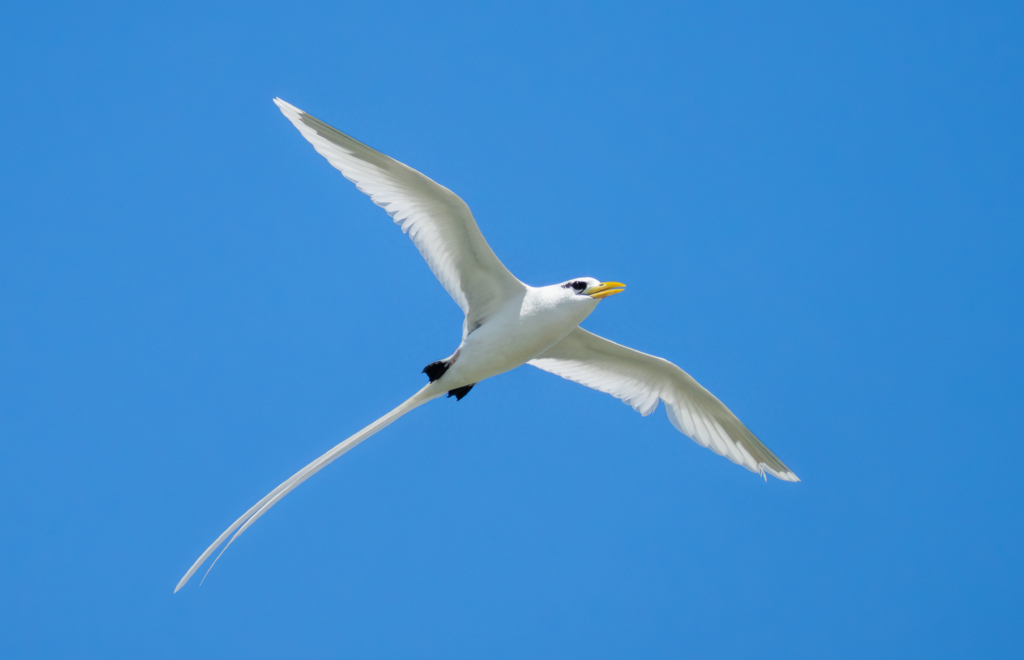
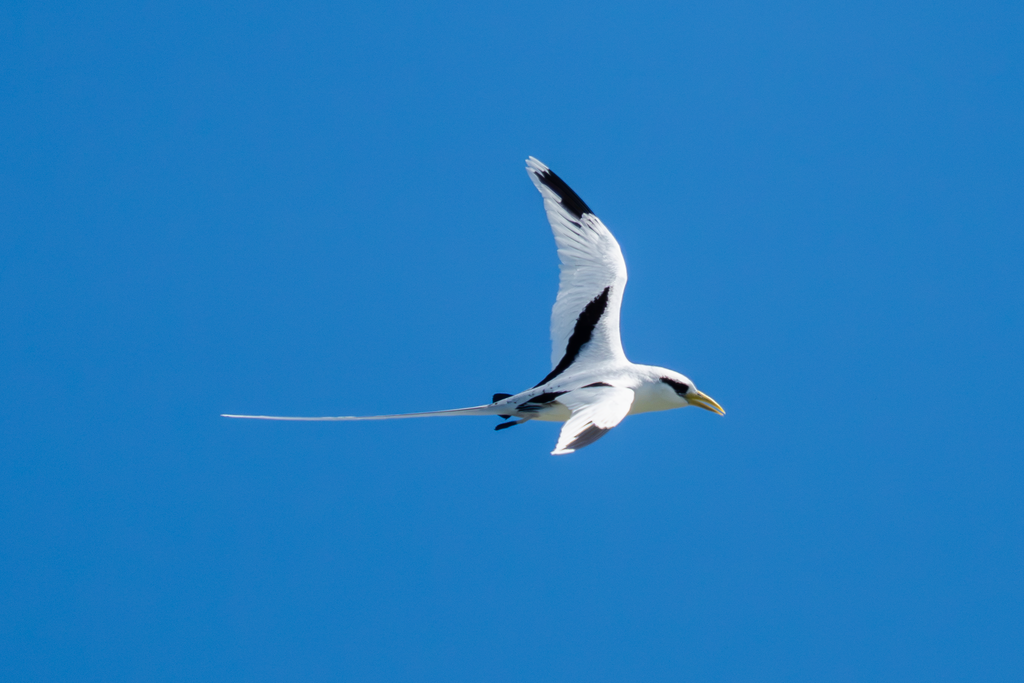
Dhandifulhu Dhooni is a common, widespread breeding resident in the Maldives, although its abundance differs greatly between islands and atolls. The 2025 national assessment classifies the species as breeding, widespread and common. Historical records describe it as formerly plentiful throughout the Maldives, while more recent information indicates that it has declined or disappeared from some islands where forests and mature trees have been removed. era.gov.mv
I have found this species especially noticeable in Laamu Gan, where birds can regularly be seen flying over inland areas, neighbourhoods and houses as well as around wetlands and coastal forest. The species breeds on Gan and other islands in the atoll, and the official national assessment specifically records breeding around Paree Fengandu on L. Gan and on L. Maandhoo. era.gov.mv
Identification
The White-tailed Tropicbird is a medium-sized seabird with long pointed wings, a relatively small body and two extremely long central tail feathers. These tail streamers give the bird a distinctive appearance when it is flying and can make the overall length of an adult look much greater than its body size.
Adults are predominantly white. A bold black stripe runs through each eye, while additional black markings occur across the upper wings and on the outer flight feathers. The bill is usually yellow to yellow-orange. The legs are short, reflecting the species’ highly aerial lifestyle.
The birds in my photographs from Laamu Gan are adults and show these characters clearly. The very long white tail streamers are especially noticeable in flight, together with the yellow bill, black facial stripe and contrasting black markings on the wings.
Juveniles are different from adults. They have more black barring and spotting across the back and wings and do not initially possess the very long tail streamers. As they mature, the plumage becomes cleaner and whiter and the elongated central tail feathers develop.
Taxonomy
The White-tailed Tropicbird was scientifically described by François Marie Daudin in 1802. The 2020 Checklist of Birds of the Maldives describes it as a widespread breeding resident, although declining and largely absent from some of the more densely populated central atolls. Indian Birds
Dhandifulhu Dhooni in the Maldives
Dhandifulhu Dhooni is one of the seabirds that naturally breeds within the Maldivian islands, rather than simply visiting the country during migration.
The latest national assessment records breeding populations from the far north to the southern atolls. Breeding is documented in parts of Haa Alifu, Haa Dhaalu, Shaviyani, Noonu, Raa, Baa, Lhaviyani, Meemu, Thaa, Laamu, Huvadhoo, Fuvahmulah and Addu, although populations are not equally large in all of these areas. era.gov.mv
The species can be locally very common even though it may be scarce or absent from other parts of the country. This appears to be strongly connected to the availability of mature island forest, large trees and protected nesting cavities.
Historical accounts described White-tailed Tropicbirds as plentiful and resident throughout the Maldives. Later records documented declines, particularly following forest clearance and development. The national assessment reports that local observers repeatedly associated the disappearance of Dhandifulhu Dhooni with the removal of mature forest for construction and urban expansion. era.gov.mv
My Observations on Laamu Gan
I have found Laamu Gan to be an important island for Dhandifulhu Dhooni. The bird is very noticeable in some parts of Gan and can be seen flying above residential areas, roads, houses, wetlands and mature island vegetation.
It is particularly interesting to see a true seabird flying regularly over neighbourhoods. Although Dhandifulhu Dhooni obtains its food from the ocean, it depends on land for breeding, and suitable nesting places can occur surprisingly close to human settlements.
On Gan, birds can sometimes be seen circling repeatedly over the same part of the island before disappearing into areas containing mature trees. This behaviour often indicates that the birds are using nearby land as breeding or resting habitat.
Published information supports the importance of Gan. The national assessment specifically records breeding around Paree Fengandu on L. Gan, as well as on nearby L. Maandhoo. era.gov.mv
From my observations, the number of birds around Gan appears greater locally than the small estimates contained in some earlier assessments. This illustrates why continued field observations are useful: seabird colonies can change over time, and populations on individual islands may increase, decrease or shift to new nesting areas.
Breeding in the Maldives
Dhandifulhu Dhooni has a very different nesting strategy from terns such as Kirudhooni.
It does not normally construct an exposed nest on an open sandbank. Instead, it searches for a sheltered cavity or protected space, often within forest vegetation, beneath roots or inside suitable structures created by large trees.
The national Maldives assessment records nesting around Nika gas (Ficus benghalensis), Kandhu gas or Lantern Tree (Hernandia nymphaeifolia), Ban’bukeyo or Breadfruit (Artocarpus altilis), and Kaani gas (Cordia subcordata). Birds also nest among the roots of Kashikeyo or screw pine (Pandanus tectorius). era.gov.mv
Only one egg is normally laid. The national assessment gives an incubation period of around 40–42 days, followed by a long chick-rearing period, with fledging after approximately 71–73 days. era.gov.mv
Because the breeding cycle is long, a nesting site must remain protected for several months.
Nesting Among Pandanus Roots
One of the most interesting nesting behaviours I have observed in the Maldives occurs around beach Pandanus or Kashikeyo.
In northern parts of the Maldives, I have seen Dhandifulhu Dhooni breeding very low to the ground, inside the protected spaces formed by dense Pandanus roots. From outside, these nesting places can be extremely difficult to notice.
The adult may sit within a dark cavity between the roots, sometimes only a short distance from a beach or path.
This observation is strongly supported by research from Kurehdhoo in Lhaviyani Atoll. Researchers documented extensive nesting among screw-pine root systems and other low protected cavities. marineornithology.org
The national Maldives assessment also specifically identifies Pandanus roots as nesting habitat for White-tailed Tropicbirds. era.gov.mv
These low nests are easily damaged accidentally. Cutting Pandanus roots, clearing vegetation or walking through dense coastal vegetation can destroy a breeding site even when the tree itself remains standing.
Nesting in Large Trees
My observations in the southern Maldives show that Dhandifulhu Dhooni can also use higher nesting locations associated with large mature trees.
I have seen birds using areas containing Sea Poison Trees (Barringtonia asiatica) and Kandhu gas (Hernandia nymphaeifolia), with nesting places considerably higher than the low Pandanus-root sites I have encountered farther north.
This does not mean that all northern birds nest low or all southern birds nest high. Rather, it shows the flexibility of the species. Where suitable protected cavities occur near ground level, the birds can use them; where mature trees provide higher sheltered spaces, those may also be selected.
The published Maldives assessment confirms that Kandhu gas is one of the important nesting trees used by the species. It also records nesting around several other large native and cultivated trees. era.gov.mv
These differences in nesting behaviour are worth documenting because they demonstrate that conserving Dhandifulhu Dhooni requires more than protecting a single type of vegetation.
Northern and Southern Nesting Observations
From my own field observations, I have noticed an interesting difference between some northern and southern nesting sites.
In parts of the northern Maldives, nests I have encountered have often been close to ground level and sheltered inside the root structures of beach Pandanus.
In parts of the southern Maldives, I have observed birds associated more often with large mature trees, including Sea Poison Trees and Kandhu gas, where suitable nesting sites may occur higher above the ground.
These are personal field observations rather than a rule applying to every island. More systematic research would be needed to determine whether there is a genuine geographical difference in nesting height across the Maldives.
However, the observation demonstrates the value of recording not only which islands contain the species but also which trees and structures the birds use for breeding.
Observations in Gaafu Dhaalu
I have also observed Dhandifulhu Dhooni on Gaafu Dhaalu Gan, showing that the species occurs in Huvadhoo as well as Laamu and other southern parts of the Maldives.
The 2025 national assessment confirms White-tailed Tropicbird breeding within Huvadhoo Atoll, although documented breeding locations in that survey were concentrated in the northern administrative part of the atoll. era.gov.mv
Continued records from G.Dh. islands are therefore useful for improving knowledge of the species’ present distribution in southern Huvadhoo.
Recent Research in the Maldives
White-tailed Tropicbirds have recently received more scientific attention in the Maldives.
A 2024 study on Kurehdhoo, Lhaviyani Atoll, documented a regionally significant population and estimated around 800 birds, making it the largest known Maldivian population reported in the national assessment. era.gov.mv
An even more detailed study published in September 2026 followed White-tailed Tropicbirds on Finolhas in Baa Atoll from August 2022 to March 2025. Researchers monitored breeding activity for 138 weeks and found that the birds bred throughout the year. Cambridge University Press
The Finolhas study recorded 60.2% breeding success and found that the number of active nests nearly doubled over the 2.6-year study period. By the end of monitoring, the breeding population was estimated at more than 100 birds. Cambridge University Press
This is important for Maldivian conservation because the colony exists on a resort island. The researchers concluded that maintaining native vegetation together with effective control of invasive rats can allow White-tailed Tropicbirds to breed successfully even on inhabited or developed islands. Cambridge University Press
Behaviour
Dhandifulhu Dhooni spends much of its life flying over the ocean but returns to islands for breeding.
Its flight is elegant and easily recognisable. The bird uses rapid wingbeats mixed with gliding, while the two long tail streamers trail behind the body.
Around breeding islands, birds may circle over the same forest or neighbourhood repeatedly. Pairs can also perform aerial displays in which two birds fly closely together, turning and following each other through the air.
The long tail streamers are particularly striking during these flights.
The birds are poorly adapted for walking on land. Their legs are short, and adults normally enter nesting sites directly from flight or move only short distances around the nest.
Diet and Feeding
Dhandifulhu Dhooni feeds almost entirely at sea.
Its diet consists mainly of small fish and cephalopods such as squid. The national assessment identifies fish and cephalopods as the main prey. era.gov.mv
The bird searches for prey while flying above the sea and then dives into the water to capture food.
Flying fish can form an important part of the diet. This relationship between tropicbirds and feeding fish has also long been recognised by Maldivian fishers.
The 2025 assessment records an old Maldivian fishing saying translated as “the tropicbird does not lie”, referring to the reliability of Dhandifulhu Dhooni as an indicator of schooling fish. era.gov.mv
This gives the species cultural importance in addition to its ecological value.
Dhandifulhu Dhooni and Island Forest
Although Dhandifulhu Dhooni is a seabird, the survival of its breeding population in the Maldives is closely linked to island vegetation.
The ocean provides food, but the island provides the nesting site.
Large trees, natural root systems, old forest, Pandanus thickets and protected cavities all provide opportunities for breeding.
The national assessment found that where forest and large trees remain, White-tailed Tropicbirds can breed even on local and resort islands. Conversely, interviewees repeatedly reported the disappearance of the species following forest clearance. era.gov.mv
This is especially relevant on large inhabited islands such as Laamu Gan. Dhandifulhu Dhooni may continue to fly above homes and roads as long as suitable mature trees and natural nesting areas survive within the island.
A neighbourhood containing old Kandhu, Sea Poison, Banyan or Pandanus trees may therefore also contain breeding habitat for a native Maldivian seabird.
Other Tropicbirds Recorded in the Maldives
Three species of tropicbird have been recorded from the Maldives, but only one is a regular breeding resident.
White-tailed Tropicbird – Phaethon lepturus
Dhandifulhu Dhooni is the familiar Maldivian tropicbird. It is a common breeding resident and the only tropicbird with an established widespread breeding population in the Maldives. Adults have a yellowish bill, white central tail streamers and distinctive black markings around the eyes and across the wings. Indian Birds
Red-tailed Tropicbird – Phaethon rubricauda
The Red-tailed Tropicbird is a rare straggler to the Maldives. Adults are mainly white but have a red bill and very distinctive red central tail streamers. There is no established breeding population known from the Maldives. Indian Birds
Red-billed Tropicbird – Phaethon aethereus
The Red-billed Tropicbird is also a rare straggler in the Maldives. Adults have a bright red bill, long white tail feathers and more extensive dark markings across the upperparts than White-tailed Tropicbirds. It is not a regular Maldivian breeding bird. Indian Birds
Older Maldivian references associate the name Dhandifulhu Dhooni with all three tropicbirds, but in everyday Maldivian biodiversity documentation the name most commonly refers to the White-tailed Tropicbird, because this is the species that regularly lives and breeds here. Indian Birds
How to Identify the Three Tropicbirds
The easiest feature to look at is the combination of bill colour and tail colour.
The White-tailed Tropicbird has a yellowish bill and white tail streamers.
The Red-tailed Tropicbird has a red bill and red tail streamers.
The Red-billed Tropicbird has a red bill but white tail streamers, together with more prominent dark markings on its wings and back.
Of these three birds, an observer in the Maldives is overwhelmingly most likely to encounter the White-tailed Tropicbird.
White-tailed Tropicbird and White Tern
Dhandifulhu Dhooni can occasionally be confused at a distance with the White Tern (Gygis alba), particularly in the southern Maldives where both species may occur.
The White Tern is smaller and almost completely white. It has large dark eyes and a dark bluish-black bill but lacks the strong black wing markings and very long white tail streamers of the White-tailed Tropicbird.
Their breeding behaviour is also very different.
White Terns normally lay a single egg directly on a bare branch, fork or similar narrow surface.
Dhandifulhu Dhooni instead uses sheltered cavities, tree structures, root systems and other protected nesting sites.
Both species can therefore depend on mature Maldivian trees, but they use those trees in very different ways.
Threats in the Maldives
The most important threats to Dhandifulhu Dhooni in the Maldives are connected with the loss or disturbance of breeding habitat.
Forest clearance and removal of mature trees can eliminate nesting cavities that may have been used for many years. The national assessment documents the disappearance of tropicbirds from some islands following construction and urban development. era.gov.mv
Invasive rats can also prey on eggs and newly hatched chicks.
The 2026 Baa Atoll study found that the period immediately after hatching had the greatest risk of nest failure, with residual rat predation considered the most likely cause. Cambridge University Press
Other threats can include disturbance around nests, clearing of Pandanus roots and understory vegetation, removal of large trees and introduction of additional predators.
Because a bird may continue flying around an island after some nesting habitat has been lost, declines may not immediately be obvious.
Conservation
The White-tailed Tropicbird is globally classified as Least Concern, but its global population trend is considered decreasing. The 2025 Maldives assessment gives a global estimate of approximately 400,000 birds. era.gov.mv
Within the Maldives, Dhandifulhu Dhooni remains widespread and common overall, but this national description hides major differences between atolls.
Some islands still contain healthy breeding populations, while the species has disappeared from other places where it was historically present.
The conservation of mature island vegetation is therefore particularly important.
Protecting large native trees, Pandanus root systems, old forest areas and known nesting cavities can allow birds to continue breeding even on inhabited islands.
Rat control can provide an additional major benefit. The recent Baa Atoll research demonstrates that a colony can breed very successfully on a developed island when suitable native vegetation remains and invasive predators are effectively controlled. Cambridge University Press
Importance to Maldivian Biodiversity
Dhandifulhu Dhooni is a particularly good example of the ecological connection between the Maldivian ocean and Maldivian islands.
Adults obtain fish and squid from the sea, but they need island forests to reproduce. Without the ocean they cannot feed; without suitable trees, roots and cavities they cannot raise the next generation.
The birds I see flying above Laamu Gan demonstrate this connection clearly. Although they are seabirds, they are also part of the everyday terrestrial wildlife of the island.
Their presence around neighbourhoods should therefore not be taken for granted.
An old tree inside an inhabited area may be more than simply part of the landscape. It may provide one of the few safe breeding sites available to Dhandifulhu Dhooni.
My observations of low nests among Pandanus roots in the north and higher nesting sites associated with mature trees in the south also show how adaptable the species can be when suitable habitat remains.
Protecting this combination of island forest, mature trees, natural root systems and healthy surrounding seas is essential if Dhandifulhu Dhooni is to remain one of the familiar breeding seabirds of the Maldives.
References
- Environmental Regulatory Authority. Status of Common Breeding and Migratory Birds in the Maldives, 2025. The report classifies White-tailed Tropicbird as widespread, common and breeding in the Maldives and documents its distribution and nesting habitats. era.gov.mv
- Anderson, R. C. & Shimal, M. A Checklist of Birds of the Maldives. Indian BIRDS Monograph 3, 2020. White-tailed Tropicbird is listed as a widespread breeding resident. Indian Birds
- Russell, J. C., Steibl, S. & Stevens, G. M. W. (2024). A regionally significant population of White-tailed Tropicbirds Phaethon lepturus on Kurehdhoo (Lhaviyani Atoll), Republic of the Maldives. Marine Ornithology 52(2): 191–196. marineornithology.org
- Cox, Z. F. et al. (2026). Breeding biology of White-tailed Tropicbirds Phaethon lepturus in the Maldives, Indian Ocean. Bird Conservation International 36: e40.

Share a useful observation
Comments can help improve local knowledge. Share identification notes, island records, behaviour, host plants, or corrections respectfully.