
 Niyaz
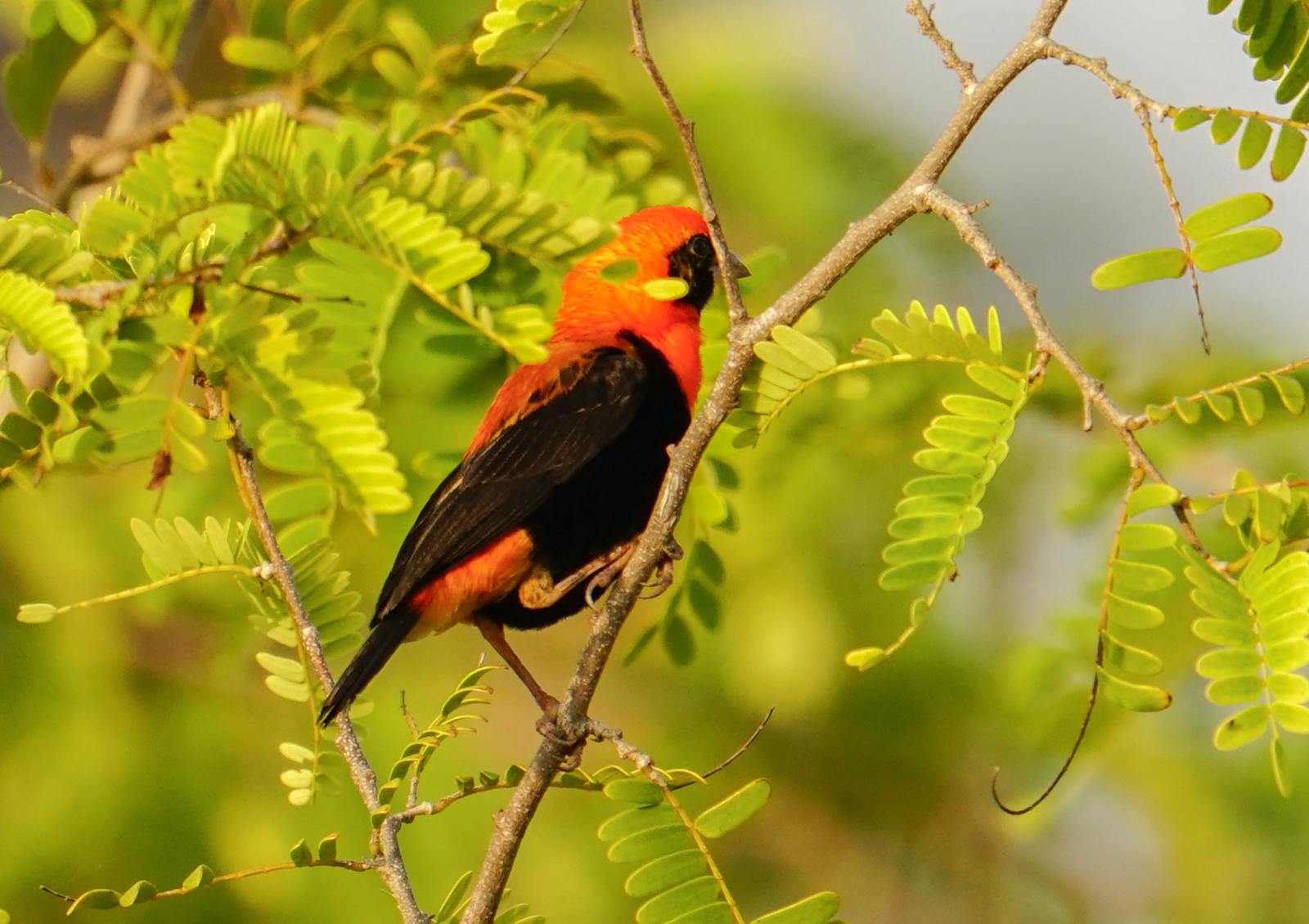
The Black-winged Bishop (Euplectes hordeaceus), also known as the Black-winged Red Bishop, is a small passerine bird belonging to the weaver family (Ploceidae). It is native to tropical Africa, where it occurs across a broad region extending from West Africa to Central and East Africa.
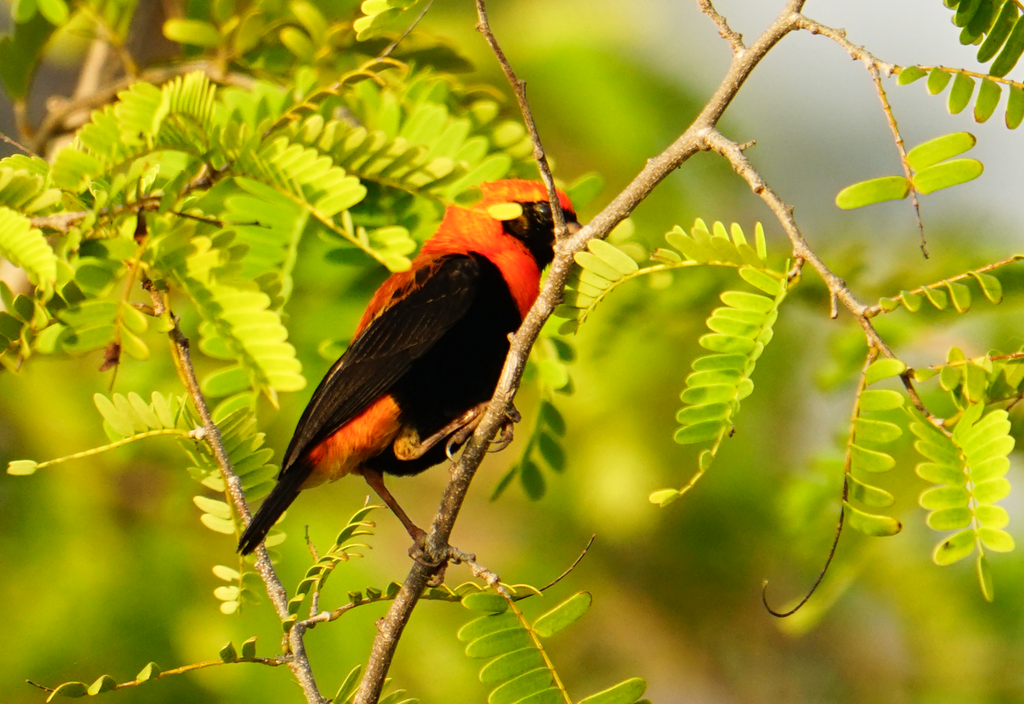
The adult breeding male is particularly distinctive, with bright reddish-orange to red plumage across the head and body, contrasting with its black wings and tail. Females and non-breeding males have much less conspicuous brownish and streaked plumage, helping them blend into grasses and surrounding vegetation.
The species generally inhabits open grasslands, cultivated fields, scrubland and areas with tall grasses, where it feeds mainly on grass seeds and other small food items. doi.org+2
Distribution and movement
Unlike many migratory birds recorded in the Maldives, the Black-winged Bishop is not considered a regular long-distance migrant. Its natural distribution is centred on tropical Africa, including countries such as Senegal, Nigeria, Ghana, Uganda, Kenya, Tanzania, Zambia and Mozambique.
Although some populations may move locally in response to rainfall, food availability and changes in grassland conditions, the species is generally classified as resident rather than migratory. The IUCN assessment also identifies its movement pattern as non-migratory. doi.org+1
Occurrence in the Maldives
A Black-winged Bishop was observed on Thoddoo in the Maldives. This is an unusual observation because the species’ established natural range is in Africa, thousands of kilometres away from the Maldives.
There is currently no established evidence that Black-winged Bishops undertake a regular migration route from Africa to the Maldives. Therefore, its appearance on Thoddoo should not automatically be considered a normal migratory arrival.
One possibility is that the bird escaped from captivity or was transported through human activities. The species is known to occur outside its native African range as an introduced bird, including in the United Arab Emirates. A rare natural occurrence cannot be completely ruled out, but there is insufficient evidence to establish how this individual reached the Maldives. iNaturalist+1
Conservation status
The Black-winged Bishop is classified as Least Concern (LC) on the IUCN Red List. Its global population is considered stable, and the species has a wide natural distribution across tropical Africa. DOI
Significance of the Thoddoo observation
The observation on Thoddoo is particularly interesting from a Maldivian biodiversity perspective. Since the species is not a regular migratory visitor to the Maldives, documenting its presence, photographs, date and behaviour could help establish whether it was an escaped bird, an introduced individual or an exceptionally unusual wild visitor.
Further observations from other Maldivian islands would help determine whether this was an isolated occurrence or whether additional individuals are present in the country.
References

Share a useful observation
Comments can help improve local knowledge. Share identification notes, island records, behaviour, host plants, or corrections respectfully.