
 Niyaz
Ardea purpurea | A Rare Migratory Heron of the Maldives
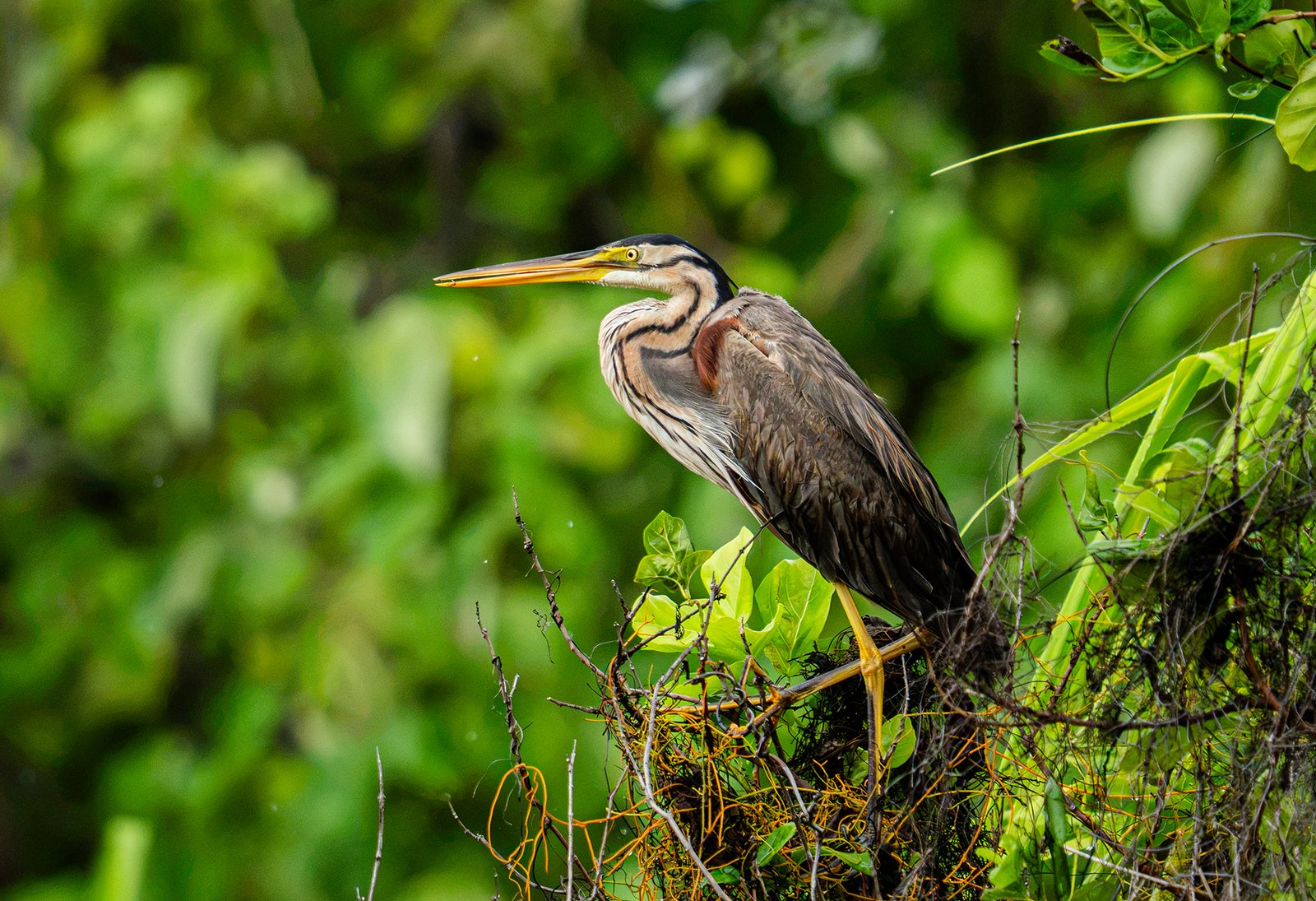
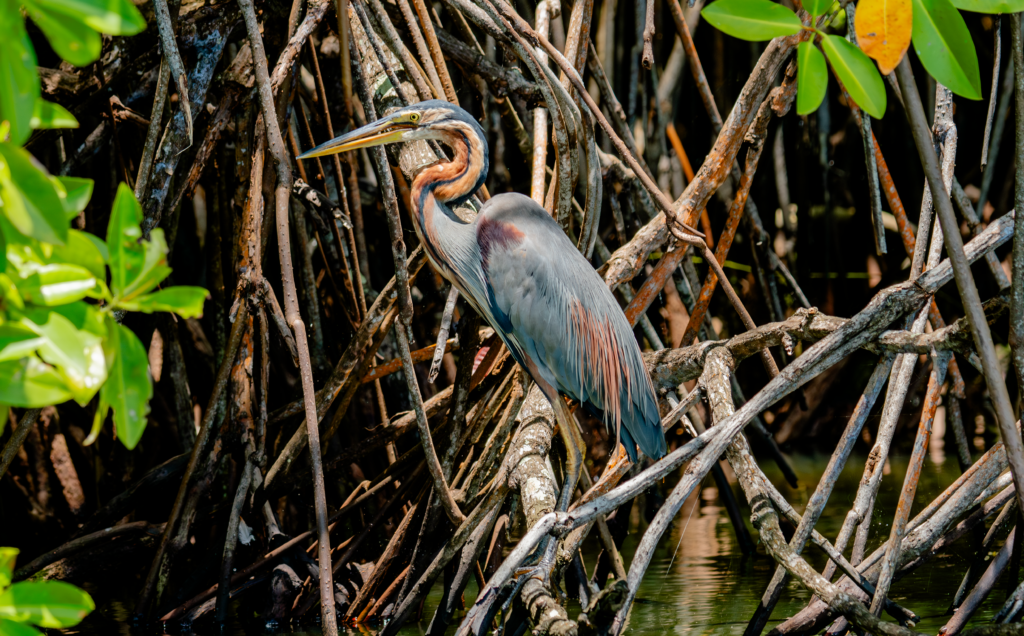
The Purple Heron (Ardea purpurea), locally known in Dhivehi as Dhanbu Maakana (ދަނބު މާކަނާ), is a large, slender wading bird belonging to the family Ardeidae. It is recognised by its distinctive reddish-brown neck, dark longitudinal neck stripes, greyish-purple upperparts, long pointed bill and slender body. The species is primarily associated with freshwater wetlands, marshes, reedbeds, mangroves, lakeshores and other shallow-water environments.
The Purple Heron has an extensive geographical distribution across Europe, Africa and Asia. While some populations remain in their breeding regions throughout the year, others undertake long-distance seasonal migrations between northern breeding grounds and warmer wetlands. These movements can involve journeys of several thousand kilometres, during which the birds depend on suitable habitats for feeding and resting.
In the Maldives, the Purple Heron is considered a rare northern winter visitor. It has been recorded from a limited number of locations across the archipelago, particularly in areas containing suitable wetland environments. Unlike the more frequently encountered Grey Heron (Ardea cinerea), locally known as Alhi Maakana, the Purple Heron is rarely observed in the country.
The species has been personally observed and photographed at L. Gan, near Maandhoo, Laamu Atoll, Maldives. Additional personal observations have been made on Mannar Island in northern Sri Lanka and at Muthurajawela Marsh near Negombo, Western Sri Lanka, where the species was also photographed.
These observations document the occurrence of the Purple Heron in three geographically separated wetland environments across the northern Indian Ocean region. They also highlight the ecological importance of freshwater marshes, vegetated wetlands and mangroves for resident and migratory waterbirds.
Classification
Description
The Purple Heron is a large but relatively slender waterbird, measuring approximately 78–97 centimetres in length and having a wingspan of about 120–152 centimetres.
Although similar in general appearance to the Grey Heron, the Purple Heron has a noticeably slimmer body, a longer and narrower neck, and more richly coloured plumage.
Adult Purple Herons have a distinctive reddish-brown or chestnut-coloured head and neck, marked by prominent black stripes extending down the sides of the neck. The crown is usually dark, and elongated feathers may form a small crest behind the head.
The upperparts are predominantly slate-grey, often showing subtle purplish or brownish tones. The shoulders and parts of the breast may display rich chestnut colouring, while the underparts are marked with dark streaks.
The bill is long, straight and sharply pointed, usually appearing yellowish or yellow-brown. The legs are long and slender, with colouring ranging from yellowish-brown to greenish-yellow.
These physical features are well suited to hunting in shallow water and dense aquatic vegetation. The bird’s narrow body allows it to move through reeds and other wetland plants, while its long neck enables it to strike rapidly at prey.
Juvenile Purple Herons are generally browner and less colourful than adults. Their plumage is often predominantly buff-brown, with darker markings on the neck and breast. The contrasting reddish-brown and black markings characteristic of adults develop as the birds mature.
In flight, the Purple Heron retracts its long neck into an S-shaped curve while extending its legs behind its body. Its broad wings produce slow, deliberate wingbeats, and the combination of dark grey wings and chestnut-brown body markings can help distinguish it from other herons.
The species’ darker plumage and elongated appearance are particularly useful for identifying it in wetland environments.
Distribution
The Purple Heron has a broad geographical distribution extending across Europe, Africa and Asia.
Its breeding range includes southern and central Europe, parts of Africa, the Middle East, the Indian subcontinent and large areas of southern and eastern Asia.
In Europe, the species breeds in countries including Spain, France, Italy, the Netherlands and parts of southeastern Europe. Many European populations migrate southwards towards sub-Saharan Africa during the northern winter.
In Africa, the Purple Heron occurs in suitable wetland habitats across several regions, with both resident and migratory populations.
In Asia, the species is distributed across India, Sri Lanka and parts of East and Southeast Asia. Some populations remain resident throughout the year, while others undertake seasonal movements between breeding and non-breeding areas.
The Purple Heron is found in wetlands across Sri Lanka and India, particularly in habitats containing shallow water, dense vegetation and abundant aquatic prey.
In the Maldives, the species is recorded as a rare migratory visitor. Its occurrence is associated with suitable wetland environments, although its complete distribution throughout the archipelago remains insufficiently documented.
Migration and Distance Travelled
The Purple Heron is a long-distance migratory bird in much of its range. However, migration behaviour differs considerably between populations.
Birds breeding in Europe and northern Asia generally migrate towards warmer regions following the breeding season, while many populations in tropical Africa and southern Asia remain resident or undertake shorter seasonal movements.
Migration from Europe to Africa
European Purple Herons commonly migrate southwards towards sub-Saharan Africa, particularly wetlands in the Sahel and other tropical African regions.
Their migration routes may cross southern Europe, the Mediterranean Sea, North Africa and the Sahara Desert before reaching suitable non-breeding habitats.
Scientific satellite-tracking research has revealed that Purple Herons can undertake remarkably long flights.
A study published in the journal Ardea in 2010 tracked seven Purple Herons during their migration from Europe towards the African Sahel.
The tracked birds travelled approximately 4,000 kilometres in five to seven days, while one individual completed an exceptional nonstop flight of approximately 5,600 kilometres, much of it over the sea.
These results demonstrate the species’ ability to cover enormous distances within relatively short periods, sometimes flying through the night and continuing across areas with limited opportunities to rest.
European populations generally begin leaving their breeding areas between July and October. Their return migration towards Europe takes place mainly during spring, particularly between March and May.
Migration in Asia
Purple Herons breeding in northern parts of Asia may migrate southwards towards warmer regions, including parts of southern China, Southeast Asia and the Indian subcontinent.
Migration routes in Asia differ from those followed by European populations. Birds from northern Asia may move south through inland wetlands, river valleys and coastal regions.
Some populations in India, Sri Lanka and tropical Southeast Asia are resident, while seasonal visitors may arrive from more northerly breeding regions.
Migration and the Northern Indian Ocean
The Maldives and Sri Lanka lie within a broader region used by numerous resident and migratory waterbirds.
Purple Herons recorded in the Maldives may represent migratory visitors or occasionally dispersing individuals from surrounding regions. However, their exact breeding origins and migration routes have not been scientifically established.
Although European Purple Herons are capable of travelling thousands of kilometres, tracking evidence indicates that their principal non-breeding destinations are in Africa.
It is therefore not possible to assume that Purple Herons observed in Sri Lanka, India or the Maldives have migrated directly from Europe.
The birds may belong to resident South Asian populations, migrants from northern Asian regions or other regional populations.
Determining the origins of individual Purple Herons visiting the Maldives would require scientific methods such as satellite tracking, bird ringing, genetic analysis or other migration studies.
The personal observations from Laamu Atoll, Mannar Island and Muthurajawela Marsh document the species in different parts of the northern Indian Ocean region, but do not establish that the same individual birds travelled between these locations.
Habitat
The Purple Heron is closely associated with wetland environments containing shallow water and dense vegetation.
Its preferred habitats include freshwater marshes, reedbeds, vegetated lakeshores, rivers, swamps, mangroves and occasionally coastal lagoons.
Unlike the Grey Heron, which frequently feeds in open coastal areas, the Purple Heron generally favours habitats where surrounding vegetation provides cover.
It is particularly well adapted to hunting among reeds, aquatic grasses and other wetland plants.
The bird’s elongated body, narrow neck and dark streaked plumage help it blend into dense vegetation, making it difficult to detect.
In the Maldives, suitable habitats include freshwater wetlands, mangrove forests, vegetated ponds and other shallow-water environments supporting fish and aquatic invertebrates.
Laamu Atoll contains several important wetland and mangrove ecosystems that provide habitat for resident wildlife and visiting migratory birds.
In Sri Lanka, wetland areas such as Muthurajawela Marsh and the coastal wetlands of Mannar provide extensive suitable environments for Purple Herons.
The preservation of these habitats is essential because the species depends on shallow water, aquatic vegetation and suitable prey populations.
Feeding and Behaviour
The Purple Heron is a carnivorous bird that feeds primarily on fish, amphibians, aquatic insects, crustaceans and other small animals.
Fish form an important part of its diet, although it is an opportunistic predator capable of consuming a wide variety of aquatic and terrestrial prey.
Its hunting technique generally involves standing motionless in shallow water or moving slowly through wetland vegetation.
When suitable prey comes within reach, the bird rapidly extends its long neck and strikes with its sharply pointed bill.
The Purple Heron may also walk carefully through dense reeds, watching for movement among aquatic plants.
The species is generally shy and secretive, often remaining hidden among vegetation for extended periods.
When threatened, it may stretch its neck upwards and remain motionless, using its body shape and plumage to blend with surrounding reeds.
If disturbed further, the bird may take flight and move to another secluded part of the wetland.
Purple Herons are frequently observed alone while hunting. However, they may gather in groups in suitable feeding areas or form colonies during the breeding season.
Their secretive behaviour and preference for dense vegetation make them more difficult to observe than many other herons.
As a result, the species may occasionally remain unnoticed even in wetlands where it occurs.
Breeding and Reproduction
The Purple Heron breeds in wetlands containing dense aquatic vegetation, particularly reedbeds, marshes and vegetated areas near lakes or rivers.
Breeding frequently occurs in colonies, although isolated nesting pairs may also occur.
The nest is generally a platform constructed from reeds, twigs, stems and other plant materials. It is usually positioned above shallow water or within dense vegetation.
Females typically lay three to five eggs, although clutch size can vary.
Both parents participate in incubation, which generally lasts approximately 25–30 days.
After hatching, the chicks remain in the nest and depend on their parents for food and protection.
Young Purple Herons generally become capable of flight after approximately six to seven weeks.
The timing of breeding varies across the species’ range, depending on geography, seasonal rainfall and wetland conditions.
In Europe, breeding typically occurs during spring and early summer. In tropical regions, breeding may be influenced by local wet and dry seasons.
There is no confirmed breeding population of Purple Herons in the Maldives.
The species is currently regarded as a rare migratory visitor, and sightings of individuals do not establish breeding activity.
Evidence such as occupied nests, eggs, dependent chicks or repeated nesting behaviour would be necessary to confirm breeding in the country.
Observations in the Maldives
The Purple Heron, locally known as Dhanbu Maakana, is regarded as a rare migratory bird in the Maldives.
Anderson and Shimal’s A Checklist of Birds of the Maldives (2020) classifies the species as a rare northern winter visitor.
Historical records indicate that Purple Herons have been encountered in several parts of the archipelago, particularly in southern atolls.
A review published in Forktail in 1995 referred to at least eight historical records involving groups of one to seven birds. Most of these records originated from Seenu Atoll, now commonly known as Addu Atoll.
The publication also documented a Purple Heron held in captivity on L. Hithadhoo, Laamu Atoll, on 12 November 1993. Although this historical record confirms the species’ presence in the atoll at that time, the original capture location of the bird was not established.
These historical records demonstrate that Purple Herons have been encountered in the Maldives for several decades, although their occurrence remains uncommon.
Personal Observation – Laamu Gan
The Purple Heron has also been personally observed and photographed on L. Gan, near the Maandhoo area, in Laamu Atoll, Maldives.
This observation provides a photographic record of the species in a region containing important freshwater and coastal wetland ecosystems.
Laamu Atoll supports a variety of wetland environments, including mangrove areas, freshwater ponds and vegetated coastal habitats.
Such environments provide shelter and feeding opportunities for herons and other migratory waterbirds.
The observation is particularly noteworthy because Purple Herons are rarely encountered in the Maldives compared with several other heron species.
The bird’s presence near Maandhoo highlights the importance of preserving suitable wetland habitats in Laamu Atoll.
Although the sighting documents the species at this location, the bird’s age, breeding origin, migration route and duration of stay were not determined.
Photographic documentation of rare species provides valuable evidence of their occurrence and can contribute to improving knowledge of the country’s bird diversity.
Occurrence in Other Maldivian Atolls
Published records indicate that Purple Herons have been observed in a limited number of locations across the Maldives.
Historical observations from Addu Atoll and Laamu Atoll provide evidence of the species occurring in southern parts of the archipelago.
However, the complete island-level distribution of the Purple Heron remains insufficiently documented.
The availability of freshwater wetlands, mangroves and other vegetated aquatic habitats may influence where the species is encountered.
Additional photographic records from wildlife photographers, birdwatchers and local communities may help establish a clearer understanding of its seasonal occurrence and geographical distribution throughout the Maldives.
Observations in Sri Lanka
In addition to the Maldives, the Purple Heron has been personally observed in Sri Lanka, particularly on Mannar Island in the Northern Province and at Muthurajawela Marsh near Negombo in the Western Province.
The species occurs more regularly in suitable Sri Lankan wetlands than in the Maldives, where it is considered rare.
Sri Lanka supports resident breeding Purple Herons, and the region may also receive seasonal migrants or dispersing individuals.
The observations from Mannar and Muthurajawela document the bird’s occurrence in two different wetland environments within Sri Lanka.
Personal Observation – Mannar Island
The Purple Heron has been personally observed on Mannar Island, in northern Sri Lanka.
Mannar Island is located off the northwestern coast of Sri Lanka and is characterised by coastal lagoons, wetlands, mudflats, mangroves, dry-zone vegetation and shallow-water habitats.
These environments support numerous resident and migratory waterbirds, including herons, egrets, storks, flamingos and shorebirds.
The Purple Heron is particularly associated with wetland areas containing aquatic vegetation and suitable prey.
The observation from Mannar Island documents the species in northern Sri Lanka, where extensive coastal and inland wetland habitats provide feeding and resting opportunities.
Unlike the Maldives, where the species is regarded as a rare visitor, Purple Herons are more regularly recorded in suitable wetland environments in Sri Lanka.
The Mannar observation forms part of the personal field records of the species across the northern Indian Ocean region.
Personal Observation – Muthurajawela Marsh, Negombo
The Purple Heron has also been personally observed and photographed at Muthurajawela Marsh, near Negombo, in the Western Province of Sri Lanka.
Muthurajawela is one of Sri Lanka’s most significant coastal wetland ecosystems. Together with the Negombo Lagoon, it forms an extensive network of marshes, waterways, mangroves, reedbeds and shallow-water habitats.
The wetland supports a rich diversity of wildlife, including numerous resident and migratory birds.
Purple Herons are among the waterbird species associated with the Muthurajawela wetland system. Historical ecological studies have also documented breeding locations of resident Purple Herons within the wider Muthurajawela–Negombo Lagoon wetland.
The species’ preference for densely vegetated marshes makes Muthurajawela particularly suitable for feeding, shelter and reproduction.
The personal observation and photographs from this wetland document the presence of the Purple Heron in an environment containing extensive aquatic vegetation and suitable feeding habitats.
The observation also demonstrates the ecological importance of large wetland systems in supporting herons and other waterbirds.
Field Observations Across the Northern Indian Ocean
The personal observations of Purple Herons from Laamu Atoll in the Maldives, Mannar Island in northern Sri Lanka and Muthurajawela Marsh near Negombo provide records of the same species occurring in three geographically separated wetland environments.
These observations highlight the importance of freshwater wetlands, coastal marshes, lagoons and mangroves for waterbirds throughout the northern Indian Ocean region.
While Purple Herons are rare visitors to the Maldives, the species is more regularly established in suitable wetland habitats in Sri Lanka.
The presence of the species at these locations does not necessarily indicate direct migration between them.
Purple Herons observed in Sri Lanka and the Maldives may belong to different populations, including resident regional birds and migrants arriving from more northerly breeding areas.
Understanding the relationships between these populations would require further scientific investigation.
Similar Species
The Purple Heron may be confused with other large herons recorded in the Maldives and Sri Lanka, particularly the Grey Heron (Ardea cinerea).
The Grey Heron is generally larger and more robust, with a thicker neck, predominantly grey upperparts and a pale head marked by a black stripe.
The Purple Heron has a slimmer body, longer and narrower neck, darker overall appearance and distinctive reddish-brown colouring along its head, neck and shoulders.
Its prominent black neck stripes and chestnut-coloured plumage are particularly useful identification features.
Juvenile Purple Herons can be more difficult to distinguish because their plumage is generally browner and less contrasting than that of adults.
The species may also be confused with some other large wetland birds when observed at a distance.
Reliable identification should consider body proportions, neck shape, bill structure, plumage, flight appearance and habitat preference together.
Ecological Importance
The Purple Heron plays an important role in wetland ecosystems as a predator of fish, amphibians, aquatic insects and other small animals.
Through its feeding activities, the species participates in the ecological relationships that regulate aquatic animal populations.
Its presence also highlights the availability of wetland habitats capable of supporting large waterbirds.
Wetlands provide important ecological services, including water storage, flood regulation, water filtration and habitat for diverse aquatic and terrestrial organisms.
In the Maldives, freshwater wetlands and mangroves are relatively limited compared with the country’s extensive marine habitats.
These ecosystems are therefore especially important for resident wildlife and migratory species that depend on shallow water and vegetation.
The occurrence of rare birds such as the Purple Heron demonstrates the ecological value of preserving these environments.
Wetland systems such as those in Laamu Atoll, Mannar Island and Muthurajawela Marsh support complex ecological communities and provide important feeding and resting habitats for waterbirds.
Protecting these environments benefits not only Purple Herons but also numerous other species of birds, fish, insects and aquatic organisms.
Conservation Status
The Purple Heron is classified as Least Concern (LC) on the IUCN Red List because of its extensive geographical distribution and substantial global population.
The IUCN’s 2019 global assessment estimated approximately 180,000–380,000 mature individuals worldwide, while identifying a decreasing overall population trend.
Although the species is not globally classified as threatened, several regional populations face conservation pressures.
Important threats include wetland drainage, habitat destruction, pollution, changes in water levels, fragmentation of marshes and the removal of dense aquatic vegetation.
Human disturbance near breeding colonies may also affect nesting success.
Because the Purple Heron depends heavily on wetlands, changes to these environments can reduce feeding opportunities, breeding habitat and suitable resting areas.
In the Maldives, the preservation of freshwater wetlands, mangroves and other vegetated aquatic habitats is important for supporting visiting herons.
Land reclamation, vegetation clearing, pollution and the modification of natural wetlands may reduce the availability of suitable habitats.
In Sri Lanka, wetland systems such as Muthurajawela face pressures associated with urban development, pollution and changes in surrounding land use.
Protecting these habitats is important for maintaining biodiversity and supporting both resident and migratory waterbirds.
Although the Purple Heron is globally listed as Least Concern, its rarity in the Maldives makes local observations and habitat conservation particularly valuable.
Importance of Field Observations
Wildlife photography and field observations are important tools for documenting rare migratory birds, particularly in regions where comprehensive long-term monitoring is limited.
Photographic records provide evidence of species occurrence and can help distinguish uncommon birds from similar-looking species.
For the Purple Heron, observations accompanied by clear photographs are particularly valuable because the bird is often secretive and difficult to detect in densely vegetated wetlands.
Recording observation dates, exact locations, habitat descriptions, feeding behaviour and the number of individuals present can improve the scientific value of these records.
Repeated observations at the same locations may help determine whether Purple Herons visit particular wetlands regularly or appear only occasionally.
Observations from the Maldives and Sri Lanka may also contribute to understanding the wider distribution and habitat preferences of the species within the northern Indian Ocean region.
Wildlife records submitted to biodiversity platforms such as iNaturalist and eBird can make observations available to researchers, conservation organisations and other naturalists.
The personal field observations from L. Gan near Maandhoo, Mannar Island and Muthurajawela Marsh provide useful records of Purple Heron occurrence in three different wetland environments.
Continued monitoring of these habitats may help improve knowledge of the species’ distribution, seasonal presence and conservation requirements.
References
- Anderson, R. C. & Shimal, M. (2020). A Checklist of Birds of the Maldives. Indian BIRDS Monographs, 3. Records the Purple Heron (Ardea purpurea), locally known as Dhanbu Maakana, as a rare northern winter visitor.
https://www.indianbirds.in/pdfs/IB_Mono3_Anderson_Shimal_Maldives.pdf - Ash, J. S. & Shafeeg, A. (1995). Birds of the Maldive Islands, Indian Ocean. Forktail, 10. Includes historical Purple Heron observations from Seenu Atoll and a captive bird recorded on L. Hithadhoo, Laamu Atoll, in November 1993.
https://static1.squarespace.com/static/5c1a9e03f407b482a158da87/t/5c1fb491f950b7ec9afa7cfc/1545581719038/Ash-Maldives.pdf - BirdLife International. (2019). Ardea purpurea – The IUCN Red List of Threatened Species. e.T22697031A154816177. Global conservation assessment, population estimate and trend.
https://doi.org/10.2305/IUCN.UK.2019-3.RLTS.T22697031A154816177.en - British Trust for Ornithology. Purple Heron – BirdFacts. Species identification, distribution, biology and conservation information.
https://www.bto.org/learn/about-birds/birdfacts/purple-heron - Heron Conservation. Purple Heron (Ardea purpurea) – Herons of the World. Distribution, habitat, feeding behaviour, reproduction and migration.
https://heronconservation.org/herons-of-the-world/list/purple-heron/ - van der Winden, J., Poot, M. J. M. & van Horssen, P. W. (2010). Large Birds Can Migrate Fast: The Post-Breeding Flight of the Purple Heron Ardea purpurea to the Sahel. Ardea, 98(3), 395–402.
https://doi.org/10.5253/078.098.0313 - EURING. European Bird Migration Atlas – Purple Heron. Migration routes, ringing recoveries and seasonal movements of European Purple Herons.
https://migrationatlas.org/node/1612 - Central Environmental Authority, Sri Lanka. National Wetland Directory of Sri Lanka. Information on the ecological significance and habitats of Muthurajawela Marsh and the Negombo estuary.
https://www.cea.lk/web/images/pdf/7-1.Book-National-Wetland-Directory-Low%20res%281%29.pdf - Netherlands Commission for Environmental Assessment. Environmental Profile of Muthurajawela and Negombo Lagoon. Includes historical ecological information and documented breeding locations of resident Purple Herons in the wetland system.
https://www.commissiemer.nl/docs/mer/diversen/pos_007-26_environmental_profile_muthurajawela_negombo_lagoon.pdf - Personal field observation and wildlife photographs – Maldives: Purple Heron (Ardea purpurea), L. Gan, near Maandhoo, Laamu Atoll, Republic of Maldives.
- Personal field observation – Sri Lanka: Purple Heron (Ardea purpurea), Mannar Island, Northern Province, Sri Lanka.
- Personal field observation and wildlife photographs – Sri Lanka: Purple Heron (Ardea purpurea), Muthurajawela Marsh, near Negombo, Western Province, Sri Lanka.
Article note: The Dhivehi name Dhanbu Maakana (ދަނބު މާކަނާ) and the species’ classification as a rare northern winter visitor in the Maldives are supported by published Maldivian bird references. The observations from Laamu Gan, Mannar Island and Muthurajawela Marsh are presented as personal field records.
Although Purple Herons are capable of travelling thousands of kilometres, the exact migration routes and breeding origins of individuals observed in the Maldives and Sri Lanka remain unknown. The European migration distances described in this article are based on tracked populations migrating towards Africa and should not be interpreted as confirmed migration distances for Purple Herons visiting the Maldives.

Share a useful observation
Comments can help improve local knowledge. Share identification notes, island records, behaviour, host plants, or corrections respectfully.