
 Niyaz
Niyaz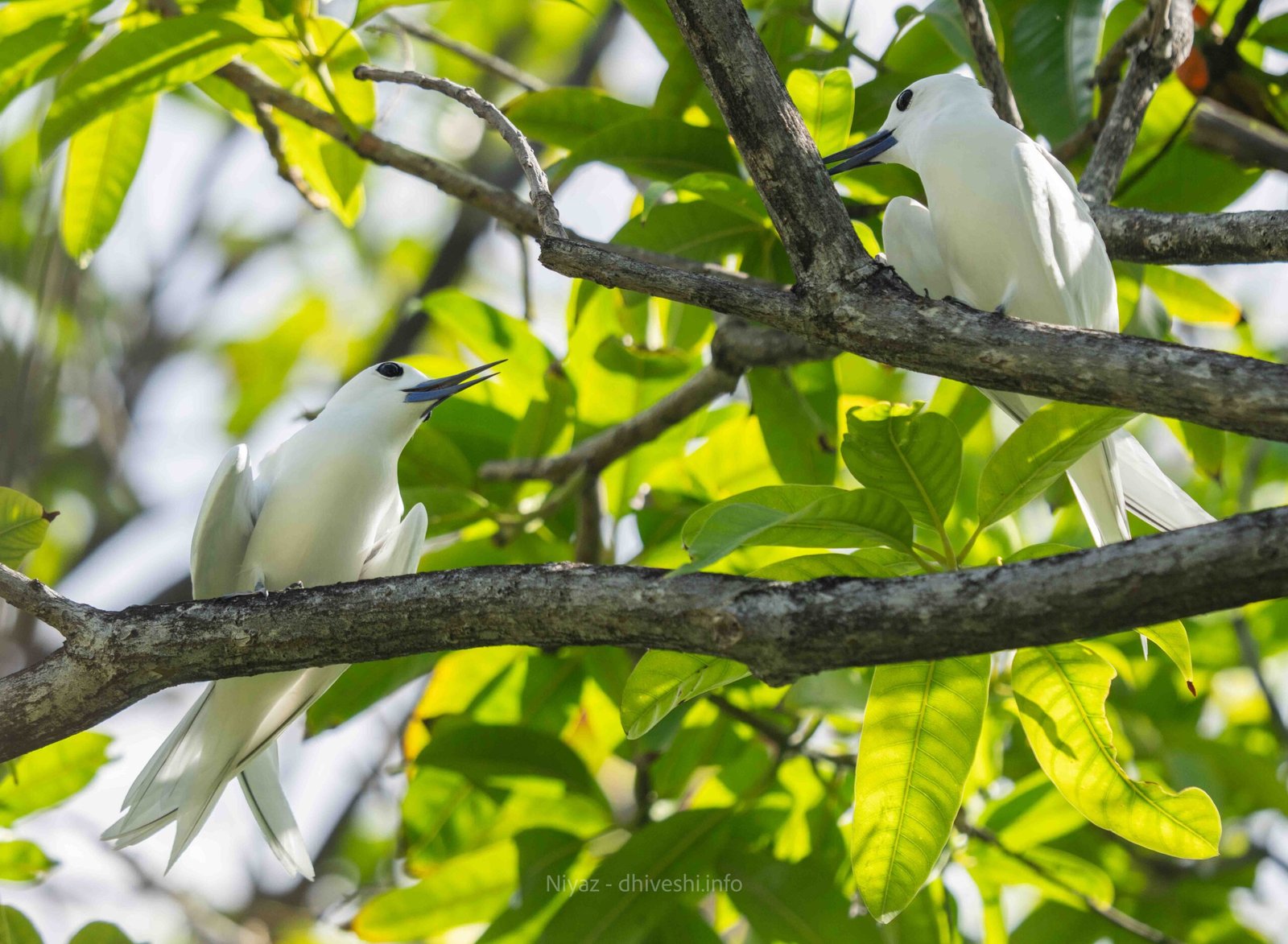
The Dhon Dheeni (ދޮންދީނި), known in English as the Blue-billed White-Tern, is a small, entirely white seabird belonging to the gull and tern family Laridae. It is recognised by its pure-white plumage, large dark eyes and sharply pointed bill, which has a noticeable blue base and dark tip. The species occurs across tropical and subtropical islands of the Indian and Pacific oceans.
In the Maldives, the Dhon Dheeni is most strongly associated with Addu Atoll, where it breeds throughout the atoll and has become an important symbol of southern identity. A breeding population is also established in Huvadhoo Atoll and is expanding among islands in Gaafu Dhaalu Atoll. During my recent field observations, I recorded Dhon Dheeni in GDh. Madaveli and GDh. Thinadhoo. I also observed a juvenile bird in Thinadhoo, providing direct evidence that the species is successfully reproducing on the island. All photographs accompanying this article were captured by me in GDh. Thinadhoo.
Taxonomy
The Dhon Dheeni belongs to the order Charadriiformes, family Laridae and genus Gygis. Its current scientific name is Gygis candida.
The bird was formerly included within a single widespread species called the White Tern, Gygis alba. Under that older classification, birds from the Indian and Pacific oceans were usually treated as Gygis alba candida. This is why many earlier publications and the 2025 Maldives national bird-status report use the name Gygis alba.
More recent international taxonomic treatments separate the former White Tern into the Atlantic White-Tern, Gygis alba; the Blue-billed White-Tern, Gygis candida; and the Little White-Tern, Gygis microrhyncha. The population occurring in the Maldives belongs to Gygis candida.
Identification
The adult Dhon Dheeni is almost completely white. Unlike many other terns, it does not have a black cap, grey back or strongly contrasting wing markings. Its wings are long and pointed, while the white tail is moderately long and forked. Under strong sunlight, the fine wing and tail feathers may appear slightly translucent.
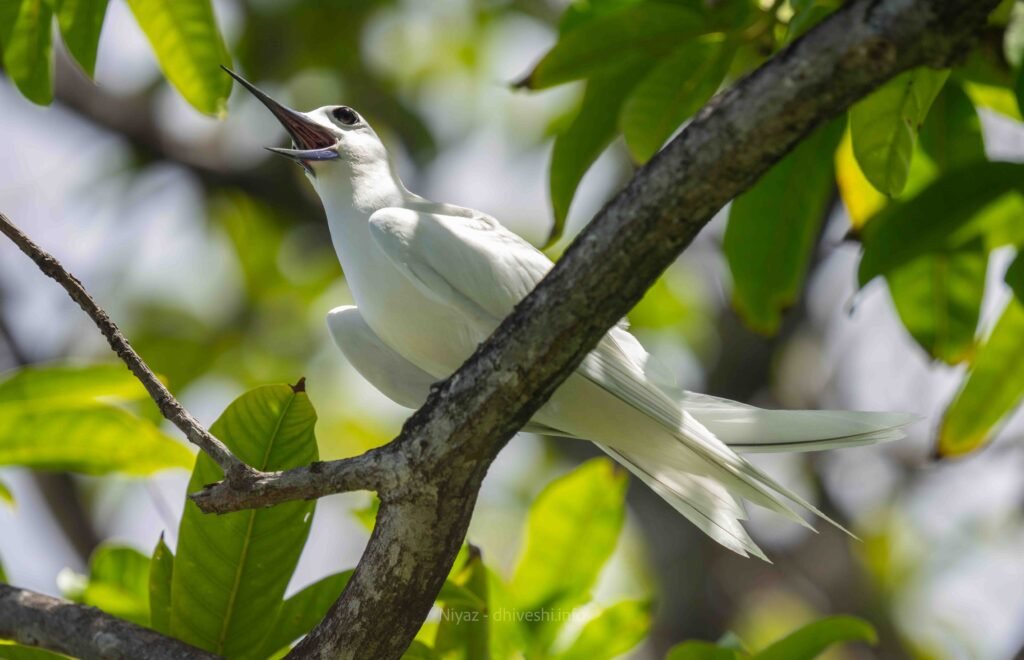
The eyes are unusually large, round and dark. A narrow black area around each eye makes them appear even larger and gives the bird its distinctive gentle expression. The bill is thick, straight and sharply pointed. Its outer section and tip are dark, while the base is blue or cobalt-blue. This blue colouring is clearly visible in my photographs from Thinadhoo, especially when the birds open their bills or turn their heads towards the light.
The legs and feet are generally bluish-grey. Male and female birds are very similar in external appearance and usually cannot be reliably separated through ordinary field observation or photographs.
Juvenile Dhon Dheeni are mainly white but differ from adults by having grey, brownish or blackish markings on the upperparts, particularly the wings and back. Young birds may also have a less strongly coloured bill and a shorter, less developed tail. As they mature, the darker juvenile markings are gradually replaced by pure-white adult plumage.
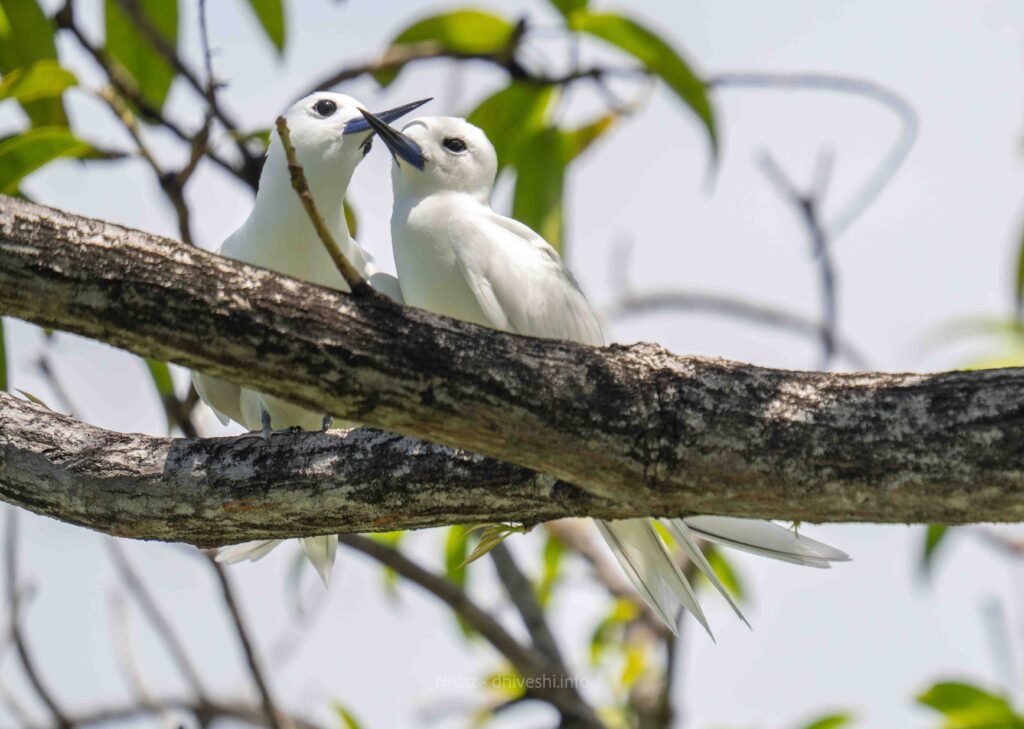
The adult birds shown in my accompanying photographs display different postures, including raised wings, extended necks and open bills, but they are all the same species. Their completely white plumage, large dark eyes and blue-based, black-tipped bills identify them as Blue-billed White-Terns.
Flight and calls
The Dhon Dheeni has a light, graceful and highly manoeuvrable flight. It can glide slowly between trees, hover briefly near branches and make sudden turns while flying above coastal waters. Its gentle wingbeats and frequent changes in direction give it the delicate, fluttering movement for which white terns are well known.
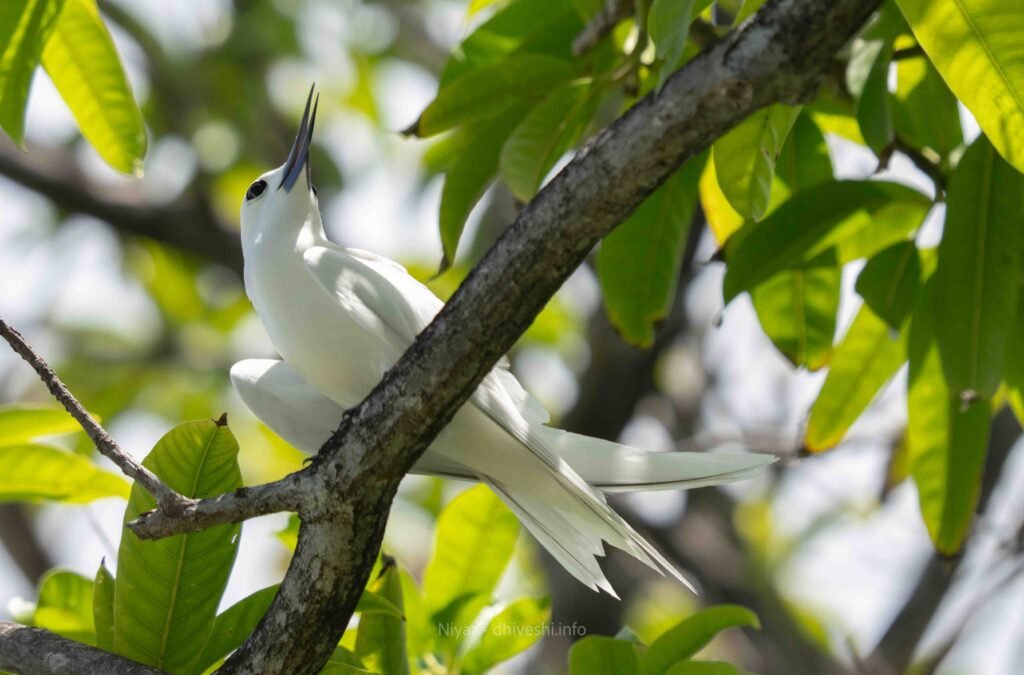
Around nesting and resting trees, birds may fly repeatedly between branches while calling to one another. They can occur alone, in pairs or in loose groups. Birds sitting together may face one another, raise their wings, extend their necks and open or cross their bills. These actions may be associated with communication, pair bonding, courtship or the defence of frequently used branches.
During my observations in Thinadhoo, I photographed adult birds resting together and interacting in mature trees. Some individuals held their wings partly raised while facing another bird, while others remained quietly on exposed branches beneath the tree canopy.
Global distribution and habitat
The Blue-billed White-Tern occurs across tropical and subtropical parts of the Indian and Pacific oceans. It breeds on low coral islands, volcanic islands and other oceanic islands that provide suitable trees or elevated surfaces.
The species is usually associated with wooded islands, coastal forests, mangroves and mature vegetation. However, it adapts well to inhabited areas when suitable trees are retained. It may breed in gardens, parks, school grounds, residential compounds and other developed locations. In some parts of its range, eggs are also laid on buildings, ledges and other artificial surfaces.
The birds forage over coastal waters, reef edges, shoals and offshore banks. They may also travel farther out to sea while searching for food. Unlike many seabirds that breed only on remote islands, the Dhon Dheeni can complete its entire breeding cycle close to houses, roads and other human activity.
Distribution in the Maldives
The confirmed breeding range of the Dhon Dheeni in the Maldives is concentrated in Addu and Huvadhoo Atolls. The 2025 national bird-status assessment estimated approximately 500 birds in Addu and between 100 and 200 birds in Huvadhoo. These figures are broad estimates based on available records and community interviews rather than complete population counts.
Historically, the species was reported mainly from Addu Atoll. A report published in 1964 described the bird as confined to Addu, where it bred in considerable numbers. Other historical accounts suggested that it became established in Addu during the twentieth century.
Outside Addu and Huvadhoo, Dhon Dheeni are regularly observed at sea around Fuvahmulah. Birds have also occasionally been recorded on the island itself. Rare observations have been reported from southern Haddhunmathi Atoll and isolated locations farther north, but these records are not presently known to represent established breeding populations.
Dhon Dheeni in Addu Atoll
Addu Atoll remains the main centre of the Dhon Dheeni population in the Maldives. The species breeds throughout the atoll and is regularly seen on inhabited islands including Hithadhoo, Maradhoo, Maradhoo-Feydhoo, Feydhoo, Gan, Hulhudhoo and Meedhoo.
The birds frequently breed within populated areas. Mature trees beside houses, roads, schools and public spaces provide suitable branches on which eggs can be laid. Individual pairs may repeatedly return to the same tree and sometimes to the same small depression or fork on a branch.
The national bird assessment reported that the species was formerly more abundant in Addu. The removal of mature trees for urban development has been identified as a possible cause of local decline, particularly on Gan and Feydhoo. House Crows have also become an important threat because they may disturb nesting adults and kill chicks.
Expansion into Huvadhoo Atoll
The Huvadhoo population represents an important expansion of the Dhon Dheeni’s Maldivian breeding range. According to accounts collected for the 2025 national bird assessment, local people reportedly moved Dhon Dheeni from Addu to GDh. Havodigalaa during the 1990s. Because this reported translocation has not been fully documented, it should be treated as a local historical account rather than a completely confirmed event.
A breeding population became established on Havodigalaa and later began colonising neighbouring islands. Breeding has been reported from GA. Hithaadhoo, GDh. Havodigalaa, GDh. Madaveli and GDh. Thinadhoo, with possible breeding on several other islands near Havodigalaa.
The movement of the birds into Madaveli and Thinadhoo shows that the species can successfully establish itself on inhabited islands when mature trees and suitable marine feeding areas are available. The population is no longer restricted to a single uninhabited island and is increasingly becoming part of the natural environment of communities in Gaafu Dhaalu Atoll.
My observations in Madaveli and Thinadhoo
During my recent field observations in Gaafu Dhaalu Atoll, I observed Dhon Dheeni in both Madaveli and Thinadhoo. In Thinadhoo, I recorded adult birds resting, calling, flying between trees and interacting in pairs. I also observed a juvenile Dhon Dheeni.
The presence of a juvenile is important because it supports the conclusion that breeding is occurring successfully on Thinadhoo. A young bird could move a short distance after fledging, but its presence within the island, together with local accounts of nesting in residential compounds and school grounds, provides strong evidence of an active local breeding population.
While carrying out my observations, I spoke with several Thinadhoo residents about the birds. They consistently told me that Dhon Dheeni breed in trees within numerous house compounds and in school garden areas. Residents were familiar with the birds nesting close to homes and described them as regularly occurring within the inhabited part of the island.
These local accounts agree with the national bird-status report, which identifies Thinadhoo as a confirmed breeding island. They also indicate that breeding is not limited to one isolated location. Instead, Dhon Dheeni appear to be using mature trees distributed through residential neighbourhoods, school compounds and other green areas across Thinadhoo.
All the Dhon Dheeni photographs accompanying this article were captured by me in GDh. Thinadhoo. The photographs document adult birds and their social behaviour, while my observation of a juvenile provides additional evidence of successful reproduction on the island.
I also observed the species in Madaveli, another confirmed breeding island. Continued field surveys in Madaveli, Thinadhoo and neighbouring islands will help document nesting trees, juvenile numbers, breeding success and the continuing expansion of the species within Huvadhoo Atoll.
Behaviour
Dhon Dheeni are usually observed alone, in pairs or in small, loose groups. They are less strongly colonial than many other tern species and do not normally form densely packed colonies. Different pairs may nevertheless breed in separate branches of the same tree or in several nearby trees.
Pairs form lasting bonds, and both adults participate in choosing the egg-laying position, incubating the egg and feeding the chick. Pair interactions may include calling, flying together, facing one another, raising the wings and touching or crossing bills.
The species shows strong attachment to successful breeding sites. Birds may return to the same tree, branch or shallow depression during later breeding attempts. This behaviour makes individual trees particularly valuable. The removal of one mature nesting tree can eliminate several branch positions that may have been used repeatedly over many years.
Diet and feeding
The Dhon Dheeni feeds mainly on small fish and occasionally squid. It searches for food over lagoons, reef edges, coastal waters, shoals and the open sea.
The bird often forages near tuna and other predatory fish. When larger fish drive baitfish towards the surface, the tern swoops down and takes the exposed prey. It usually catches food from or immediately above the water surface rather than making deep plunge-dives.
Adults may return to their young carrying several small fish arranged crosswise in the bill. The fish are delivered whole to the juvenile. The birds may forage during the day and can also be active in the lower light of dawn and dusk. The Maldives national assessment records fish and squid as their main food.
Breeding and nesting
The breeding behaviour of the Dhon Dheeni is unusual because it does not construct a nest. Instead, the female lays a single egg directly on a bare tree branch, fork, shallow depression in the bark, ledge or another surface where the egg can remain balanced.
The egg is usually pale grey or whitish with dark spots, streaks and irregular markings. These patterns provide some camouflage against tree bark. Both parents incubate the egg and carefully exchange positions without causing it to roll from the branch.
The egg may be placed on a branch as high as approximately 18 metres above the ground. Incubation generally lasts about 33–41 days, while the young bird may take approximately 31–67 days after hatching to become capable of flight. Breeding can occur throughout the year, although local peaks may be influenced by food availability.
The chick hatches with large feet, strong toes and sharply curved claws. These specialised features allow it to grip the branch despite the complete absence of a nest. A young chick usually remains close to the position where the egg was laid and grips tightly when the branch moves in the wind.
After fledging, the juvenile may continue to remain near the breeding tree and depend on its parents for food. Adults continue bringing fish while the young bird develops the flying ability and experience needed to forage independently. The juvenile I observed in Thinadhoo may have been at this post-fledging stage.
Nesting trees in the Maldives
Mature mango trees, locally called Anbu (Mangifera indica), and breadfruit trees, known as Banbukeyo (Artocarpus altilis), are documented nesting trees in the Maldives. Their large branches, rough bark, forks and shallow natural depressions provide suitable surfaces for balancing an egg.
The species has also been locally associated with Sea Cordia, known as Kaani (Cordia subcordata), and Alexander Laurel, known as Funa (Calophyllum inophyllum). Further observation of eggs, chicks and adult incubation is needed to document how frequently these tree species are used.
The information shared with me by Thinadhoo residents shows the importance of trees growing within private house compounds and school gardens. These planted and naturally occurring trees are not merely decorative greenery; they function as active seabird breeding habitat.
Old trees are especially valuable because they provide thick branches, sheltered areas and natural depressions that may not occur in younger trees. A single mature tree may provide several possible egg-laying positions and can be used repeatedly by the same pair or by different pairs over many years.
Conservation status
The Blue-billed White-Tern is regarded globally as a species of low conservation concern because it has a broad distribution across the Indian and Pacific oceans. However, individual island populations can remain vulnerable to habitat loss, introduced predators, storms and human disturbance.
Bird protection in the Maldives was extended under the Protected Species Regulation of 2021, which gives protected status to 207 bird species occurring, breeding, roosting or migrating within the country. The Dhon Dheeni is included among the protected birds assessed in the national bird-status report.
Although the species is not globally threatened, its Maldivian breeding population remains concentrated mainly in Addu and Huvadhoo. Protection of local nesting trees and breeding sites is therefore important for maintaining the species within the country.
Threats
The removal of mature trees is one of the most serious threats to Dhon Dheeni breeding on inhabited islands. Cutting or heavily pruning mango, breadfruit and other nesting trees can directly destroy eggs, chicks and frequently used breeding positions.
The accounts I collected in Thinadhoo show that many breeding sites occur within house compounds and school garden areas. This means that the survival of the local population partly depends on decisions made by homeowners, schools, island authorities and development planners. Removing trees without first checking for eggs or chicks could cause breeding failure.
House Crows, locally called Kaalhu, may disturb nesting adults, take eggs or kill chicks. Crow predation has been specifically reported as a threat to the Addu population. Cats and rats may also threaten birds using lower branches, although many Dhon Dheeni select exposed branches that are difficult for mammalian predators to reach.
Strong winds and storms can dislodge eggs because they are balanced directly on branches. Newly hatched chicks are also vulnerable, although their strong feet and claws allow them to hold tightly as they grow.
Human disturbance may cause additional breeding failure. Cutting an occupied branch, handling a healthy chick, attempting to move an egg or repeatedly approaching an active breeding position can disturb the adults. A juvenile or chick resting securely on a branch should normally be left undisturbed unless it is clearly injured or in immediate danger.
Conservation
Protecting mature nesting trees is the most effective local action for conserving the Dhon Dheeni. Trees containing eggs, chicks or dependent juveniles should not be cut or heavily pruned until the breeding attempt has ended.
Frequently used trees in Thinadhoo, Madaveli and other breeding islands could be identified and mapped. Schools and homeowners could record the dates when adults begin using a branch, when an egg appears, when the chick hatches and when the juvenile first flies. Such community observations would provide valuable information about the breeding period and success of the Huvadhoo population.
Before clearing land or removing mature trees, surveys should be carried out to check for active breeding sites. New mango, breadfruit, Kaani, Funa and other suitable trees can be planted, but replacement trees may take many years to develop branches appropriate for egg-laying. Protecting existing mature trees is therefore more immediately valuable than relying only on new planting.
Regular surveys are needed to document the continuing spread of Dhon Dheeni through Huvadhoo. Photographs of eggs, chicks, juveniles, adults carrying fish and repeated occupation of particular branches can help confirm breeding when the island, location and date are accurately recorded.
Cultural significance
The Dhon Dheeni is one of the most recognisable birds of the southern Maldives. It is especially important in Addu, where it is widely regarded as a symbol of the atoll and is closely connected with local identity and pride.
Its pure-white plumage is commonly associated with purity, while its lasting pair bonds and shared parental care are associated with loyalty and commitment. Its habit of nesting peacefully within island communities has also created a close relationship between the bird and people living around its breeding trees.
The growing population in Huvadhoo is extending this relationship to new communities. In Thinadhoo, the birds now breed among homes, schools and gardens, where residents regularly see adults, chicks and juveniles. My observations and conversations with local residents show that the Dhon Dheeni is becoming an established and familiar part of the island’s natural environment.
The continued survival and expansion of this distinctive seabird will depend on protecting mature trees, reducing disturbance, managing introduced predators and documenting new breeding sites. The juvenile I observed in Thinadhoo represents a new generation of Dhon Dheeni and provides encouraging evidence that the species is successfully establishing itself in Gaafu Dhaalu Atoll.
All photographs accompanying this article were captured by me in GDh. Thinadhoo, Maldives.

Share a useful observation
Comments can help improve local knowledge. Share identification notes, island records, behaviour, host plants, or corrections respectfully.