
 Niyaz
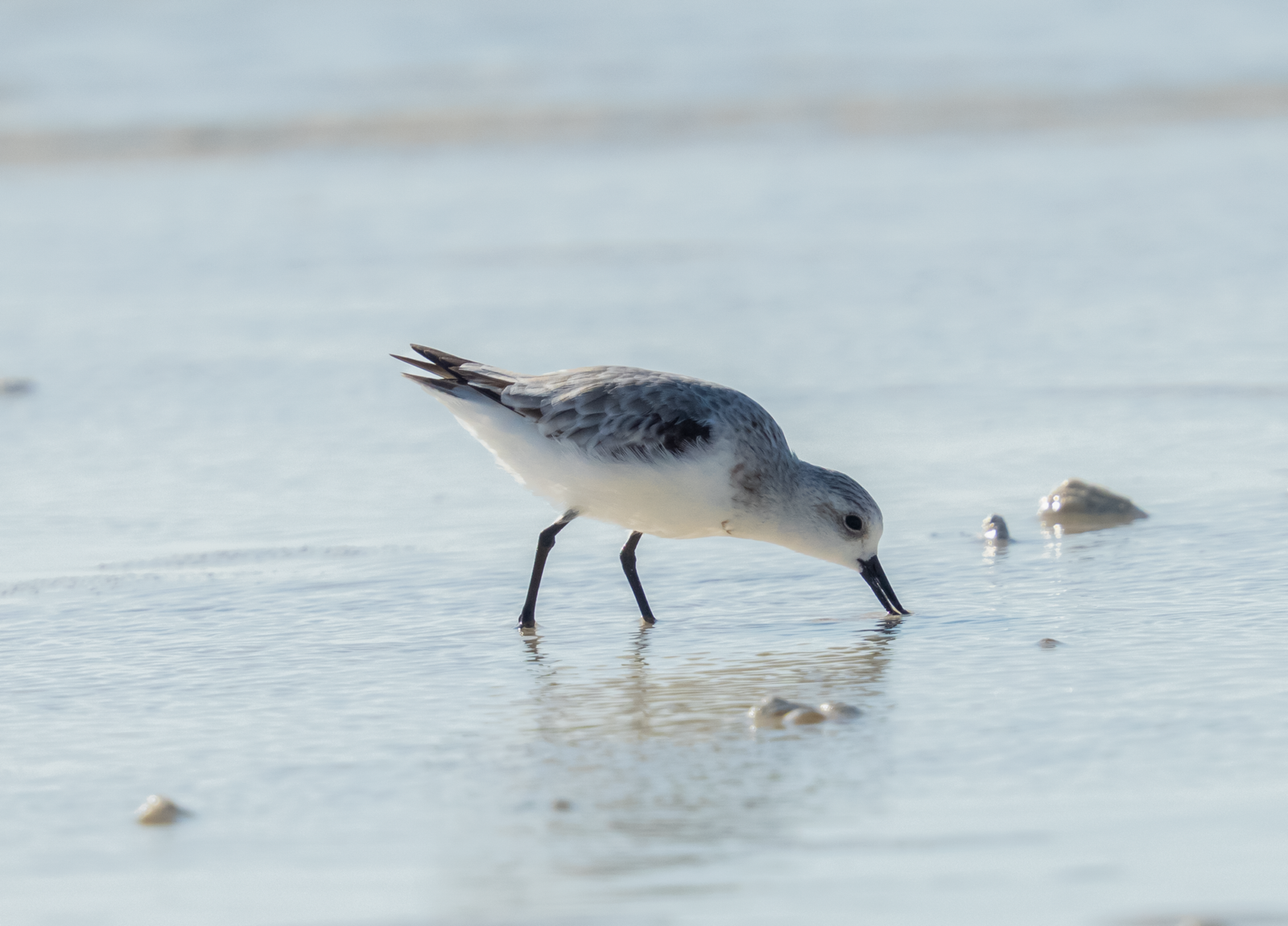
Calidris alba | A migratory shorebird of the Maldives
The Sanderling (Calidris alba), known in Dhivehi as Kirudushin Ilolhi (ކިރުދުށިން އިލޮޅި), is a small migratory shorebird belonging to the family Scolopacidae. It is recognised by its pale grey upperparts, white underparts, short black bill, black legs and distinctive habit of running along sandy shorelines in search of food.
The Sanderling is one of the world’s most widely distributed migratory shorebirds. It breeds in the high Arctic regions of North America, Greenland and northern Eurasia, travelling thousands of kilometres to temperate and tropical coastal environments during the non-breeding season.
The species is particularly associated with sandy beaches, tidal flats and shallow coastal waters. It is frequently observed running towards and away from breaking waves, searching for small marine invertebrates exposed by the retreating water.
In the Maldives, the Sanderling is recorded as an uncommon northern winter visitor. It uses suitable sandy shorelines and shallow coastal habitats for feeding and resting during migration and the non-breeding season. The species is also included in the list of migratory waterbirds associated with the Maldives under the African-Eurasian Waterbird Agreement (AEWA). AEWA
One of the most remarkable characteristics of the Sanderling is its long-distance migration. Individuals can travel several thousand kilometres between their Arctic breeding grounds and wintering areas, with some completing annual round-trip journeys exceeding 20,000 kilometres.
Classification
Description
The Sanderling is a small, plump shorebird measuring approximately 18–20 centimetres in length. It has a compact body, relatively short neck, small rounded head and medium-length black legs.
Its bill is short, straight and black, making it well suited for picking small invertebrates from wet sand and shallow coastal sediments.
One of the species’ most distinctive anatomical features is the absence of a hind toe, known as the hallux. Unlike most other sandpipers, the Sanderling has only three toes on each foot. This characteristic is associated with its ability to move rapidly across sandy shorelines.
During the non-breeding season, adult Sanderlings have pale grey upperparts, a mostly white head and white underparts. A darker patch is often visible around the shoulder, near the bend of the folded wing.
In flight, the bird displays a prominent, broad white wing stripe bordered by darker feathers. This feature is particularly useful when identifying Sanderlings in flight.
During the breeding season, the species develops considerably darker and more colourful plumage. The head, breast and upperparts become reddish-brown or sandy-brown, with a mixture of pale and dark feather markings. The underparts remain predominantly white.
Juvenile Sanderlings generally resemble non-breeding adults but have more strongly patterned upperparts, with black-and-white feather markings and a darker, streaked crown. Some individuals also display buff-coloured patches on the breast.
The pale non-breeding plumage seen in Sanderlings visiting tropical beaches helps distinguish them from many other migratory shorebirds. Calidris Alba
Distribution
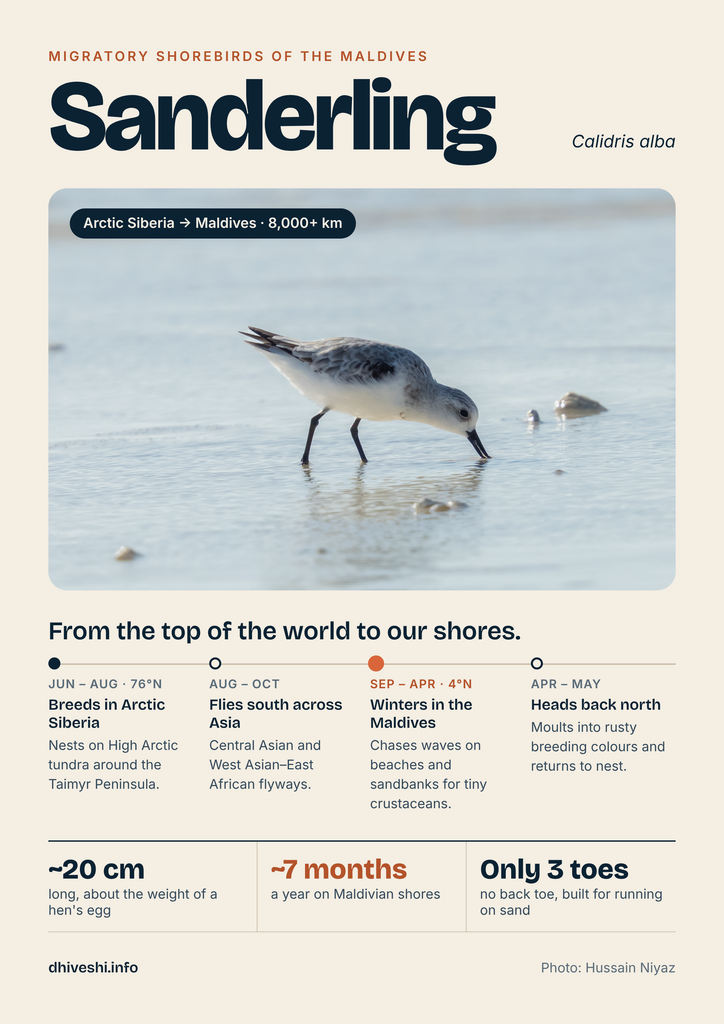
The Sanderling has an extensive global distribution and occurs along coastlines on every continent except Antarctica.
It breeds in high Arctic regions, including Greenland, northern Canada, Svalbard and parts of northern Russia and Siberia.
Outside the breeding season, Sanderlings migrate towards coastal regions of Europe, Africa, Asia, Australia and the Americas.
The species is strongly associated with marine coastlines during migration and winter, especially open sandy beaches where wave action exposes food.
In the Indian Ocean region, Sanderlings occur along suitable coastlines of India, Sri Lanka, the Maldives and other coastal areas.
The Maldives provides suitable feeding and resting habitats through its natural sandy beaches, exposed tidal flats, lagoon margins and other shallow coastal environments.
However, the exact geographical origins of Sanderlings visiting the Maldives are not fully established. Determining their breeding populations and migration routes would require scientific tracking, ringing studies or other specialised research.
Migration and Distance Travelled
The Sanderling is an exceptional long-distance migrant. Each year, it travels between breeding grounds in the high Arctic and non-breeding coastal habitats located thousands of kilometres farther south.
Its migration occurs twice annually. After breeding during the northern summer, Sanderlings migrate south towards warmer coastlines. They later return north to breed during the following Arctic summer.
Typical one-way migration
3,000–10,000 km
Depending on breeding and wintering locations
Exceptional annual round trip
Up to 32,000 km
Reported for some exceptionally long-distance migrants
Research on Sanderlings breeding in northeast Greenland has documented annual migration distances ranging from approximately 3,700 to 22,200 kilometres among tracked or individually identified populations. Other published accounts report exceptional annual round trips reaching approximately 32,000 kilometres. These figures describe different studied populations and should not be interpreted as the distance travelled by every Sanderling. PubMed Central (PMC)+2
Sanderlings usually begin leaving their Arctic breeding grounds between July and September. Their southward migration takes them towards coastal areas where suitable feeding habitats remain available during the northern winter.
Northward migration generally begins between March and June, depending on the population and location. The birds return to Arctic breeding habitats as seasonal conditions improve.
During migration, Sanderlings may stop at several coastal locations to rest and replenish energy reserves. These stopover habitats are important because long-distance flights require substantial energy.
Some Sanderlings undertake exceptionally long flights between stopover sites. Research on birds wintering in Namibia has documented northward nonstop flights of approximately 7,500 kilometres. besjournals
The Maldives forms part of the broader Indian Ocean region used by migratory shorebirds. Its sandy beaches and intertidal environments can provide suitable resting and feeding habitats.
However, the precise migration distance travelled by an individual Sanderling visiting the Maldives cannot be determined from its location or appearance alone. Such information would require tracking or identifying the bird’s breeding origin.
These remarkable journeys demonstrate how a relatively small bird, weighing only around 50–60 grams, can travel across enormous geographical distances during its annual life cycle.
Habitat
The Sanderling is primarily associated with open sandy coastal environments. During the non-breeding season, it is most frequently found along beaches where waves regularly wash over the sand.
Its preferred habitats include sandy beaches, tidal sand flats, shallow lagoons, intertidal shorelines, sandbars and occasionally muddy or rocky coastal areas.
Unlike many other sandpipers that frequently forage in muddy wetlands, the Sanderling is particularly adapted to feeding in the wave-washed zone of sandy beaches.
In the Maldives, suitable habitats include natural white-sand beaches, shallow lagoon margins and exposed intertidal areas surrounding the islands.
These environments provide feeding opportunities when tidal movements and wave action expose small marine organisms.
The availability of relatively undisturbed coastlines is important for Sanderlings, especially during migration when birds must feed frequently to replenish energy reserves.
Feeding and Behaviour
The Sanderling feeds primarily on small invertebrates found in wet sand and shallow coastal water. Its diet includes small crustaceans, marine worms, molluscs, insects and other organisms.
The species is especially famous for its distinctive feeding behaviour along the shoreline.
As waves retreat, Sanderlings run quickly towards the exposed wet sand, searching for organisms brought close to the surface. When another wave approaches, they rapidly move back up the beach before returning to feed.
This repeated movement creates the appearance of the birds chasing waves along the shoreline.
The Sanderling uses its short, straight bill to pick prey from the surface or probe shallow sand. It can feed individually or in groups, occasionally gathering in large flocks where food is abundant.
During the non-breeding season, Sanderlings may also associate with other migratory shorebirds, including stints, sandpipers and plovers.
When disturbed, they often take flight together, displaying their prominent white wing stripes before settling at another location along the coast.
The species spends much of its time feeding, particularly when suitable intertidal areas are exposed. At high tide, birds may gather in resting groups on undisturbed beaches and sandbars. Animal Diversity Web+1
Breeding and Reproduction
The Sanderling breeds in the high Arctic tundra during the short northern summer, generally between June and July.
Its breeding habitats include open gravelly areas, sparsely vegetated tundra, stony ridges and relatively dry ground near freshwater wetlands.
The nest is usually a shallow depression on the ground, sometimes lined with moss, lichen, leaves or other available vegetation.
Females generally lay three to four eggs, which are naturally camouflaged against the surrounding ground.
The incubation period lasts approximately three to four weeks. After hatching, the chicks are covered in downy feathers and are capable of walking and searching for food shortly afterwards.
The young remain dependent on parental protection during their early development.
After completing the breeding season, adult Sanderlings and their young gradually leave the Arctic and begin their southward migration.
The species does not have an established breeding population in the Maldives. Birds visiting the country are regarded as migrants or non-breeding visitors. Animal Diversity Web+1
Observations in the Maldives
The Sanderling, known in Dhivehi as Kirudushin Ilolhi, is recorded in the Maldives as an uncommon northern winter visitor.
Anderson and Shimal’s A Checklist of Birds of the Maldives (2020) includes the species among the country’s migratory shorebirds. whale-and-dolphin.com
Earlier published observations document Sanderlings from several locations in the Maldives. These include an individual observed at the airfield on S. Gan, Addu Atoll, on 9 September 2001, and observations from V. Anbara in Vaavu Atoll during February 2004.
The Vaavu observations included one bird on 9 February 2004 and two individuals on 20 February 2004. These records provide evidence of the species occurring in both southern and central parts of the archipelago. ResearchGate
The accompanying personal wildlife photograph shows a Sanderling actively feeding in shallow coastal water. The bird has pale grey upperparts, predominantly white underparts, a black bill and dark legs, consistent with its non-breeding plumage.
The photograph also captures its characteristic feeding posture, with the body leaning forward and the bill directed into the shallow water while searching for food.
The exact island and observation date associated with this photograph have not yet been specified.
Although Sanderlings are recorded from the Maldives, their local distribution and seasonal abundance remain comparatively less documented than those of several other migratory shorebirds.
Additional observations from different islands, particularly those accompanied by photographs, dates and habitat descriptions, would help improve knowledge of the species’ occurrence in the country.
Similar Species
The Sanderling can be confused with several other small migratory sandpipers found in the Maldives.
The Little Stint (Calidris minuta) is generally smaller and has a finer bill, while the Dunlin (Calidris alpina) typically has a longer bill that curves slightly downward.
The Curlew Sandpiper (Calidris ferruginea) is generally more slender and longer-legged, with a noticeably longer, downward-curved bill.
In comparison, the Sanderling has a compact, plump body, a relatively short and straight black bill, black legs and pale grey-and-white non-breeding plumage.
Its lack of a hind toe is an especially distinctive anatomical feature, although it may be difficult to observe in photographs.
The broad white wing stripe visible during flight and its characteristic wave-following feeding behaviour are also useful identification features.
Sanderlings may occur alongside plovers, including Kentish Plovers and Tibetan Sand Plovers. However, plovers belong to the family Charadriidae, whereas the Sanderling belongs to the sandpiper family Scolopacidae. Avifauna of Hong Kong+1
Ecological Importance
The Sanderling plays an important role in coastal ecosystems through its feeding interactions with marine invertebrates.
By consuming small crustaceans, worms, molluscs and other organisms, it forms part of the food web of sandy beaches and intertidal habitats.
Its presence can also indicate the availability of suitable feeding areas for migratory shorebirds.
Because the Sanderling travels between Arctic breeding regions and tropical or temperate coastlines, it depends on a network of habitats spread across several countries and continents.
The loss or degradation of important stopover sites can affect birds even when those habitats are located thousands of kilometres away from their breeding grounds.
The occurrence of Sanderlings in the Maldives illustrates the ecological connections between the country’s tropical coastal environments and distant northern regions.
Maintaining healthy beaches, lagoons and intertidal habitats therefore contributes to the conservation of migratory wildlife that depends on these environments.
Conservation Status
The Sanderling is classified as Least Concern (LC) on the IUCN Red List, based on its extensive geographical distribution and relatively large global population.
The 2024 IUCN assessment estimates approximately 900,000–1,200,000 mature individuals worldwide. However, the assessment also identifies an overall decreasing population trend, with differences between regional populations. DOI
Important conservation threats include coastal development, habitat degradation, pollution, human disturbance and changes affecting food availability.
Activities such as beach reclamation, construction, intensive recreational use and disturbance by vehicles may reduce suitable feeding and resting areas.
Climate change may also affect Sanderling populations through changes in Arctic breeding habitats, sea levels and coastal ecosystems.
In the Maldives, protecting natural sandy shorelines and intertidal environments is important for supporting migratory shorebirds.
Reducing unnecessary disturbance in areas used by feeding and resting birds can help ensure that suitable habitats remain available during migration and the non-breeding season.
Although the Sanderling does not breed in the Maldives, the country’s coastal environments may contribute to the wider network of habitats used during its annual migration.
Importance of Field Observations
Wildlife photography and field observations are valuable tools for documenting migratory bird species, particularly in regions where comprehensive long-term monitoring is limited.
Photographic records of Sanderlings can provide information about their occurrence, distribution, plumage, feeding behaviour and the habitats they use.
Because the species undergoes seasonal changes in plumage, photographs taken at different times of the year may also help document changes associated with migration and breeding cycles.
Repeated observations from the same islands may help determine whether Sanderlings regularly return to particular feeding grounds or occur only occasionally.
Recording observation dates, island names, flock sizes, habitats and feeding behaviour would increase the scientific value of these records.
Observations submitted to biodiversity platforms such as iNaturalist and eBird may also contribute to regional and international knowledge of migratory shorebirds.
In the Maldives, continued documentation of Sanderlings and other migratory birds can improve understanding of how the country’s sandy beaches, lagoons and coastal wetlands support wildlife travelling across vast geographical distances.
References
- Anderson, R. C. & Shimal, M. (2020). A Checklist of Birds of the Maldives. Indian BIRDS Monographs, 3. Maldives bird checklist
- BirdLife International. (2024). Calidris alba. The IUCN Red List of Threatened Species 2024: e.T22693369A154671400. IUCN conservation assessment
- Reneerkens, J., et al. (2020). Low Fitness at Low Latitudes: Wintering in the Tropics Increases Migratory Delays and Mortality Rates in an Arctic Breeding Shorebird. Journal of Animal Ecology. Migration distance research
- Kent Wildlife Trust. Sanderling (Calidris alba). Migration, appearance and behaviour
- Royal Society for the Protection of Birds (RSPB). Sanderling – Bird Guide. Species identification and habitat
- Animal Diversity Web, University of Michigan. Calidris alba – Sanderling. Biology, reproduction and migration
- Agreement on the Conservation of African-Eurasian Migratory Waterbirds (AEWA). Maldives Country Species Information. Migratory waterbird records
- Convention on the Conservation of Migratory Species of Wild Animals (CMS). Sanderling – Calidris alba. Species profile
- Maldivian bird identification reference: Sanderling (Calidris alba), Dhivehi name ކިރުދުށިން އިލޮޅި, northern winter visitor, uncommon; supplied reference excerpt. Publication details not yet identified.
- Personal field photograph: Sanderling (Calidris alba), feeding in shallow coastal water in the Maldives. Observation location and date not specified.

Share a useful observation
Comments can help improve local knowledge. Share identification notes, island records, behaviour, host plants, or corrections respectfully.