
 Niyaz
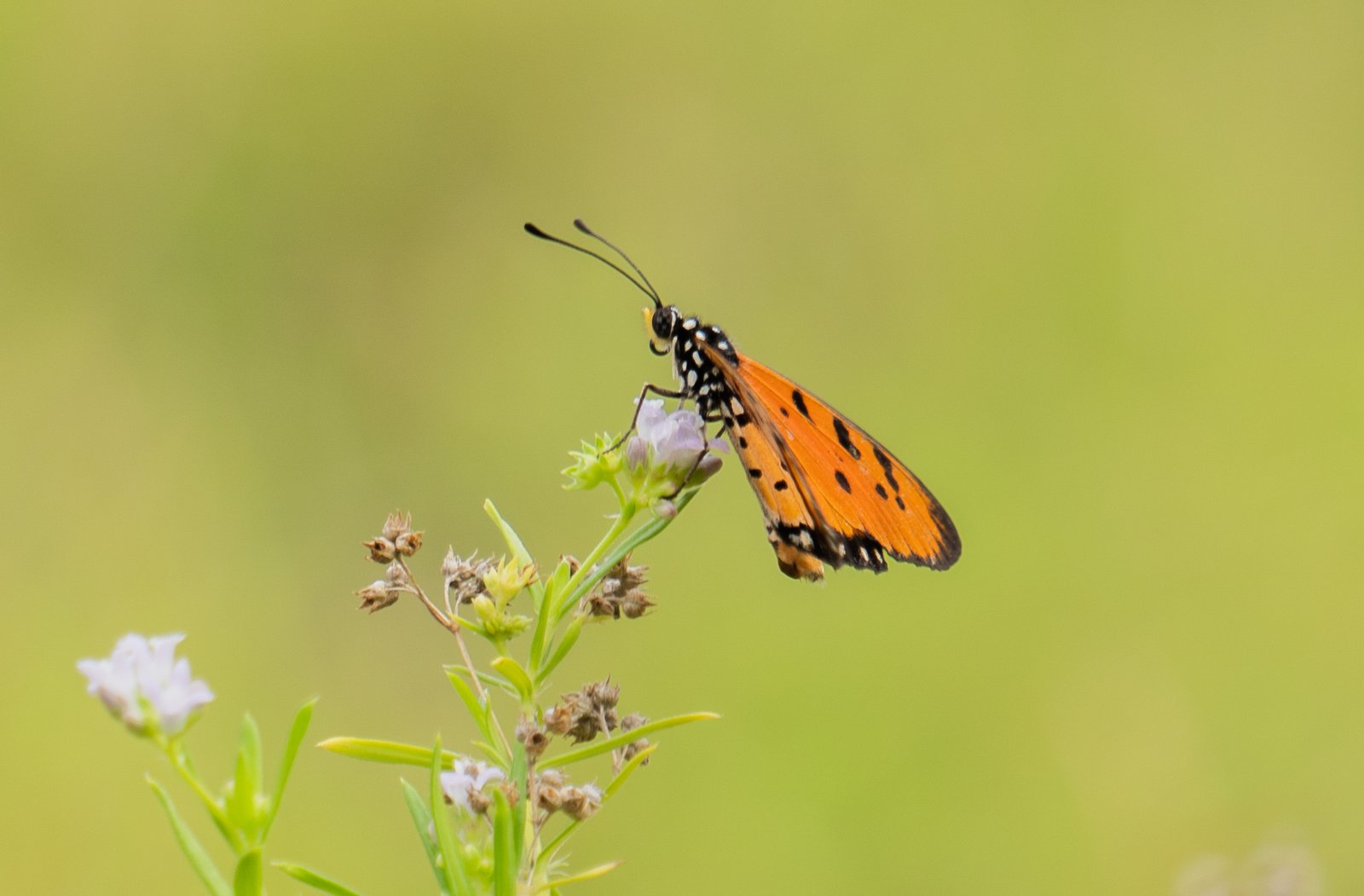
The Tawny Coster (Acraea terpsicore), locally known in Dhivehi as Orange Kokaa (އޮރެންޖް ކޮކާ), is a medium-sized butterfly belonging to the family Nymphalidae. It is distinguished by its orange or reddish-orange wings marked with numerous black spots, contrasting black-and-white wing borders and a dark body covered with pale markings.
The species is widely distributed across the Indian subcontinent and parts of Southeast Asia, occurring in countries such as India, Sri Lanka, Bangladesh, Myanmar, Thailand, Malaysia and Singapore. Its geographical range has expanded into other parts of Southeast Asia and northern Australia.
The Tawny Coster is generally associated with open grasslands, gardens, roadsides, coastal vegetation, scrubland and other habitats where flowering plants and suitable larval host plants are available. It is particularly recognised for its slow, fluttering flight and its habit of resting on low-growing vegetation while feeding on nectar.
The species has been personally observed and photographed at several locations in the Maldives, including Haa Alifu Baarah, Haa Dhaalu Kulhudhuffushi, Haa Dhaalu Hanimaadhoo and Shaviyani Funadhoo. The same species has also been personally observed on Mannar Island in northern Sri Lanka. These records document the butterfly’s occurrence in different island environments within the northern Indian Ocean region.
Classification
Description
The Tawny Coster is a medium-sized butterfly with a wingspan generally ranging from approximately 50 to 65 millimetres. Its wings are relatively long and narrow, with a characteristic orange or reddish-orange upper surface decorated with numerous black spots.
The forewings have dark outer margins and irregularly arranged black spots. The hindwings display broader black borders containing a series of pale or white markings. These features give the butterfly a distinctive appearance and help distinguish it from other orange-coloured butterfly species.
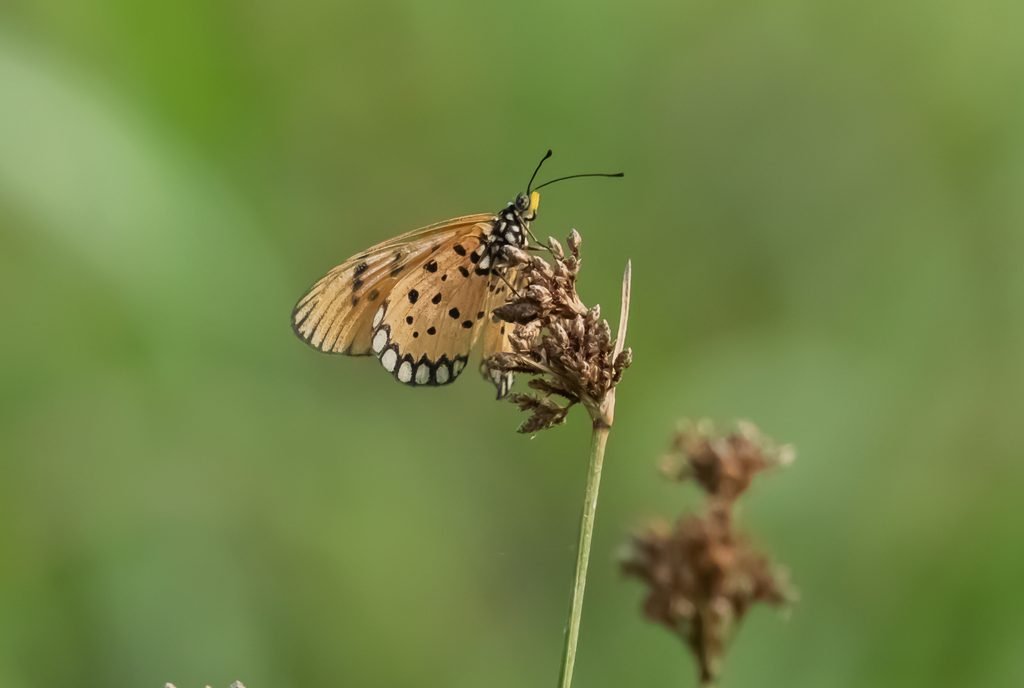
The undersides of the wings are generally paler than the upper surfaces, displaying yellowish-orange, cream or light brown shades. Black spots remain visible, while the white markings along the outer margins of the hindwings are often particularly prominent.
The body is predominantly black, with conspicuous white spots on the thorax and abdomen. The antennae are slender and dark, ending in slightly enlarged clubs.
Male Tawny Costers generally display brighter orange or reddish-orange wings, while females may be noticeably paler, sometimes appearing yellowish or brownish-orange. However, colour intensity varies between individuals and may also be affected by age, wing wear and environmental conditions.
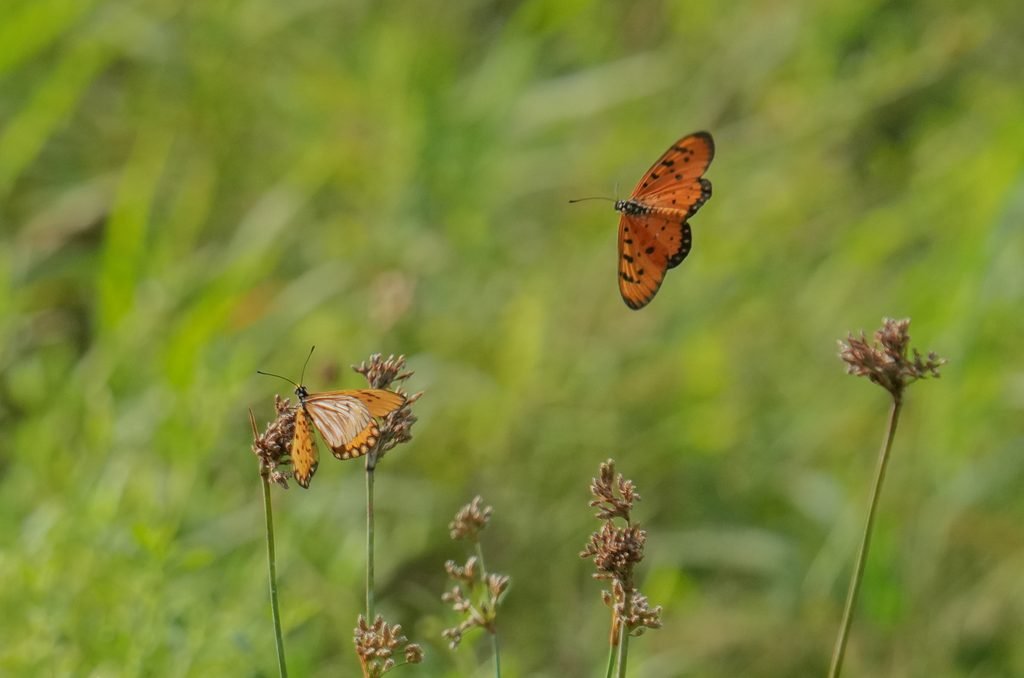
The photographs taken in the Maldives illustrate differences in wing colour and appearance. One individual displays bright orange wings with prominent black markings, while another shows paler, more translucent wings. Such differences may reflect natural variation, sex or wing condition, although these characteristics cannot be determined conclusively from photographs alone.
Distribution
The Tawny Coster is widely distributed across South and Southeast Asia. Its historical distribution was centred largely on the Indian subcontinent, including India and Sri Lanka, although the species has subsequently expanded into additional regions.
It is recorded in Bangladesh, Myanmar, Thailand, Vietnam, Malaysia, Singapore and other parts of Southeast Asia. More recently, populations have become established in northern Australia.
Scientific research has documented the geographical expansion of the Tawny Coster and examined the ecological factors influencing its spread. The species is considered capable of colonising suitable habitats outside its former range, particularly where its larval host plants are present.
The Tawny Coster occurs in both mainland and island environments. Its presence in Sri Lanka, the Maldives and other islands of the Indian Ocean region demonstrates its ability to occupy geographically separated habitats.
However, observations from different islands do not necessarily establish the direction or timing of dispersal between locations. Further research would be required to determine the historical origin, population connectivity and movement patterns of Tawny Costers occurring in the Maldives.
Habitat
The Tawny Coster primarily inhabits open environments with grasses, herbaceous plants, low shrubs and flowering vegetation. It is commonly found in grasslands, gardens, roadsides, disturbed vegetation, scrubland, coastal areas and forest clearings.
Unlike butterflies associated with dense forest interiors, the Tawny Coster is frequently observed in open, sunlit environments where suitable flowers and larval host plants occur.
In the Maldives, suitable habitats include island gardens, open grassy areas, coastal vegetation, roadside plants and vegetation surrounding wetlands.
On Mannar Island in northern Sri Lanka, the species may use comparable open habitats, including coastal scrublands, grasslands and other areas containing flowering plants. The specific habitat associated with the personal Mannar observation has not been documented here.
The availability of suitable larval host plants is important for reproduction, while adult butterflies depend on nectar-producing flowers for food.
The Tawny Coster’s ability to occupy open and human-modified environments has contributed to its success in several parts of its geographical range.
Feeding and Behaviour
Adult Tawny Costers primarily feed on nectar from flowering plants. They use their long, coiled proboscis to extract nectar while perched on flowers or flowering stems.
The species is particularly recognised for its relatively slow, fluttering flight. Individuals commonly move at low heights above grasses and other vegetation, occasionally gliding short distances before landing.
Tawny Costers frequently spend extended periods resting on flowers, grasses and low-growing plants. During feeding, they may remain on a single flowering stem for a considerable time before moving to another nearby plant.
The species possesses chemical defences that make it distasteful to certain predators. Its conspicuous orange-and-black coloration functions as a warning signal, discouraging potential attacks.
These defensive characteristics help explain why Tawny Costers can display comparatively slow and conspicuous flight behaviour rather than relying entirely on rapid escape.
The butterfly is commonly observed individually or in small numbers, although groups may gather in areas containing abundant flowering plants or suitable habitat.
Life Cycle and Reproduction
The Tawny Coster undergoes complete metamorphosis, consisting of four developmental stages: egg, larva, pupa and adult.
Female butterflies lay eggs on or near suitable larval host plants, particularly members of the passionflower family, Passifloraceae.
After hatching, the caterpillars feed on the leaves and tender shoots of the host plants. The larvae generally have elongated bodies covered with rows of branched spines, which provide protection against potential predators.
The caterpillars pass through several growth stages before forming pupae. After completing development, adult butterflies emerge from the pupae and begin feeding, dispersing and eventually reproducing.
Documented host plants include Passiflora foetida, Passiflora suberosa and other suitable passionflower species.
The availability of these plants strongly influences the ability of Tawny Coster populations to establish and reproduce in particular locations.
Although adult butterflies have been personally photographed at several locations in the Maldives, the observations described here do not independently confirm breeding at those sites. Records of eggs, caterpillars, pupae or oviposition would provide stronger evidence of local reproduction.
Observations in the Maldives
The Tawny Coster, locally known as Orange Kokaa, has been personally observed and photographed at several locations in the northern Maldives, including H.A. Baarah, H.Dh. Kulhudhuffushi, H.Dh. Hanimaadhoo and Sh. Funadhoo.
These observations document the presence of the species across three northern atolls: Haa Alifu, Haa Dhaalu and Shaviyani.
The photographs show individuals resting on flowering plants and low-growing vegetation. One photograph captures a brightly coloured orange individual with prominent black spots and contrasting wing margins, while another shows a noticeably paler individual with more translucent wings.
These differences demonstrate natural variation in appearance, although the photographs alone do not conclusively establish whether the individuals differ in sex, age or wing condition.
The observations also highlight the importance of terrestrial vegetation in the Maldives, particularly flowering herbs, grasses, gardens and open coastal environments that provide feeding and resting habitats for butterflies.
Although the records establish the presence of Tawny Coster at the observed locations, additional surveys would be required to determine its overall distribution, seasonal abundance and breeding status throughout the Maldives.
Continued photographic documentation by wildlife photographers and naturalists can help improve knowledge of terrestrial insects, a group that remains relatively less documented than marine wildlife in the Maldives.
Observations in Sri Lanka
In addition to the Maldivian observations, the Tawny Coster has also been personally observed on Mannar Island, in northern Sri Lanka.
Mannar Island lies off Sri Lanka’s northwestern coast and is characterised by dry-zone vegetation, coastal scrub, grasslands, wetlands and open landscapes. These environments provide suitable habitats for many butterfly species, including those associated with low-growing vegetation and flowering plants.
The observation from Mannar adds a further geographical location to the personal field records of the Tawny Coster, extending them beyond the Maldives to the northern part of Sri Lanka.
The species is already recognised as part of Sri Lanka’s butterfly fauna and is documented by the Butterfly Conservation Society of Sri Lanka. Its recorded larval host plants in the country include Passiflora foetida and Passiflora suberosa, among other species. slbutterflies.lk
The observations from the Maldives and Mannar Island demonstrate that the Tawny Coster occurs in island environments separated by considerable distances across the northern Indian Ocean region.
However, these records do not establish direct migration or population movement between Sri Lanka and the Maldives. Additional ecological and genetic studies would be necessary to investigate possible relationships between populations.
Ecological Importance
The Tawny Coster contributes to terrestrial ecosystems through its interactions with flowering plants and other organisms.
Adult butterflies regularly visit flowers for nectar and may transfer pollen between plants while feeding, contributing to pollination.
The caterpillars are herbivorous and depend on suitable host plants for their growth and development. Their interactions with these plants form part of broader ecological relationships involving insects, vegetation and predators.
Butterflies can also provide useful information about environmental conditions because their occurrence and abundance are influenced by habitat quality, vegetation and the availability of food plants.
In small island environments such as the Maldives, natural vegetation, coastal scrub, flowering herbs and open green spaces provide important habitats for butterflies and other insects.
The observations of Orange Kokaa from multiple Maldivian islands, together with Mannar Island in Sri Lanka, demonstrate the value of documenting terrestrial biodiversity across different island environments.
Conservation
The Tawny Coster has a broad distribution across South and Southeast Asia and has expanded its range into additional regions.
The species has not been confirmed as globally assessed by the IUCN Red List. Nevertheless, it is considered relatively common in several parts of its range, particularly in suitable open habitats. Pierre Wildlife
At the local level, its populations depend on the availability of flowering plants, suitable larval host plants and undisturbed vegetation.
Habitat clearance, excessive pesticide use, the removal of flowering plants and changes in land use may reduce the availability of suitable habitats.
In the Maldives, preserving natural vegetation, allowing beneficial flowering plants to grow and reducing unnecessary pesticide application may help maintain favourable conditions for Orange Kokaa and other butterfly species.
Further surveys are needed to determine the butterfly’s population trends, reproductive activity and conservation requirements within the Maldives.
Importance of Field Observations
Wildlife photography and field observations contribute valuable information to the documentation of species distribution, particularly in regions where comprehensive biodiversity surveys are limited.
Photographic records of the Tawny Coster from Baarah, Kulhudhuffushi, Hanimaadhoo, Funadhoo and Mannar Island provide evidence of its occurrence at geographically separate locations.
Repeated observations across different seasons may help establish whether local populations are continuously present, seasonally abundant or occasionally established following dispersal events.
Photographs documenting mating, egg-laying, caterpillars, pupae or newly emerged adults would provide additional evidence of local breeding activity.
Recording observation dates, precise habitat types and the plants used by adult butterflies or caterpillars would also improve the scientific value of these records.
Public biodiversity platforms such as iNaturalist can support this documentation by allowing observations to be shared, identified and incorporated into wider biodiversity datasets.
The personal observations from the Maldives and northern Sri Lanka therefore provide a useful foundation for further investigation of the Tawny Coster’s occurrence and ecology in island environments.
References
- National Parks Board, Singapore. Tawny Coster (Acraea terpsicore) – Flora & Fauna Web. Species description, habitats and host plants
- Butterfly Conservation Society of Sri Lanka. (2026). Tawny Coster (Acraea terpsicore) – The Story of Sri Lankan Butterflies. Sri Lankan species records and life cycle
- GBIF Secretariat. Tawny Coster – Acraea terpsicore (Linnaeus, 1758). Taxonomic information
- Department of Forest Education, India. (2023). Titli – The Dancing Wings. Tawny Coster species account, p. 40. Butterfly field guide
- Sheikh, T. & Parey, S. H. (2019). Taxonomic Treatment of Acraea terpsicore. Taxonomic description and distribution
- Personal field observations and photographs, Maldives: H.A. Baarah; H.Dh. Kulhudhuffushi; H.Dh. Hanimaadhoo; and Sh. Funadhoo.
- Personal field observation, Sri Lanka: Mannar Island, Northern Province.

Share a useful observation
Comments can help improve local knowledge. Share identification notes, island records, behaviour, host plants, or corrections respectfully.