
 Niyaz
Niyaz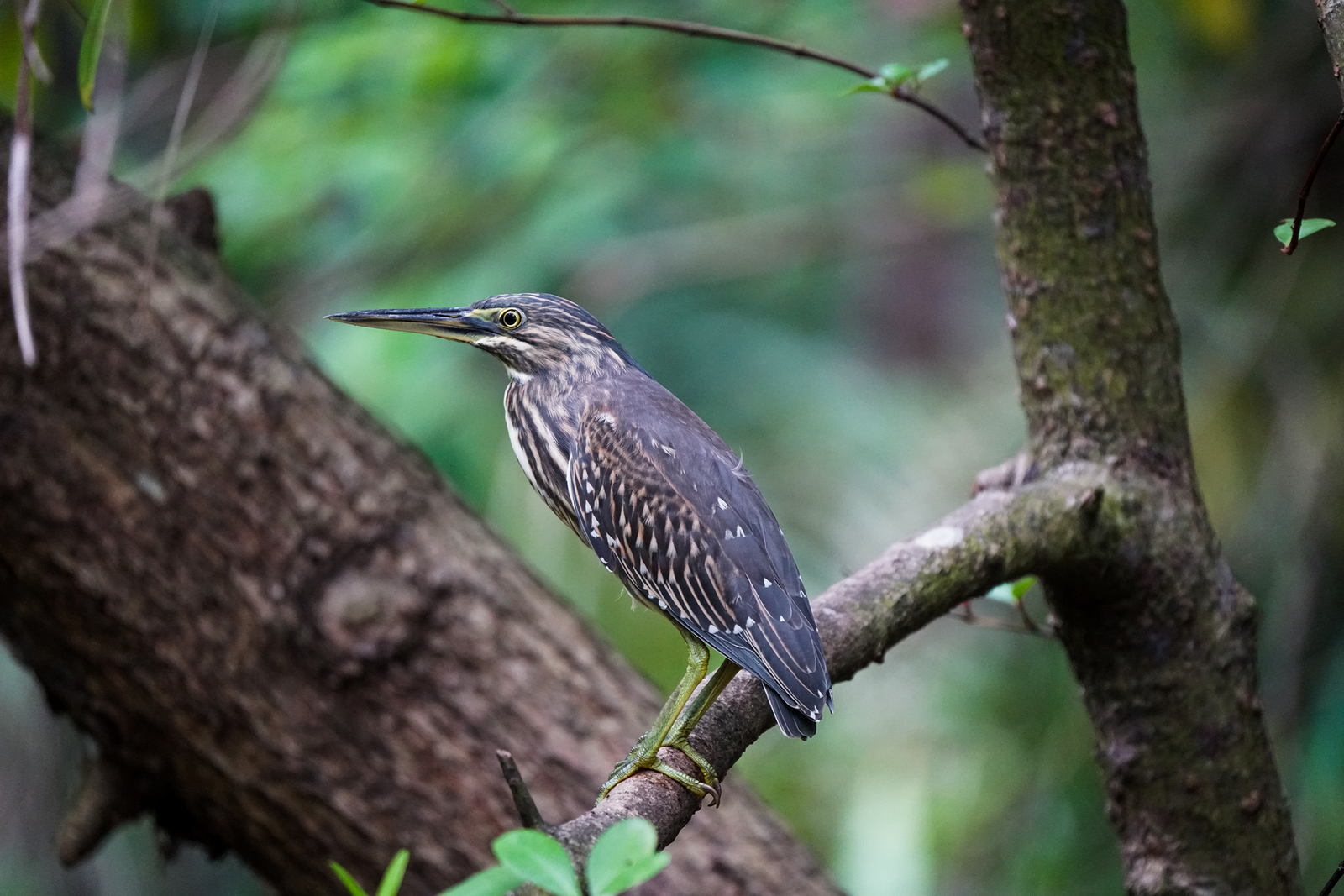
The Little Heron (Butorides atricapilla) is a small waterbird belonging to the heron family. In the Maldives, it is locally known as ދިވެހި ރާބޮނދި — Dhivehi Raa’bondhi. It is usually found around mangroves, wetlands, lagoons, reef flats and quiet coastal areas.
Older books and Maldivian records may identify this bird as the Striated Heron (Butorides striata), Green-backed Heron or Mangrove Heron. Current IOC, Clements and eBird classifications recognise Old World populations as the Little Heron (Butorides atricapilla).
Description
The Little Heron is a small and compact heron, usually around 40 to 45 centimetres in length. It has a relatively short neck, short legs and a long, straight, sharply pointed bill. When resting, the bird usually pulls its neck close to its body, giving it a crouched appearance.
Adult birds generally have a dark grey or blackish crown, grey to blue-grey wings and back, and paler grey or whitish underparts. A narrow pale stripe is often visible along the throat. The eyes are yellow, while the legs may appear yellowish, greenish-yellow or olive. Males and females are similar in appearance.
Juvenile
Juvenile Little Herons look noticeably different from adults. Young birds are mainly dark brown or grey-brown above and have prominent pale streaks running down the head, neck, breast and underparts. Their dark wing feathers are marked with cream-coloured spots and pale edges.
Juveniles retain the species’ long, narrow bill, yellow eyes and greenish legs. As they mature, the heavy streaking and spotted wing pattern gradually disappear and are replaced by the smoother grey plumage of the adult.
A juvenile can sometimes be confused with a young night heron or pond heron. However, the Little Heron is generally smaller and more compact, with a slimmer bill, shorter legs and darker, more strongly patterned wings.
Distribution and habitat
The Little Heron occurs widely across tropical and subtropical regions of the Old World. Its range extends from sub-Saharan Africa and the Middle East through South and Southeast Asia to Japan, Australia and numerous islands of the Indian and Pacific oceans.
It inhabits both freshwater and marine environments. Typical habitats include mangrove forests, marshes, lakes, rivers, forest streams, tidal creeks, lagoons, rocky shores and coastal wetlands. It is also capable of using artificial ponds, drainage channels, harbour walls and other human-modified water bodies.
In the Maldives, the Dhivehi Raa’bondhi may be seen around mangroves, shallow lagoons, harbour areas, reef flats and vegetated wetland edges. It commonly rests on low branches, mangrove roots, rocks or concrete structures overlooking the water.
Behaviour
The Little Heron is usually solitary and secretive. It often remains completely motionless near the water, watching carefully for prey. When a suitable animal comes within reach, the bird rapidly extends its neck and strikes with its pointed bill.
It may also walk slowly through shallow water or search between rocks and mangrove roots. Its dark plumage helps it remain concealed in shaded coastal vegetation. When disturbed, it normally flies a short distance with quick wingbeats before landing nearby.
The call is generally a short, harsh croak. It is most often heard when the bird is alarmed, disturbed or taking flight.
Feeding
The Little Heron feeds mainly on small aquatic animals. Fish form an important part of its diet, but it also captures crabs, shrimps, frogs, tadpoles, aquatic insects, larvae, molluscs and other small animals found near water.
The bird commonly uses a sit-and-wait hunting method. It stands quietly at the water’s edge and strikes when prey approaches. It may also actively stalk prey through very shallow water.
Herons belonging to the genus Butorides are known for occasionally using bait. A bird may place an insect, feather or small piece of material on the water’s surface, attracting curious fish into striking range.
Breeding
The Little Heron builds a relatively simple nest from sticks and small branches. The nest is usually placed in a mangrove tree, shrub or other dense vegetation close to or above water.
The female normally lays between two and five pale blue or greenish-blue eggs. Both parents may participate in incubation and caring for the chicks. The young remain in the nest and surrounding branches until they develop the strength and flight feathers needed to become independent.
Conservation
The Little Heron has a wide distribution and can survive in several natural and human-modified habitats. However, local populations may be affected by mangrove destruction, wetland reclamation, coastal development, water pollution and the removal of shoreline vegetation.
Discarded fishing lines and plastic waste can also injure birds living around harbours and coastal areas. Protecting mangroves, freshwater wetlands, lagoons and natural shorelines is important for preserving feeding and breeding areas used by the Dhivehi Raa’bondhi.
Identification note
The photographed bird in the first image is a juvenile Little Heron. Its dark upperparts, strongly streaked neck and breast, pale-spotted wing feathers, yellow eye, slender pointed bill and greenish legs are

Share a useful observation
Comments can help improve local knowledge. Share identification notes, island records, behaviour, host plants, or corrections respectfully.